Five people wanted each chair. When Hatch Enterprise launched a programme for Disabled and neurodivergent founders in September 2024, applications outnumbered places five to one. The pilot, backed by Ares Charitable Foundation, concerned the ordinary business of getting started. Yet the queue suggested something rather extraordinary: people were waiting for support designed with them in mind.
- Business programmes, mentors and peers for underrepresented UK founders.
- Some programmes are free; others charge a subsidised contribution, with bursaries available.
- No equity taken. Graduate grants are competitive, rather than automatic.
Hatch occupies the space before entrepreneurship becomes a polished performance. It helps people test ideas, understand customers and work out whether the numbers make sense. Women, ethnic minority founders, Disabled and neurodivergent people and younger entrepreneurs are central to its work. The proposition is practical: a promising idea should not require an impressive address book before anybody takes it seriously.
The help before the handshake
Dirk Bischof founded the organisation in 2013; Hatch dates its support for founders from 2014. The distinction explains why its birthday can look slightly different depending on which document you read. What began in South London became a charity whose work links business education, individual advice and a community of people trying to build something.
By its current count, Hatch has supported more than 10,000 founders through programmes and events. That includes lighter community activity as well as longer courses. More than 1,800 have participated in its longer-term cohorts. The distinction matters: attending a workshop and spending months revising a business are different experiences, even if both can begin with the same uncomfortable question.
Consider the founders it brings together. Hatch’s community includes a rug business, Aasté Rugs; pottery venture Clay Days; and Wakuda, a marketplace for African and Caribbean brands. This is a broader menu than the familiar software startup procession. Hatch is open to different sectors and business models. A founder can be selling something tangible, something useful, or something intended to change a community.
A staircase with an extra first step
The programme names describe a progression. Launchpad is for an idea or a newly launched venture. The Incubator addresses a trading business that needs a clearer strategy. Its dedicated page describes a three-month online course for annual turnover between £5,000 and £50,000. Accelerator tackles growth and leadership; Deep Dives focus on particular challenges such as funding or digital transformation.
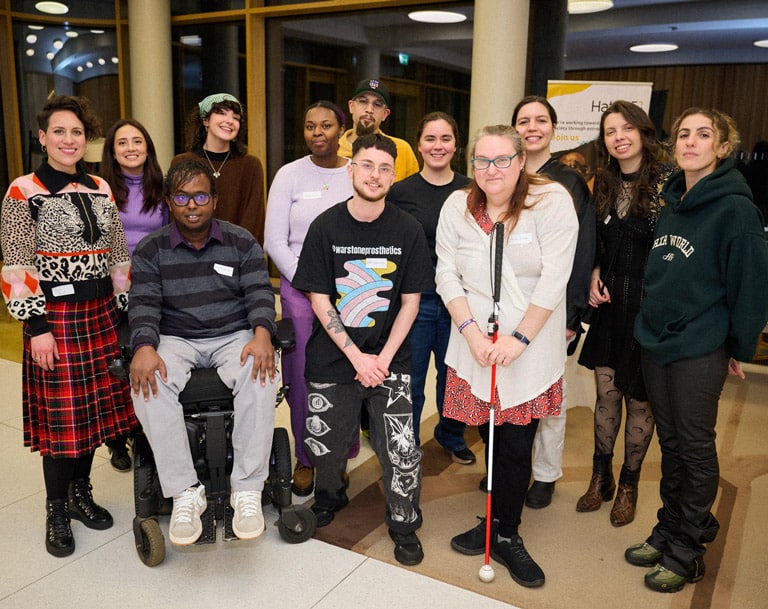
Get Ready to Start adds a step before all that: deciding whether an idea is viable and whether running a business suits the person proposing it. Between January and March 2026, a specialised version supported 19 Disabled founders. Funding Circle and Linklaters backed the programme, with more than 25 volunteers contributing over 80 hours of guidance on customer research, legal requirements and pitching.
Nearly half the participants, 47%, refined or pivoted their business models. That is a revealing result. A course can be useful because it changes a founder’s plan, rather than merely making the original plan sound more confident. Feedback has arrived while revision is still possible. In this setting, discovering a weak assumption early may be one of the more economical forms of progress.
“Before I started the course, I never thought I would be an entrepreneur.”Ed Shearer, Neurodivergent Joy · Get Ready to Start graduate
Hatch reported that 89% of the cohort had launched or planned to launch within 12 months. Those are two different outcomes bundled into one figure, so enthusiasm should keep its shoes on. Still, the programme offers a useful example of what founders can copy: seek outside feedback, investigate the customer problem and give yourself permission to revise the business before defending it.
The money has a different entrance
Hatch’s financial model lets it offer support without taking ownership of participants’ businesses. Corporate and foundation partnerships help subsidise delivery. Founders may pay a contribution; some programmes are free. Its bursary system uses self-referral, including where paying would threaten basic needs or the ability to run the business. Applicants can request a reduction or removal of the fee.
The cost behind that arrangement is substantial. Charity Commission figures show £2,348,486 in income and £2,288,884 in expenditure for the year ending March 2025. These are charity accounts, not a startup funding round. The business relies on raising and earning enough money to keep useful help affordable for people who might otherwise go without it.
Grants make the classroom less abstract. In November 2024, a NatWest partnership awarded £10,000 each to ten Hatch graduates. But graduation does not entitle everyone to a cheque. Funding varies by programme and round. Groundwork helps administer the Hatch Fund, and applications compete for a finite pot. Founders needing immediate, guaranteed capital would have to plan accordingly.
There is an amusingly sensible separation here. Hatch calls its demo-day panellists “friendly dragons”, but their role is feedback. Grant decisions are based on written answers, separate from the pitch. A founder can practise explaining the business without that single performance deciding the grant. Other support organisations could copy that distinction tomorrow, provided they have the staff and funding to sustain it.
London was only the beginning
The move online in early 2020 changed Hatch’s reach. Previously concentrated in London and the South East, it now reports that more than a third of cohort founders are outside London. Digital delivery removes a journey, though participation still requires time, access and a suitable programme. Eligibility differs, and founders should check the actual cohort rather than assume every offer fits.
Its place in the market is between generic business information and more demanding growth support: structured learning, repeated contact and introductions for founders facing barriers. The first disability-focused pilot led to further programmes in 2025. Rebekah Sun succeeded Bischof as chief executive in September that year, and June 2026 brought 16 founder ambassadors. Hatch keeps widening the circle. The useful question for a reader is modest: which assumption in your business would improve if somebody helped you examine it?