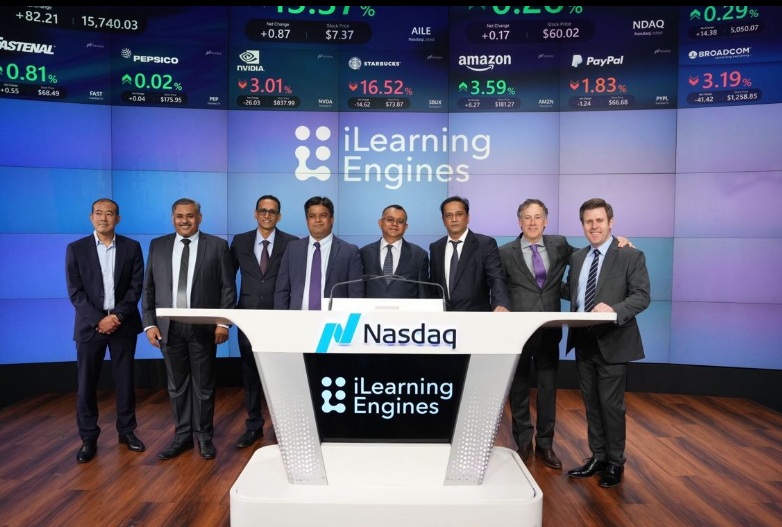
On May 1, 2024, Harish Chidambaran rang the Nasdaq closing bell. His company, iLearningEngines, had reached the kind of occasion that comes with a podium, a delegation and a photograph designed to outlast the afternoon. Fourteen years after founding the business, he was standing in Times Square with a public company behind him. A bell is a wonderfully uncomplicated instrument. A balance sheet asks rather more of its audience.
The photograph survives. So does a short interview released that month, in which he described going public as the beginning of another chapter. By December, iLearningEngines had filed for bankruptcy. In April 2026, federal prosecutors charged its founder and former chief executive with fraud. Those charges are allegations. Chidambaran is presumed innocent unless and until proven guilty. The speed of the reversal is a documented part of his story; the criminal accusations require their own, separate judgment.
Before the podium, the processor
Chidambaran’s professional preparation ran through engineering and management. He earned an undergraduate degree in electrical and electronics engineering at the College of Engineering, Trivandrum, followed by a master’s in electrical engineering at the University of Idaho and a master’s in management at Stanford Graduate School of Business. The sequence matters: the technical education preceded a career in which he would have to explain technology to people deciding whether to finance it.
His early Silicon Valley work included the UltraSPARC microprocessor design group at Sun Microsystems. That is a different setting from the enterprise software pitch: chips, architecture and the practical business of getting computers to do more. His subsequent career included roles at Maple Optical Systems and other technology businesses. From 2004 to 2007 he was president of Goorka; from 2008 to 2010 he served as senior vice president of strategy and products at Ninth Sense.
These are useful coordinates for understanding the founder who emerged in November 2010. He had already worked on products and held executive responsibility. When he started iLearningEngines, he was bringing that experience to the problem of organizational learning. The business would eventually be presented as a way for companies to turn their accumulated information into something employees could use while working.
A company’s memory, available on demand
The premise had an everyday appeal. Organizations collect manuals, policies, training materials and operating knowledge. Finding the right piece at the right moment can still be a minor expedition. Chidambaran’s proposition was to make that knowledge useful within the flow of work, with artificial intelligence supporting learning and automation. Corporate memory, in this telling, could become a product rather than an archive.
The company described a platform combining knowledge repositories, AI models and tools for building workflows without extensive coding. It called those repositories Knowledge Clouds. The intended customer was an enterprise with its own information, its own rules and its own reasons for wanting answers in context. The proposed applications extended across sectors such as education, insurance, energy and manufacturing.
There is a recognizable ambition here: take something a company already possesses and make it easier to apply. It also makes the sales pitch demanding. A buyer needs to understand the software, the information it handles and the business result being promised. Chidambaran’s public appearances repeatedly returned to that connection between learning and work. The idea was broader than a digital classroom; it concerned what people could do with institutional knowledge.
Recognition arrived before the public listing. Chidambaran was among the EY Entrepreneur Of The Year 2020 Mid-Atlantic award winners. Deloitte’s 2020 Technology Fast 500 placed iLearningEngines twentieth, listing growth of 10,304 percent. That is a historical ranking based on revenue growth, and the later financial controversy means it should be read as recognition received at the time. It cannot settle the questions that followed.
iLearningEngines’ position in Deloitte’s Technology Fast 500 that year. Historical ranking; subsequent financial disclosures require caution.
The public-market rehearsal
By 2023, Chidambaran was explaining the company alongside Matthew Safaii, chairman and chief executive of Arrowroot Acquisition Corp. Their proposed combination carried an implied enterprise value of approximately $1.4 billion. Arrowroot was a special purpose acquisition company, a listed vehicle designed to combine with an operating business. For iLearningEngines, the transaction offered a route to the stock market.
In a December 2023 podcast, Chidambaran discussed a business he described as having developed with little outside funding and outlined the prospect of using public capital for acquisitions. Safaii discussed Arrowroot’s long relationship with the company. The conversation supplies a picture of the plan before the listing: more capital, more transactions, a larger business. These were management’s ambitions, rather than results already achieved.
A January fireside chat paired the two executives again, this time with audience questions. The topics included technology, the proposed merger, an education partnership and the insurance market. The format put the founder in the role of interpreter. He had to connect the platform’s vocabulary to an investor’s simpler questions: who buys it, what does it do, and how does the company grow?
When iLearningEngines became publicly traded in April 2024, Chidambaran remained chief executive and became chairman of the public company. The board included Michael Moe and Ian Davis. He and his wife, Preeta Chidambaran, jointly held approximately 71.7 percent of the voting power as of June 24, 2024. Public ownership had arrived alongside substantial continuing founder-family control.
“Going public is the first day of the next chapter of our company.”
Harish Chidambaran · Nasdaq interview, May 2024
In the same interview, he advised listening to people offering counsel while ultimately trusting one’s instincts. The remark is a small glimpse of his public leadership philosophy. It does not provide access to his private thoughts. Beside the bell ceremony, however, it captures the confidence with which he was presenting the next stage of a business he had led since its formation.
Four months later, the questions changed
On August 29, 2024, Hindenburg Research published a short-seller report challenging iLearningEngines’ revenue and relationships with a technology partner. Hindenburg disclosed a short position, giving it a financial interest in a falling share price. Its accusations needed to be considered with that interest in view. They nevertheless placed the company’s commercial relationships, rather than its AI vocabulary, at the center of attention.
Chidambaran pushed back. In September, the company distributed his response disputing the short seller’s claims and pointing to its history, audited accounts and technology. That defense belongs in the story. He did not publicly accept the portrait being drawn of his company. For investors, the dispute created two competing accounts of a business that had only recently entered the public markets.
The next developments came from inside the company. On November 11, its audit committee determined that a broad set of previously issued annual and quarterly financial statements should no longer be relied upon. The company said its investigation was ongoing and it could not yet quantify any necessary corrections. A question raised by an outside critic had become a formal warning attached to the company’s own accounts.
In December, the board placed Chidambaran and several other executives on administrative leave, and Thomas Olivier became interim chief executive. Bankruptcy followed that month. The proceedings were converted to Chapter 7 liquidation in 2025. For Chidambaran, the executive tenure that began with a private venture in 2010 had ended amid a rapid dismantling of the public-company chapter.
Two courtrooms, different questions
In March 2026, Chidambaran obtained a significant civil-court result. A federal judge in Maryland granted motions to dismiss a proposed securities class action. His lawyers announced that the claims had been dismissed with prejudice. Their account emphasized failures to plead actionable misstatements, fraudulent intent, loss causation and standing adequately. The distinction between an accusation and a legally sufficient claim had practical consequences.
That ruling addressed the civil complaint before that court. It was not a decision on the criminal charges announced the following month. Keeping those proceedings separate is essential to describing his position fairly. A favorable civil ruling belongs beside the allegations, with its actual scope intact. Neither proceeding can be compressed into a convenient verdict about the other.
On April 17, 2026, a ten-count federal indictment was unsealed in Brooklyn charging Chidambaran and former chief financial officer Farhan Naqvi. Prosecutors accused them of operating a continuing financial crimes enterprise, securities fraud, wire fraud and related conspiracies. Chidambaran was arrested in Potomac, Maryland. The case challenged the underlying commercial reality of the business he had spent years presenting to investors.
Prosecutors alleged that customer relationships and revenue had been fabricated and described money moving through accounts before returning to iLearningEngines. The alleged round-trip transactions exceeded $144 million. They contrasted that activity with reported 2023 revenue of roughly $421 million. Those figures describe the government’s allegations and the company’s historical reporting; they do not establish Chidambaran’s guilt.
The photograph and the unfinished account
Return to the Nasdaq photograph and the distance becomes easier to understand. The picture records an event that happened: a founder brought a company to the public markets and stood with colleagues at the bell. It cannot tell a reader whether the commercial picture presented around that event was accurate. That requires contracts, transactions, testimony and the tests imposed by a courtroom.
Chidambaran’s career contains engineering work, executive roles, a long founder tenure and recognition that preceded the collapse. It also contains a forceful public defense of his company, a civil dismissal and serious criminal accusations. Holding those facts together requires more care than either a success story or a scandal headline usually allows. The bell supplied a clean ending to one afternoon. His account of the business remains subject to a much longer examination.