The directors were accomplished. The business had serious strategic questions to answer. Then the paperwork took over. In Board Intelligence’s account of its beginnings, consultants observing a FTSE 250 board meeting in 2008 watched hours disappear into backward-looking data. The meeting covered plenty of ground without getting to the ground that mattered. It was a useful disappointment: the people seemed capable, but the information was steering them towards the wrong conversation.
That observation became the organising idea behind a business selling software and advice to boards. A pack can arrive on time, open perfectly on an iPad and still leave directors poorly equipped to make a decision. Board Intelligence wants to influence what goes into that pack, how directors interrogate it and what happens after the meeting. The PDF has acquired a fairly demanding supervisor.
The report before the report
Board Intelligence operates in the market for board management software: secure systems that assemble meeting papers, distribute them to directors and support collaboration. Its customers include governance professionals doing the preparation, executives writing the papers and board members reading them. Those groups share a meeting date, but their daily frustrations are different.
The company’s current website says more than 80,000 leaders use its offering, and that 30% of FTSE 100 companies have used its products or services. That latter wording matters: it describes reach across software and advice, rather than a count of current portal subscriptions. Named clients range from Nationwide and Schroders to Aston Martin, Sage and NHS organisations.
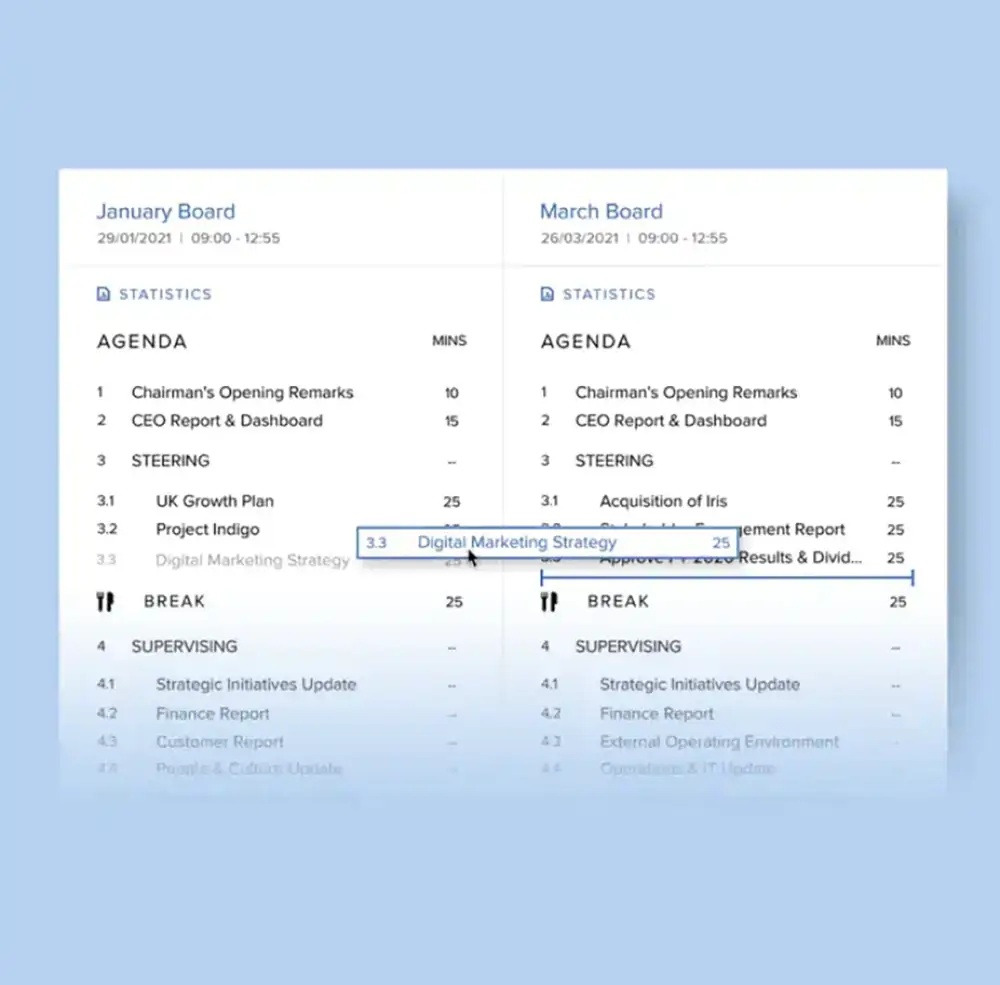
At the centre sits Board Portal. Around it are tools for commissioning reports, planning agendas, drafting papers and minutes, and evaluating the board. Report Briefer gives authors a brief, deadline and approval process. Report Writer provides AI-assisted drafting and feedback inside Microsoft 365. Some products can be bought independently, giving an organisation an entry point smaller than replacing its entire board platform.
The sequence is the interesting part. Commission a useful paper before asking a director to read it. Decide which questions deserve the meeting before the calendar fills up. This is a proposition about how work is organised, expressed through software. It also explains why the company keeps selling training and advice alongside the applications.

When two hours of assembly became a buying decision
Nationwide offers a concrete account of the problem. In a case study published by Board Intelligence, society secretary Jason Wright described an existing portal that took about two hours to build and share packs. His team also depended on external support to change users. Highly skilled governance staff were spending time operating the machinery.
Peer recommendations brought Board Intelligence into consideration. The supplier helped develop an internal business case and migration plan. But document distribution alone was insufficient: Wright wanted a view of whether board attention matched the organisation’s priorities.
“Agenda planner sealed the deal for us.”Jason Wright · Society Secretary, Nationwide
After switching, Nationwide calculated a 45% saving in preparation time. Its team could administer permissions itself, while directors could clarify points through in-app discussions before meetings. These are customer-reported results in a vendor case study, not a forecast for every buyer. The transferable lesson is narrower and more useful: measure the administrative work and examine the annual agenda before assuming the problem is simply a slow document upload.
45% less preparation time
Nationwide’s reported result. Indexed illustration: previous preparation time = 100. Not a measure of meeting length.Less detail, more confidence
Essentra’s experience addresses a different bottleneck: management had more information than the board could use comfortably. Its case study describes papers that overwhelmed directors with detail. Report Writer helped reshape their structure, length and tone, while reducing drafting work.
Chief executive Scott Fawcett reported saving two to three hours of writing time a month. Former company secretary Emma Reid described stronger board confidence in the new executive team. The interesting claim is relational: better papers helped directors see management’s competence without having to excavate it.
That does not establish that shorter is always better. A concise paper can omit the awkward fact that changes a decision. The useful standard is whether the reader can identify the issue, understand the evidence and see what management wants the board to do. Length is something to manage, rather than a substitute for judgement.
The AI still needs someone to read it
Board Intelligence’s AI offering extends beyond generating polished prose. IQ Insights helps directors examine pack contents and identify matters requiring attention. IQ Experts adds perspectives intended to help them think beyond the documents in front of them. Minute Writer produces drafts from recordings, transcripts or notes, including decisions and actions.
The company describes its consultants and engineers working together to embed governance expertise in these tools. That is a more specific proposition than attaching a chat window to a document store. Whether it earns its place depends on what a board actually receives: better questions, useful context and drafts that survive informed review.
Human review is part of the stated design. The company presents AI output as material people should refine and own. A fluent minute is still a draft; someone must check that it records the decision and the reasoning accurately. Equally, a suggested gap in a paper invites investigation. It does not prove that management has overlooked something.
Security is central to the purchase. Board Intelligence advertises ISO 27001 certification, UK private-cloud hosting and zero retention for AI processing. Buyers need to distinguish that processing promise from the storage of board documents in the portal. The platform exists to retain and organise records; an AI processing policy concerns a different part of the service.
Software with a consulting habit
Board Intelligence has competition. Diligent Boards also offers document preparation, AI-assisted reading and governance workflows. A buyer cannot treat either AI or secure distribution as exclusive territory. Board Intelligence’s distinctive argument is the connection between its advisory practice, report-writing methods and software.
Its business model combines subscription software with advisory projects, reviews and education. The sales process centres on demonstrations and tailored conversations. For a buyer, the meaningful cost comparison includes the chosen products, implementation work, training and any overlap with an existing contract. Board Intelligence currently promotes switching arrangements intended to avoid paying for two portals at once, subject to terms.
The practical purchasing exercise is to bring a real reporting cycle to the demonstration. Ask the people who assemble the pack to use it. Give an author an actual brief. Have a director locate an earlier decision. The best-looking feature may save less time than a permissions change that no longer needs a support ticket.
Private equity, then a larger classroom
Susquehanna Growth Equity records an investment in 2020. In August 2024, K1 became Board Intelligence’s only institutional shareholder, with the founders retaining minority stakes. Begg’s stated rationale was access to expertise in international expansion, acquisitions and AI; she said the business was already profitable. The deal was a choice about how to grow.
The next moves made that intention visible. In September 2024, Board Intelligence acquired Stockholm-based TeamEngine, adding Nordic reach and software engineering capability. TeamEngine brought an established business serving board members and organisations, making geographic expansion more immediate than opening an office and starting from scratch.
In May 2025 came Competent Boards, founded by Helle Bank Jorgensen. Its programmes had reached leaders in 57 countries and brought expertise in director education, assessment and sustainability governance. Jorgensen joined as global managing director of board development. This widened the offering around the people using the software: a director may need help understanding an emerging issue as well as finding the relevant paper.
The expansion continued with a Juristic partnership announced on June 22, 2026. The Copenhagen legal technology business brings visual workspaces, timelines and workflows for legal teams. For Board Intelligence, the connection opens territory adjacent to the boardroom, where governance records and legal processes meet. Its current catalogue also includes IQ Entities for entity management and Companies House workflows.
Who gets to ask the awkward question?
Leadership has changed alongside the product range. Begg now runs the business as CEO; co-founder Jennifer Sundberg moved from executive leadership to the advisory board. Ann Hiatt appeared as the company’s new chair in a March 2025 interview with Begg. The founders also co-authored Collective Intelligence: How to build a business that’s smarter than you, taking their argument about organisational thinking beyond board papers.
The company’s stated culture puts kindness and curiosity alongside quality and service. Those values fit the problem it has chosen. A better template depends on people being willing to put difficult information into it. A board that discourages disagreement can receive beautifully structured reports and still miss the issue everyone is reluctant to raise.
Board Intelligence’s first Board Value Index, launched in June 2025, surveyed more than 200 executive and non-executive directors at UK and US companies with turnover above $50 million. It reported that only 44% of boards spent more time looking ahead than reviewing past performance. The sample is a defined slice of corporate life, but the finding returns the company to its original observation about where meetings spend their attention.
There is something readers can borrow immediately: write down the decision a paper is meant to support before drafting the paper. Reserve agenda time for the questions that could change the business. Check whether the eventual minutes make ownership and action clear. Software can make these habits easier to repeat. The next useful test comes when somebody around the table asks a question the pack did not anticipate.