Greg Strakosch had an unfashionable advantage in the internet business: he understood newsletters. The narrow subject, the reader with a job to do, the answer worth returning for. While a website could promise the whole world, a newsletter had to justify its place on one particular desk. TechTarget grew out of that smaller, more demanding bargain.
Consider the person responsible for keeping an IBM AS/400 system running. That reader did not necessarily need another sweeping account of the digital future. There was a machine to maintain and a question to settle. Search400, the early site that preceded TechTarget’s incorporation in 1999, addressed precisely that audience. Specificity was the attraction.
Strakosch had already worked on the other side of the transaction, selling technology. He would spend the next quarter-century helping build a business around the space between someone trying to understand a product and someone trying to sell one. It was a space with plenty of jargon, substantial budgets and remarkably little patience for wasted time.
A storage salesman’s education
Before the websites came EMC. Strakosch joined when the storage company had $18 million in revenue, worked through its public offering and opened its first Silicon Valley office. His responsibilities included launching its first mainframe product. These were assignments in getting a young technology business taken seriously.
Looking back on the competition with IBM, he described selling computer memory and disk drives as distinctly unglamorous work. “We were fighting Goliath,” he said. There is an education in that position: the customer already knows the larger rival’s name. The smaller company must give the customer a reason to listen.
EMC co-founder Roger Marino was part of that early professional world. Years later, Marino sat on TechTarget’s board. The connection followed Strakosch from hardware into information, a reminder that this career developed through working relationships as well as changes in business model.
In 1989, Strakosch founded Reliability Ratings, an information-technology publishing company. United Communications Group bought it in 1992. He joined the buyer and became president of its Technology Division. The move put him inside a publisher accustomed to serving specialised audiences whose information needs could support a subscription.
That background gave the emerging web a familiar shape. A new distribution system could carry the same old obligation: know what the reader needs. In September 1999, Strakosch and Don Hawk incorporated the business that became TechTarget. Hawk came from new-media work at UCG; Strakosch became chief executive. Their company would build a family of technology destinations.
The economics of a useful answer
The early operating choices were unusually revealing. By 2002, TechTarget had about 70 full-time editors and another 150 contracted experts. Its sites went deep into technical subjects and sometimes divided those subjects further. The editor’s understanding of a particular system mattered to the reader trying to run it.
“Our biggest department is our editorial department,” Strakosch said. He also described turning down advertising demand when it risked exhausting the audience. A willing buyer with a cheque could still be a poor bargain if the resulting messages made readers stop paying attention. Even an email list has a tolerance for being invited to things.
technical question
earns attention
signals interest
potential buyers
There were mundane complications, too. In the company’s early days, Strakosch wanted his technical team building the business rather than managing an expanding collection of storage hardware. TechTarget outsourced storage to StorageNetworks, allowing capacity to grow as needed. An equipment-order mistake then threatened the connection between the two companies. The supplier fixed it overnight.
The episode is pleasingly circular. Someone who had sold storage was now buying a way to spend less time thinking about it. The practical goal was to get sites earning revenue quickly. A founder’s previous industry had become an operating problem to delegate, with a deadline attached.
As technology changed, the editorial subjects changed with it. In 2006, TechTarget launched SearchServerVirtualization.com alongside live seminars. Strakosch described server decisions becoming strategic again as virtualisation and new hardware designs reshaped data centres. A technical shift created questions for readers and an opportunity for suppliers. His business wanted to be present at that moment.
A company learns to change hands
TechTarget went public in 2007, with Strakosch as chairman and CEO. In the quarter that included the IPO, total revenue reached $24.6 million. Online revenue accounted for $16.3 million, or 66 per cent. The figures capture a business in transition: substantial digital activity within a company that also operated other marketing formats.
That year also brought the acquisition of KnowledgeStorm. Strakosch described completing the deal and integrating the business as a principal focus of the fourth quarter. Building TechTarget involved buying capabilities as well as creating them internally, with the attendant work of making separate operations function together.
The more consequential change in his own job arrived in May 2016. Michael Cotoia became CEO; Strakosch moved to executive chairman, retaining responsibility for helping with long-term strategy and investor relations. Cotoia had joined the company in 2002 and served as chief operating officer since 2012. This was a succession developed inside the business.
Strakosch explicitly tied the timing to a commercial shift. TechTarget was increasing its emphasis on purchase-intent data under long-term contracts, beyond quarterly marketing campaigns. The company could learn from the subjects people researched and help technology vendors identify potential customers. The specialist audience remained essential, while the service built around it changed.
By its twentieth-anniversary celebration in August 2019, TechTarget described serving more than 1,300 customers worldwide. At the Newton headquarters, Massachusetts Lieutenant Governor Karyn Polito joined employees, customers and the leadership team. The occasion also introduced the Archer Awards for customers’ data-driven marketing and sales work.
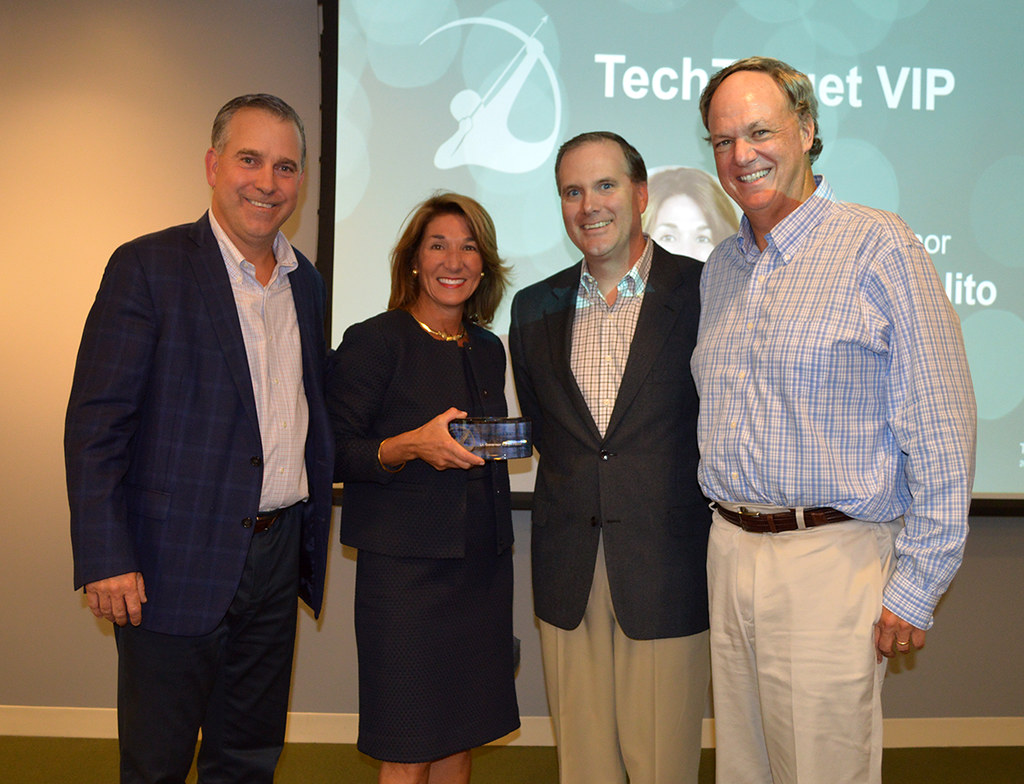
It made a suitable anniversary picture: the founders, the successor CEO and the customers’ results sharing the occasion. A company born around technical questions had acquired the ceremonies of an established institution. Underneath the celebration was the continuing need to make those questions commercially useful.
Another kind of return
Strakosch’s education work offers a different view of the same career. He graduated from Boston College in 1984. His wife, Peggy, graduated the following year; their three children also became alumni. The university is both an institutional commitment and a family connection.
Greg and Peggy backed the venture competition that now carries their name. At its 2018 celebration, the winner was Aryeo, a software platform for real-estate photographers. The ventures on display were already meeting customers and testing their businesses. For someone who had started a publishing company before co-founding TechTarget, that practical stage was familiar territory.
He brought a little irreverence to the occasion. Recalling an invitation to meet a dean about supporting the competition, he joked that his last encounter with a Boston College dean had gone poorly. The joke left the youthful offence unspecified, which is generally the most economical way to preserve an undergraduate reputation.
“Success is not guaranteed.”
Greg Strakosch, speaking to Boston College student entrepreneurs
He also recalled telling Peggy, before each of his two startups, that failure could leave them broke. She encouraged him both times. The recollection gives the founder narrative another participant: the person sharing the financial risk before there is a business substantial enough to celebrate.
His stated interest in entrepreneurship goes beyond the founder’s reward. He has linked it to how companies treat employees, contribute to their communities and develop useful innovations. A later account of the competition described his enthusiasm for a student business taking a $50,000 order from a residence hall. The customer had supplied a particularly persuasive assessment.
The family’s giving also includes financial aid. Greg and Peggy have described wanting other families to experience the opportunities Boston College gave theirs. His service has extended to the university’s Board of Regents, Fairfield Prep and Cristo Rey Boston High School. These commitments place education alongside company-building in the account of where he spends his attention.
After the founder’s chair
TechTarget’s combination with Informa Tech’s digital businesses closed on December 2, 2024. Gary Nugent became CEO of the combined operation, Informa TechTarget. Strakosch retired that December, bringing his executive chapter at the company to a close after roughly twenty-five years.
In March 2025, he joined the board of red violet, an analytics and information-solutions company. He joined its compensation committee that August and its audit committee in March 2026. The work now includes oversight of another public company, drawing on experience accumulated as a founder, CEO and chairman.
His public messages to former colleagues are warmer than a list of titles suggests. He praised Hawk’s combination of strategic thought and attention to execution, and credited Cotoia’s humour with making work enjoyable. Long partnerships, in his telling, contain affection as well as achievement.
The career began with technology that needed selling, moved into information that needed organising and grew into a business that could connect research with a commercial decision. Along the way, Strakosch kept encountering a recognisable customer: someone with a specific question and work waiting to be done. It was enough of an audience to build around.