The Mac mini was a charming little square with an identity problem. On a desk, it looked tidy. In a data center, it was an uninvited guest: no standard rack shape, no redundant power supply, no obvious desire to sit shoulder to shoulder with hundreds of its siblings. Greg McGraw saw the nuisance and, with his MacStadium co-founders and team, treated it as an invitation.
The business rested on one stubborn fact. Developers building serious software for Apple's platforms use Xcode, and Xcode runs on macOS, which Apple licenses for Apple hardware. Linux clouds could expand with a click. Mac build capacity arrived as a physical machine, often under someone's desk, with cables, updates and a person eventually wondering why the fan sounded worried.
MacStadium made that inconvenience somebody else's job. It hosted real Macs in controlled facilities, gave customers dedicated access, and gradually built the layer of automation that enterprise software teams expected from every other cloud. McGraw supplied something less visible than the machines: the operating experience to turn a clever answer into a company.
The accountant enters the server room
McGraw earned a bachelor's degree in public accounting and business administration from George Mason University. His career then moved through the practical machinery of technology businesses. He served two stretches as chief executive at Broadriver Communications. At Cypress Communications, regulatory filings place him as president and chief operating officer before he became chief executive; his remit also included the chief financial officer role. Later stops included TechCXO and North Highland, where he led a business intelligence and analytics division.
By the time MacStadium began in Atlanta in 2011, he had spent decades looking at technology from the corner office and the ledger. That combination mattered. A cloud made from Apple computers is an argument about utilization, capital and operational detail. Each machine consumes cash before it earns any. Each rack asks for power and cooling. Every manual intervention adds cost. Romance ends where the hot aisle begins.
Early demand supplied its own comic proof. As MacStadium grew, one large order sent employees driving among Apple stores across the Southeast to buy enough Mac minis. Customers who had wanted a few machines began asking for 50, then 400. The little square was becoming infrastructure faster than conventional procurement could admit it.
McGraw's public explanation remained brisk. People at conferences or bars would ask, with a note of disbelief, whether he hosted Mac computers. His reply was wonderfully specific: “Yeah, we've got 20,000 of them.” The number did the persuasion. A curiosity had become a fleet.
Industrial life for elegant objects
Apple's industrial designers had not optimized the Mac mini for a steel rack, and the cylindrical 2013 Mac Pro looked even less cooperative. MacStadium answered with metal. McGraw is named alongside colleagues on multiple patents for racks, shelves, sleds and enclosures that place Apple machines densely while preserving cable access and directing cooling air.
One patented small-form design stacks rectangular computers vertically. Another arranges cylindrical Mac Pros horizontally on sliding sleds. These are inventions from the part of cloud computing usually edited out of the picture: perforations, brackets, cable passages and the management of hot air. The cloud, in this telling, has screws.
A cloud you can count
Hardware density alone did not solve the customer's problem. Software teams wanted clean build environments that could appear, run a job and disappear. MacStadium moved from bare-metal hosting into virtualization, supported VMware on Apple infrastructure and later developed Orka, its Kubernetes-native virtualization platform for Mac build systems. The product arc followed a familiar enterprise wish: keep the genuine hardware, remove as much human babysitting as possible.
McGraw described every deployment as dedicated, whether it involved one mini, a hundred Mac Pros or a thousand minis. Customers received root-level control and visibility while MacStadium stayed outside their guest operating systems and data. That division of responsibility was both a response to Apple's rules and a useful security boundary. The company could manage the concrete world below the workload without rifling through the customer's digital desk drawers.
The panel made the benefit tangible. Box described creating fresh virtual machines for builds, then discarding them after use. Its engineers could focus on software and tooling instead of keeping spare Macs nearby or dispatching someone to repair a failed box. Flash storage, faster internal networking and automated provisioning cut waiting from the process. None of those improvements looked dramatic in isolation. Together they made a consumer computer behave more like dependable industrial capacity.
During a panel with engineers from Box, Capital One and Travis CI, McGraw kept returning to shared learning. The companies could compete on their products, he said, but did not need to compete on best practices. “If we can share those best practices, everybody wins.” It was the language of an operator who understood that a young technical category becomes less fragile when its participants trade notes.
Growth, with the cables still attached
MacStadium's expansion was measurable in machines and geography. By the time Summit Partners and Noro-Moseley Partners invested in 2017, the company reported more than 10,000 deployed Mac minis and Mac Pros, over 2,500 customers and operations in Atlanta, Las Vegas and Dublin. McGraw said the capital would support product innovation, brand building and global expansion for a growing population of iOS developers.
The geography solved a prosaic problem. A company that promised Mac infrastructure could not depend on one room in one city. It needed capacity, transport links, reliable power and staff who could put hands on hardware when software could not help. McGraw's earlier telecom career proved useful here. When MacStadium evaluated a western data-center partner in Las Vegas, he already knew the transport network from that earlier chapter. Careers often appear linear only after the useful relationships return.
The customer list also changed the stakes. By the 2023 leadership transition, MacStadium said companies including Box, Salesforce, Capital One, Delta, Thumbtack and Pandora relied on its systems for mobile application work. These were not hobby projects waiting patiently for a reboot. Build infrastructure sat inside release schedules, and downtime could turn into a queue of developers staring at clocks.
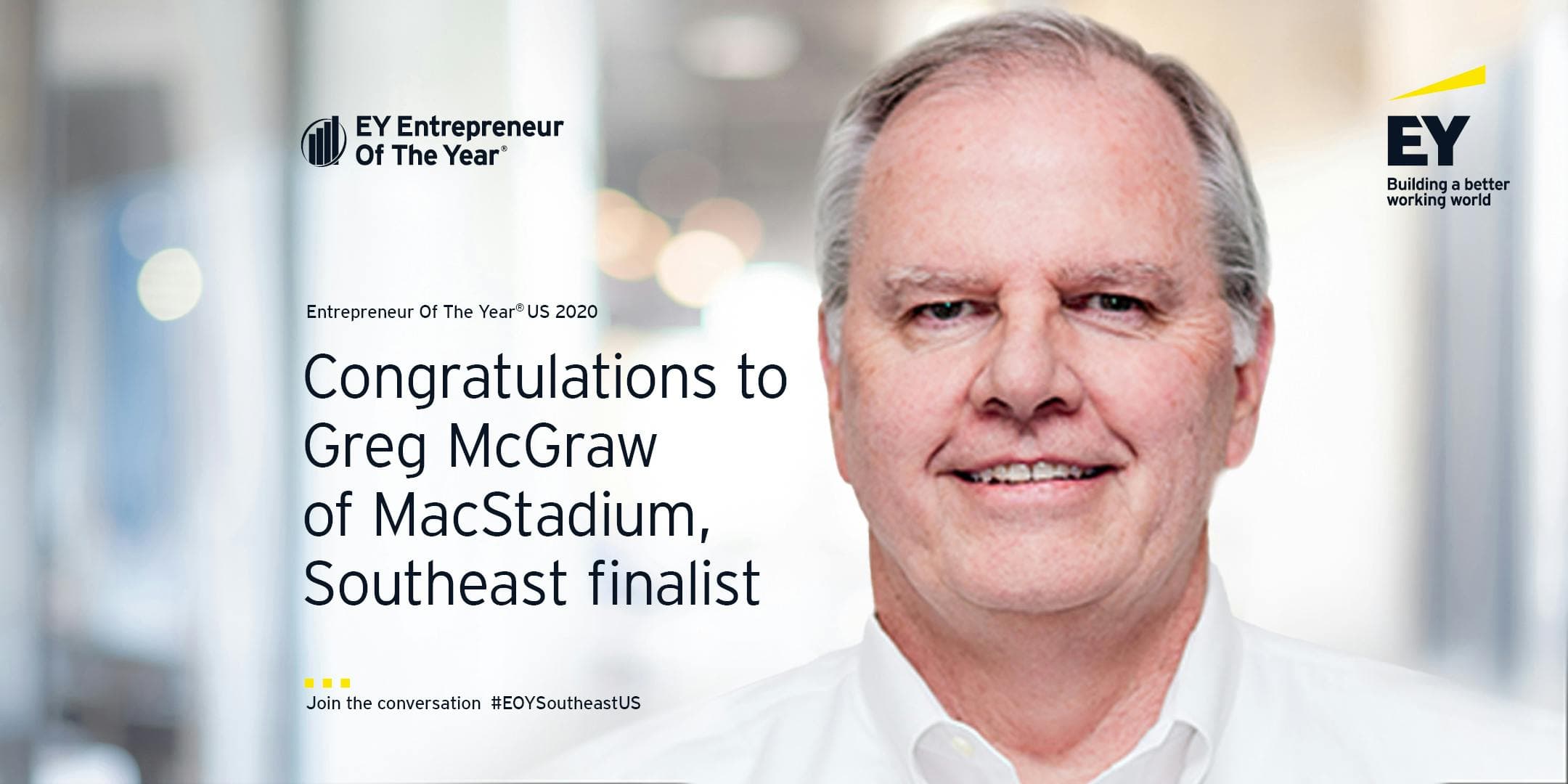
Recognition followed. His public profile lists TiE Atlanta's Middle Market Top Entrepreneur award in 2016 and 2017, then its Innovator Award in 2018. In 2020, he and MacStadium CFO Michael Landreth were selected among 30 Southeast finalists for EY's Entrepreneur Of The Year program.
McGraw redirected the compliment toward the staff: none of it, he said, would have been possible without MacStadium employees who kept innovating. The line fits the record. Patents list teams of inventors. Technical panels placed engineers and customers beside the CEO. The company's infrastructure was collective work, down to the bracket.
Executive leadership across telecom, software and business analytics.
Co-founds MacStadium in Atlanta.
Growth investment supports wider product and geographic expansion.
Rack inventions receive additional U.S. patent grants.
Retires as CEO, then transitions to Executive Chair.
The quieter scorecard
When McGraw marked his retirement in June 2023, he shared words written by his daughter Katie. Her account did not dwell on data centers. She remembered being brought to work, photocopying her face, and learning that colleagues could both like and respect you. She wrote about his confidence in her own career, the people he had helped, and his habit of putting family first.
She also recalled his advice in three climates. In good times, be grateful and grow. In difficult times, be patient. In the worst moments, trust that good people can still prevail. It is not the language of a quarterly operating plan, but it says something about endurance across a career that ran for roughly five decades. Technology cycles make a habit of declaring the old world finished. McGraw moved through telecom, analytics and cloud computing without confusing novelty for the whole job.
Her best phrase described him leaving without a ticker-tape parade but with “a wake of impact.” The comments underneath supplied corroboration in miniature. Former colleagues called him a mentor, supporter and advocate. Several measured the relationship in decades. The career had a public balance sheet of roles, awards, patents and expansion. It also had a private balance sheet of votes of confidence.
Retirement did not mean a clean disappearance. In November 2023, MacStadium announced Ken Tacelli as president and CEO, succeeding McGraw after his twelve-year tenure. McGraw moved to Executive Chair of the board, tasked with working alongside Tacelli and the leadership team through the transition. Succession, like infrastructure, is most elegant when the load moves and the system stays available.
MacStadium's machines continue to change. Mac minis gained new processors and new shapes. Virtualization replaced more handwork. The customer problem, however, remains recognizable: teams want Apple's development environment without building a small Apple data center of their own.
McGraw's contribution was to take that peculiar sentence seriously. He helped build the company, racks and operating model around it. Plenty of founders speak about seeing around corners. This story concerns the less celebrated skill of looking directly at the awkward box on the desk, counting how many customers need one, and finding a sensible way to stack them.