There is a boring sentence buried in Apple's software license, and an entire industry grew up around it: macOS and iOS software has to be built and tested on Apple hardware. Not a Linux box pretending to be a Mac. An actual Mac. For a solo developer, that is a laptop on a desk. For a company shipping an app used by millions, it means owning, cooling, updating, and babysitting a room full of Mac minis - the least glamorous job in software. MacStadium's entire business is volunteering to do that job for everyone else.
The Atlanta company, founded in 2011, runs more than 10,000 Apple computers across roughly five data centers and rents them out by the month. Some customers take a single dedicated Mac mini. Others run elastic fleets that spin up hundreds of macOS virtual machines to build software, then tear them all down an hour later. What ties it together is a simple promise: you never see the hardware, and the bill is the same every month.
A niche that refused to shrink
Most infrastructure stories are about going broad. MacStadium's is about going narrow and staying there. Co-founders Greg McGraw and Jason Michaud started with what was, effectively, a data center that hosted nothing but Macs - an odd thing to build in an era when everyone else was racking generic x86 servers. The bet was that Apple's ecosystem would keep growing, that the licensing rule would never change, and that almost nobody would want to run Mac hardware themselves.
All three held. When Amazon finally launched EC2 Mac instances in November 2020, it validated the category - but MacStadium had a nine-year head start on a problem the giants only just noticed.
The narrowness is a feature. A general cloud provider has to be good at databases, storage, networking, machine learning, and a hundred other things; Mac hosting is a rounding error on its roadmap. MacStadium has the opposite problem and the opposite advantage. When Apple ships a new Mac mini, or changes how macOS virtualizes on Apple silicon, or tweaks its licensing terms, it is not one of a thousand things the company tracks. It is the thing.
Orka: Kubernetes, but for Macs
The product that changed MacStadium from a hosting company into a platform is Orka. The name is a portmanteau - Orchestration with Kubernetes on Apple - and it is also the whole pitch. Orka takes the orchestration ideas that made Linux containers easy to scale and applies them to macOS virtual machines running on real Apple silicon. A continuous-integration pipeline can request a fresh macOS VM through an API, run an Xcode build or a test suite on it, and destroy it when finished. The next job gets a clean machine.
That "clean machine every time" property is the quiet magic. Build environments rot; the value of ephemeral VMs is that yesterday's mess never contaminates today's build. The groundwork came in part from MacStadium's 2018 acquisition of Atlanta software company Virtual Command, whose people and IP fed directly into Orka's development.
What customers actually get out of it
The payoff shows up as time. Ride-hailing and delivery company Glovo reported cutting build times by about 30% after moving to Orka. Dutch bank ING said it accelerated its macOS CI/CD pipeline by roughly 50%. Thumbtack moved over after VMware could not support the newest Apple silicon machines, and reported halving build times while shedding a network-storage bottleneck. The list of named users runs into serious enterprise territory - AppDynamics, Capital One, and Nubank among them.
The unglamorous physics of it
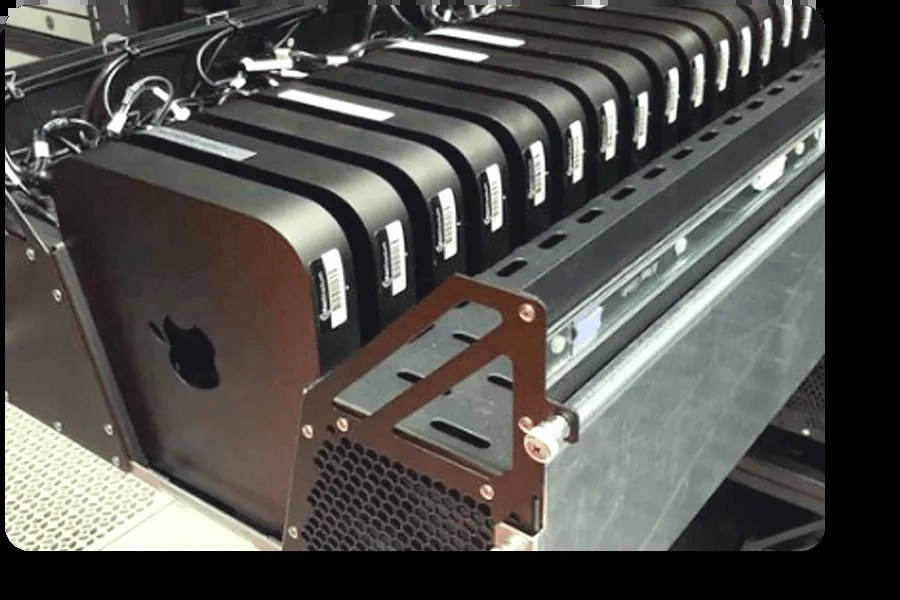
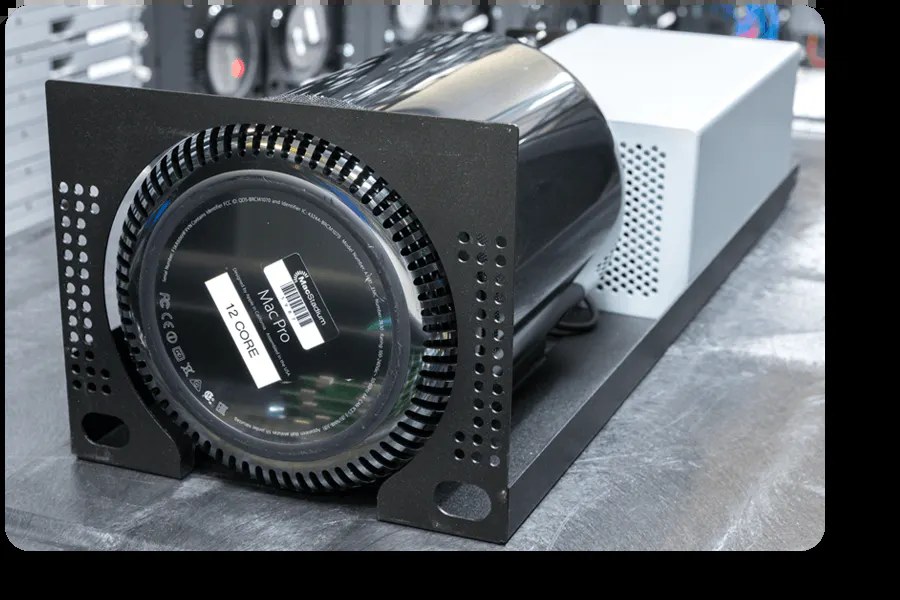
Apple never designed its computers to live in a data center. A Mac mini has no rack ears; a Mac Pro is a beautiful tower meant to sit under a designer's desk. So a real part of MacStadium's expertise is physical: custom sleds, custom drawers, and patented rack designs that turn consumer hardware into dense, serviceable infrastructure. Then there is the operational grind of keeping thousands of them healthy - power redundancy, cooling, high-availability networking, and the recurring headache of macOS version upgrades that Apple ships on its own schedule, not the enterprise's.
The business model is the moat
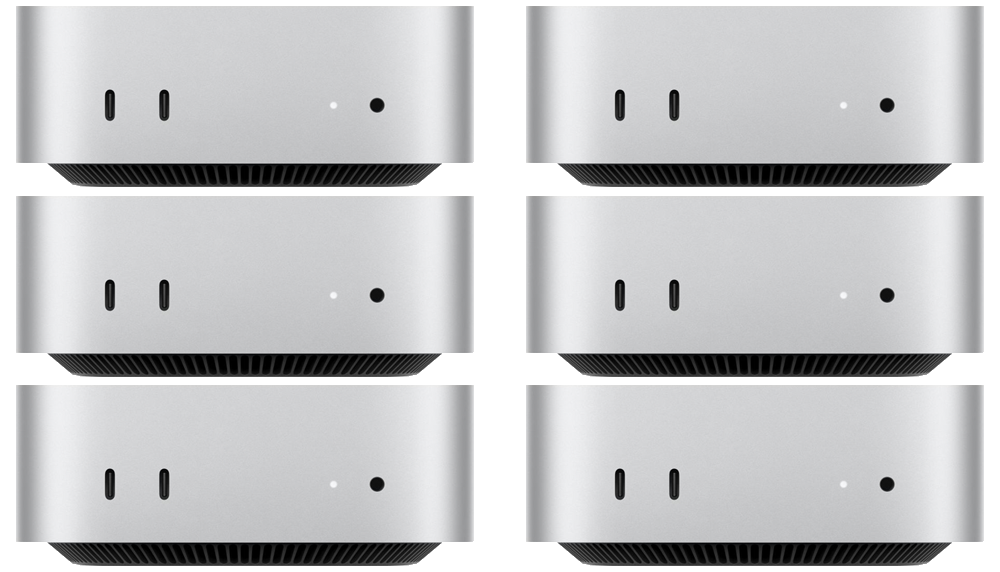
MacStadium sells subscriptions, not surprises. Instead of usage-based metered billing that spikes when a build queue goes wild, customers pay a predictable fixed fee per bare-metal node or per Orka subscription. A single hosted M4 Mac mini runs about $119 a month; the self-service Orka Small Teams Edition, launched in 2023, starts at $499 a month. Enterprise deals climb from there into private Mac clouds with dedicated support and SLAs.
The other half of the moat is compliance. Selling consumer-grade Mac hardware into banks and regulated enterprises means proving the environment is secure. MacStadium's posture maps to SOC 1 and SOC 2 Type 2 and ISO 27001, 27017, and 27018 - the paperwork that lets a company like ING put its build pipeline on someone else's Macs.
What can you actually do with it? The obvious answer is continuous integration - running Xcode builds and automated tests for iOS, iPadOS, and Mac apps at a scale a single laptop could never reach. But the same fleet also powers remote Mac desktops and VDI for distributed teams, notarization and release automation, and app-testing farms that need dozens of clean macOS environments on demand. If a task requires a genuine Mac and you would rather not own one, it fits.
Find a rule everyone hates, that never changes, and become the company that deals with it - so nobody else has to think about it again.
How it stacks up
The competition falls into two camps: the hyperscaler and the specialists. Amazon's EC2 Mac put Mac instances inside AWS, which is convenient if your whole stack already lives there - but it bills by the hour and inherits AWS's Mac-dedicated-host quirks. Specialists like MacinCloud, Scaleway's Apple silicon in Europe, and Veertu's Anka each carve off a slice. MacStadium's differentiation is depth: it does only this, has done it the longest, and pairs its own data-center hardware with Orka's orchestration layer on top.
Its place in the market is easy to describe and hard to displace. It sits at the intersection of two things most companies want to avoid at once: Apple's closed hardware ecosystem and the compliance demands of regulated enterprises. Serving both at scale is not a weekend project, and the switching costs for a customer that has wired its CI/CD pipeline into Orka are real. That is the kind of position - specific, defensible, and quietly essential - that rarely makes headlines but reliably pays rent.
Where it goes next
In November 2023, MacStadium named Ken Tacelli - previously COO and division president at Domino Data Lab - as president and CEO. McGraw, after roughly twelve years running the company he co-founded, moved to executive chairman. The generational handoff came alongside a growth-capital raise led by Summit Partners and a broader push to become, in the company's framing, a software-led Mac DevOps platform rather than a place that merely hosts machines.
The clearest signal of that shift arrived in March 2025 with Orka Cluster 3.2, which the company positions as the only multi-cloud macOS virtualization solution - running in MacStadium's own data centers, on AWS, and on-prem. In other words: the orchestration layer is now the product, and the hardware can live anywhere.

There is nothing flashy about renting Macs by the month. That is precisely the point. MacStadium found an unglamorous, permanent problem - Apple's hardware requirement - and built a durable company by owning the boring part so that thousands of teams could keep their build pipelines exciting. The reward for taking on infrastructure nobody wants to touch is that, eventually, nobody wants to touch it without you.