On a ski slope in Park City, Greg Head was doing something ordinary: helping someone find the way. Then the stranger asked whether he had a podcast. He recognized the voice. The stranger was Jeremy Clarke, a software founder Head had already interviewed. Head’s face was covered. Apparently, after enough hours of talking about software businesses, even ski gear offers limited anonymity.
Head shared the encounter in early 2025, sounding pleased and slightly baffled. He had been skiing in Park City for thirty years and regularly helped people navigate the mountain. Now one of the people asking directions belonged to the world he had assembled behind a microphone. It was a small, funny collision between his leisure time and his working life. Both involved helping someone work out where to go next.
The shop assistant and the ten-person company
His own route began without a grand announcement. After graduating from the University of Iowa, Head went to work with a friend at Egghead Software in the Chicago area. He had studied economics. He did not yet have a settled answer to the question of what to do with it. Selling software gave him something concrete to learn: the products, the buyers, and the language that connected them.
There was also the matter of his introduction. “Greg Head from Egghead” was a joke the business had supplied free of charge. He enjoyed it. Behind the coincidence was a consequential discovery. A contact-management program called ACT! helped salespeople keep track of their relationships. Head sold plenty of copies, then joined the company that made it. At the time, it had ten people.
The distance between a retail counter and a software company was short enough to cross, and large enough to change his career. His early work at ACT! included product management. Before advising founders about their customers, he had spent his days meeting customers who needed a reason to buy.
Learning what happens after the start
In 1996, Head moved to Arizona to help start SalesLogix, a customer relationship management software company. He was a co-founder and marketing executive. SalesLogix went public in 1999; Sage bought its parent, Interact Commerce, in 2001 in a deal valued at about $300 million. Head’s software career had acquired an experience that would later matter in rooms full of founders: he had participated in building a business through a public offering.
The familiar shorthand would turn this into a story about someone who learned how to grow companies and then taught the trick. His career supplies a more useful complication. Growth keeps changing the job. The person who helps a company reach one stage may face very different demands at the next. Having a successful chapter does not settle the terms of the following one.
At Infusionsoft, where he served as chief marketing officer, that complication became personal. During his nearly five-year tenure, revenue grew from $15 million to $100 million. Those numbers would look comfortable in a farewell note. His November 2015 account also included an admission: in his final year, he had struggled to deliver a key part of new customer growth.
“I am responsible for that,” he wrote. Changes had been made, but he had run out of time to see them produce results. He said the company needed a CMO for its next phase. The candor gives his later advisory work some texture. He can discuss executive transitions from the position of someone who has had to explain his own.
His immediate plans were modestly specific: a hiatus, travel with his wife Felicia, more than ten days of skiing in Park City, and time helping Arizona software entrepreneurs. After years inside growing companies, he was making room to consider what should come next.
A list with a useful spelling problem
One answer arrived as a directory. Gregslist began in August 2016 with 126 Phoenix-area software companies. The name did much of its own marketing, although it presumably required the occasional clarification. The project made local businesses easier to find, bringing founders into view for people looking for jobs, investments, customers, or useful introductions.
By March 2021, Head reported more than 5,000 companies across eleven cities, with 2,500 open software jobs listed as well. Records were added, updated, and removed every week. This was patient work with practical consequences. A company could be doing meaningful business and still be hard to discover. A directory helped someone beyond its immediate circle find the door.
Companies listed. The directory expanded geographically, from Phoenix to 11 cities; these are not same-market growth figures.
In January 2026, he handed the Phoenix directory to PHX FWD. It then listed 661 active Arizona software, SaaS, and AI companies. Head credited operations leader Donna Hacker for the years of curation and made a joke about their use of AI: “Actual Intelligence.” He reported more than three million visitors over the directory’s first decade.
The handover also acknowledged geography. He and Felicia had returned to the Dallas area in 2019. Clate Mask and Becky Winter at PHX FWD were closer to Phoenix’s current software activity. Passing the list to people who could maintain it was consistent with its purpose. A directory earns its usefulness one accurate entry at a time.
Ten answers to one question
Head’s consulting work offered another explanation for why companies get stuck. In a 2018 account, he described helping a founder named Sean whose business had stopped growing. The team was busy, capable, and frustrated. A website project had dragged on for months. Head visited the company in Orlando and asked its leaders what kind of business they were actually running.
Ten people produced ten answers. The disagreement made the stalled website easier to understand. A homepage cannot clarify a company’s identity when the leadership has yet to agree on it. Head helped the team identify its category as business coaching for fitness coaches, then connect its positioning and messaging to that decision.
The episode contains much of his working method: ask a plain question, make the conflicting answers visible, and narrow the choices. He calls the approach Scaling Point. It is easy to admire a focused business after it has become successful. Choosing the focus means letting plausible opportunities go while they still look tempting.
The room he keeps deliberately small
Today, Head puts much of his time into Practical Founders CEO Peer Groups. The format gives his interest in focus a calendar invitation. Eight to ten founders at similar stages meet for three hours each month, with Head moderating. The same people return, learn the details, and carry the conversation forward.
Companies are selected to be non-competing, bootstrapped or lightly funded B2B software businesses. Discussions cover decisions such as changing prices, hiring leaders, considering funding, and responding to buyers. Members also have access to Head between meetings. Confidentiality matters because a useful answer depends on knowing more than the polished version of a problem.
There is something refreshingly unglamorous about three hours on Zoom. It leaves time to ask whether last month’s decision worked. A founder cannot start every meeting with a new origin story; the other people already know the cast. Over time, that familiarity can make advice more precise.
“I prefer depth over scale.”
Greg Head
His current work spans five peer groups and more than 45 software CEOs. He divides his time between Southlake, Texas, and Park City, Utah, with grown children and a marriage of more than thirty years. He describes wanting a company and a life that work together, a wish he recognizes in the founders he advises. The size of his practice reflects that preference.
A microphone for the other outcomes
The Practical Founders Podcast extends the conversation to people outside those rooms. Its weekly interviews follow software founders who built valuable businesses with little or no big venture funding. Some have sold. Others continue running their companies. The distinction matters to Head because keeping a company can also be a chosen outcome.
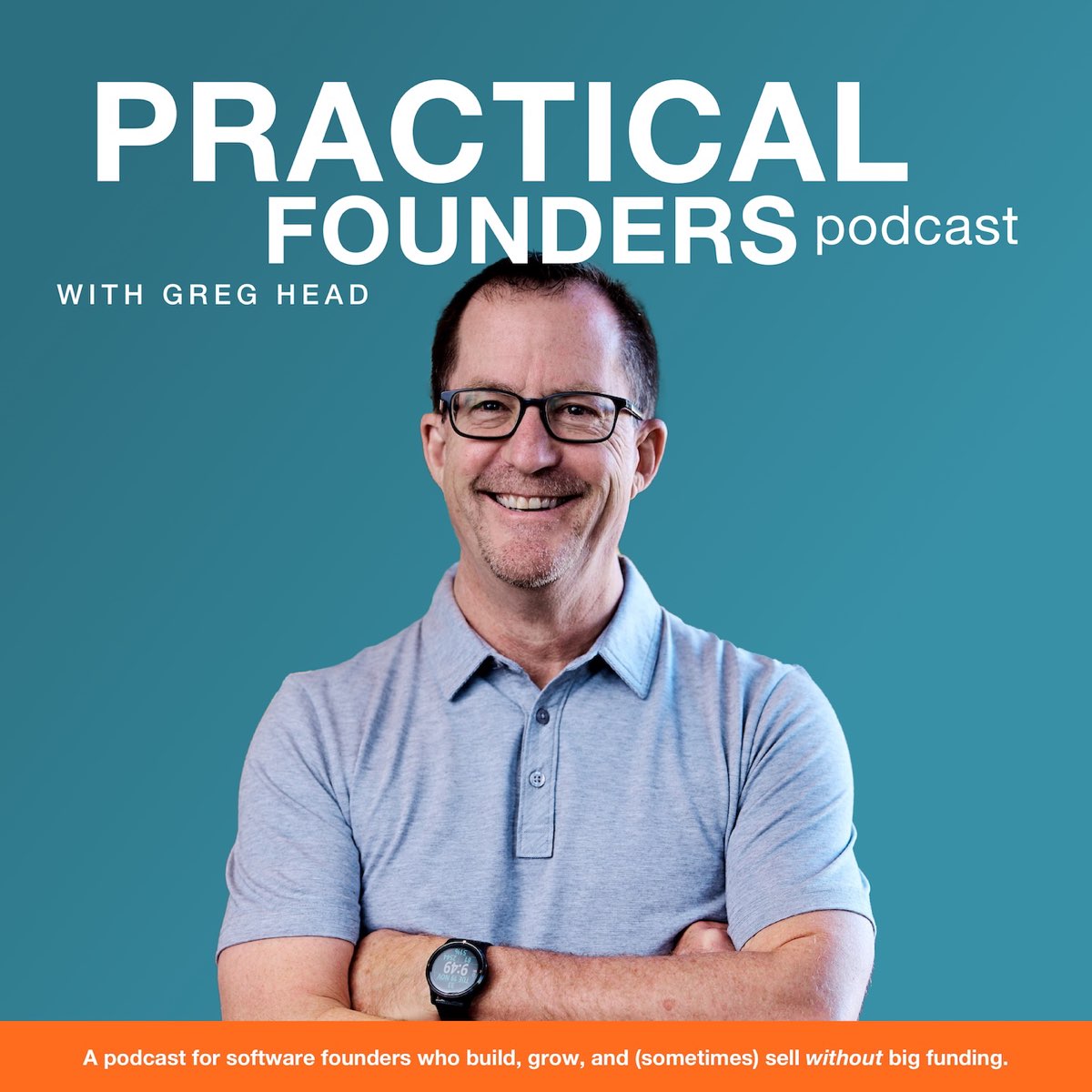
The episode list provides a sense of his curiosity. Recent conversations have covered pricing, customer onboarding, growth equity, acquisitions, and the difficulty of making a business less dependent on its founder. He also interviews investors and advisers. The show’s position leaves room for capital, provided the terms and expectations fit the company.
That gives his argument more range than a simple celebration of doing everything yourself. Founders still need knowledge, colleagues, customers, and options. Head has made a working life out of putting those things within reach, through a directory, a monthly meeting, or a long conversation that someone can hear on a walk.
The next question is already here
In August 2026, he hosted 43 software CEOs at the third Practical Founders Summit in Phoenix. AI occupied much of the discussion. Founders considered whether to add products, move into larger customer accounts, open their platforms, or change how their businesses operated. Vincent Serpico joined as an expert speaker; founders including Shalin Jain and Andrew Wallace shared their own experience.
Head’s account emphasized the decisions that followed faster software development. A new capability creates choices about customers, competition, and the shape of the business. The useful conversation begins when someone describes what they tried and what happened. His groups offer a place to compare those experiences as they unfold.
By October, he was also recounting a Dallas-area gathering with HighLevel co-founder Robin Alex, who answered founder questions and stayed until the last attendees left. Head was still arranging introductions, still looking for people willing to explain how they built something.
The setting has changed considerably since Egghead Software. The questions retain a familiar shape: who needs this, why will they buy it, and what happens after it works? Head has spent a career getting closer to the answers. Occasionally, they even recognize his voice on a mountain.