Some career changes arrive in envelopes. Greg Christy’s arrived as a question: could he light a tent for a party? He had trained in theatrical lighting, and this was unfamiliar territory. A tent offered none of the reassuring associations of a theatre. It was, however, a place where people would gather and somebody wanted them to see something. That was enough to begin.
The commission was a private Irvine Company event. Another prominent assignment followed, for the opening of the Orange County Performing Arts Center. Christy would remember the move into special and corporate events as something he fell into while confronting the difficulty of earning a living entirely in theatre. The change had a practical motive. Its creative consequences lasted considerably longer.
“I’d never lit a tent before in my life,” he recalled. There is something agreeable about an origin story that admits this. No childhood prophecy, no business plan claiming to anticipate an industry. A client asked a question. A lighting designer tried an answer. The next client arrived.
The useful part of his training travelled with him. Stage lighting teaches a designer to decide where an audience looks, when it looks there, and what the surrounding darkness contributes. At a party, the audience can wander off for another drink. Holding its attention becomes an interesting professional problem.
Two theatre graduates, one continuing production
Christy studied theatre arts at California State University, Fullerton. His wife and business partner, Julia Christy, also earned a theatre arts degree there. Together they co-founded Brite Ideas, established in 1989. The family connection belongs in the business story: the company they built remains family-founded and family-led, rather than merely carrying a founder’s surname on a door.
Their relationship with Fullerton continued after graduation. Brite Ideas helped stage Concert Under the Stars and the university’s Front & Center gala. Greg and Julia were also involved in the gala opening of the university’s Performing Arts Center. It is a pleasing circuit: learn how to put on a show, leave to make a business of it, then return with the means to help the next show happen.
Greg received Fullerton’s Vision & Visionaries recognition in 2005. His public professional profile also records service on the College of the Arts Dean Leadership Council, including scholarship support and master classes about opportunities in the working world. He appears on the advisory board for Orange County School of the Arts’ Production & Design conservatory. The bridge between a theatre classroom and a paying assignment is one he has reason to maintain.
Venice, briefly, under canvas
Years after that first tent, Christy’s work helped turn another one into a Venetian palazzo. For an opening at the Los Angeles County Museum of Art’s Resnick Gallery, Brite Ideas collaborated with Megavision Arts and J. Ben Bourgeois Productions. Digital projection followed the shape of a 140-by-160-foot structure, carrying the illusion across its ceiling and gabled ends.
Gondolas passed through afternoon scenes. Artwork appeared overhead. As the presentation moved into evening, one end of the tent opened to reveal Christina Aguilera. A virtual fireworks display played across the interior. The sequence gave the room a changing sense of place and time. For a while, the tent had a considerably more ambitious job description than keeping dinner dry.
The craft also required decisions less picturesque than gondolas. Christy has discussed experimenting with projection fabrics to find a surface that returns light properly. Materials can absorb an image, allow too much light through, or create an unpleasant bright spot. The romance depends on such matters. Someone still has to check the fabric.
That combination explains much of his work: an imagined environment, then the physical conditions needed to make it convincing. The technical director connects the people responsible for the picture with the people responsible for making the picture appear in a real space. A beautiful rendering cannot resolve that conversation on its own.
The budget enters before the equipment
In conversation with GoGather CEO Brian Kellerman, Christy uses a phrase he credits to a colleague: “You can budget to a design or you can design to a budget.” The distinction is useful because it makes the order of decisions explicit. A team can begin with an agreed vision and price it, or start with a financial boundary and create within it.
His objection is to the wasteful middle: producing a proposal without knowing the available money, cutting it back, and repeating the exercise. An early discussion gives the production team something solid to work around. It also lets the client explain the audience, the purpose of the gathering, and the feeling the event should create.
Brite Ideas’ approach begins with those questions and moves through drawings, renderings and system diagrams. Lighting, audio, video and staging become parts of the same plan. This is a theatre designer’s way of considering a corporate room. Every department contributes to the experience; none gets a pass simply because its equipment switched on.
The company owns production equipment and supplies its crews. Its services extend from site surveys and system design to motion graphics, show calling and broadcast work. Ownership gives a designer another set of practical choices when matching an idea to available tools. It also leaves the company responsible for joining those choices together on the day.
“You can budget to a design or you can design to a budget.”
Greg Christy, crediting a colleague
The distinction matters to the audience, too. People enter a gathering with expectations about where to sit, where to look and when something has begun. Production can make those decisions legible without a lengthy explanation. A change in light or a well-timed image can carry information that would otherwise require another announcement. Christy’s theatrical background gives that ordinary problem a creative vocabulary.
There is also a modest pleasure in work whose success allows somebody else to receive the applause. The performer, speaker or host occupies the centre of attention. The production team arranges the conditions around that person. In Christy’s career, the interesting decisions often sit at that boundary: how much to show, when to change the view, and how to help an occasion feel like it belongs to the people in the room.
A ballroom with an evening appointment
A recent assignment makes the time pressure wonderfully plain. At the 2026 Pollstar Live! conference and awards at the Loews Hollywood Hotel, Kapture Global brought in Brite Ideas for technical production. The main ballroom had to serve conference sessions and then become the setting for the awards show. The final session ended at 3 p.m. The evening event began at 7:30.
Four and a half hours is an unforgiving interval for a room to change character. The production included LED displays, sound, set design and lighting, with 72 Astera QuikPunch fixtures used across the project. Brand colours mattered during the conference; the evening required its own atmosphere. The same space had to support both.
“We’re designers who just happen to own gear,” Christy said. It is a compact explanation of his priorities. The inventory serves the design, and the design serves the occasion. A conference ballroom can be an efficient place to exchange information in the afternoon and a place to celebrate the people in that industry at night. Getting from one to the other is the work.
The room behind the room
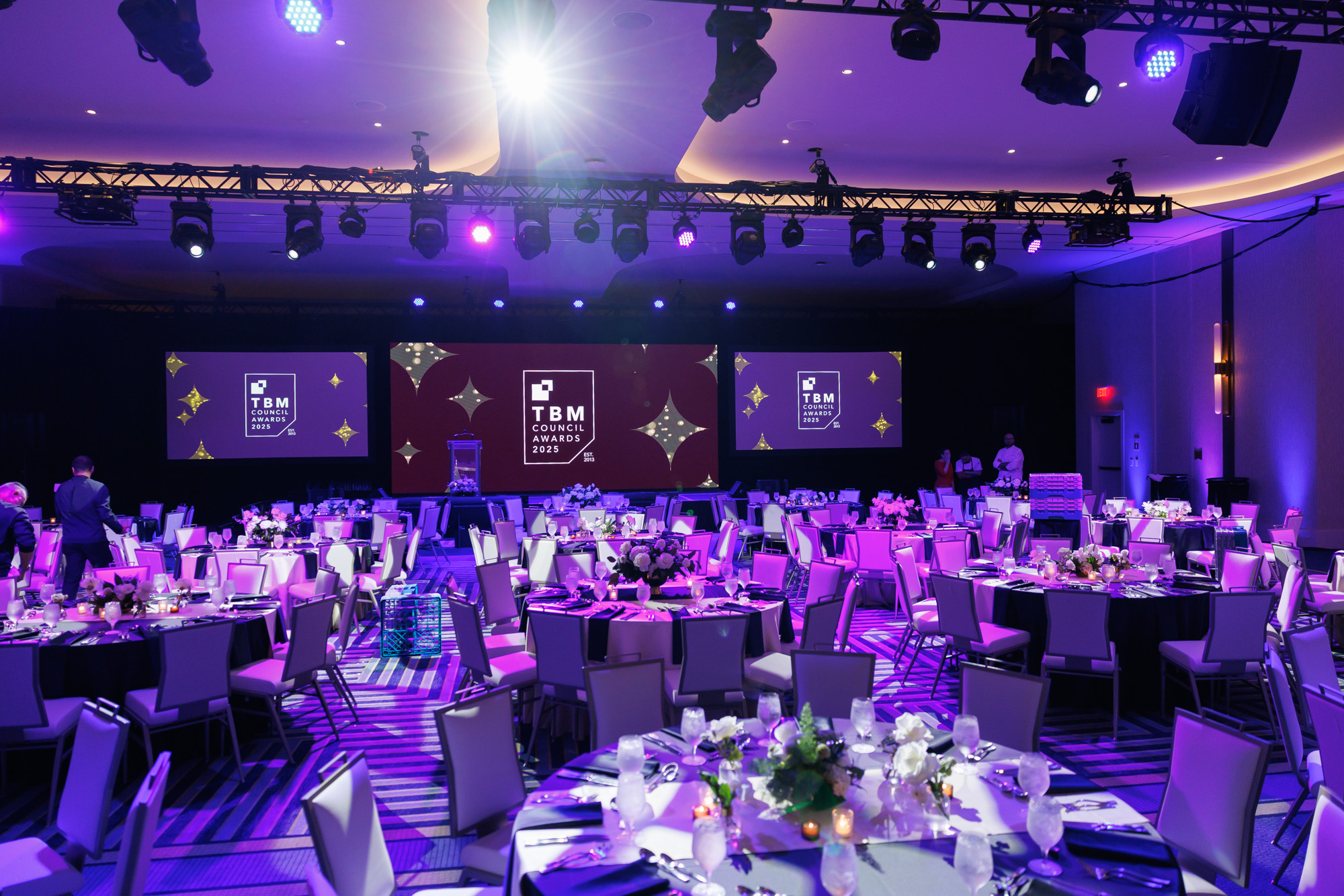
The less visible side of that work comes through in Brite Ideas’ account of TBM Conference 2025 at the Fontainebleau Miami Beach. Working with ITA Group, the team supplied lighting, audio, video, rigging and stage design. Apptio created the content, while Brite Ideas helped coordinate it and develop the stage’s visual treatment.
The hotel lacked a dedicated loading dock. Equipment still had to reach breakout rooms, the keynote stage and the awards area. The crew revised its plan and worked overtime. Colourful LED tubing and a video header could command attention once the audience arrived; getting the equipment into position had to happen first.
Christy’s company connects that willingness to troubleshoot to its founder. The example also puts a useful limit on the glamour of the finished photographs. A production is a chain of dependencies. An inviting room depends on a functioning stage, which depends on installed systems, which depend on access. The loading route has a vote in the creative meeting.
Leaving the show in other hands
Christy has had to apply the same attention to how his business runs. After years of organic growth, he returned to industry consultant Tom Stimson to work on operational and organizational problems. Earlier recommendations had met resistance. This time, Christy and his team acted on them.
Department leaders took a larger role in management. Christy described seeing colleagues assume responsibility, contribute ideas and build repeatable processes. The practical test was a week away: he returned to find the company carrying on and its goals being met. For someone whose business depends on being ready at a particular hour, that is a consequential kind of confidence.
It changes the meaning of a long career. Christy can point to performances, museum openings and industry recognition. He can also point to people who can keep the work moving in his absence. A founder’s experience becomes more useful when colleagues can draw on it without needing the founder beside every decision.
The tent remains a good place to understand him. It begins as a physical constraint and becomes a question about what could happen inside. His career has followed that question into galleries, university celebrations and conference hotels. The next transformation still needs someone to imagine the room, someone to plan it, and a team capable of opening the doors on time.