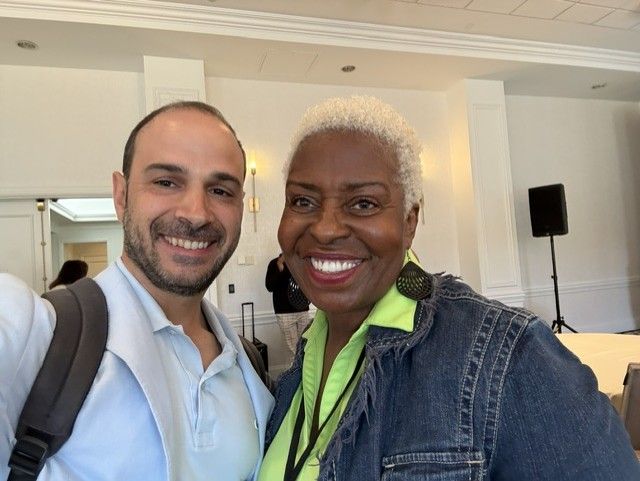
Greg Bilazarian was on a river cruise in Savannah when five founders pulled him aside with questions. They had found the private equity representative. One opening, as he recalled it, was gloriously direct: “you're the money guy right?” For a former television reporter, this was a new kind of introduction. The questions were about the owners themselves, rather than a transaction. He liked that distinction. A useful conversation could happen before anyone had decided to sell.
He had spent three days among more than 50 founders at the TCGi Foundation leadership gathering and the EY EAN Spring Summit. In his May 2026 account, he thanked Avis Yates Rivers for inviting him and Darrien M. Pinkman for being a trusted sounding board. He also gave private equity a fairly stern review. Owners, he wrote, can come away feeling that buyers never understood their work. He wanted to help them secure a better ending.
The microphone came first
Long before he was talking to owners about exits, Bilazarian was helping put games on the radio. In February 2005, Syracuse’s lacrosse notes listed him as the sports director leading WAER FM 88’s broadcasts of the season. It is a small line in a document mostly devoted to athletes, fixtures and previous scores. It places him inside the machinery of a live broadcast, where someone has to make the next thing happen on time.
Sports radio offers a particular discipline. The audience cannot see what the broadcaster sees. A good account has to select the detail that makes an event understandable, then move on before the game outruns the sentence. That is a useful way to think about the beginning of Bilazarian’s working life: attention, interpretation and a deadline. The corporate titles would arrive later.
His professional reporting took him to Florida and Ohio. A Toledo investigation published in February 2010 followed pizza delivery drivers who had recently been robbed. He visited two pizza businesses and spoke to the people making the deliveries. Their work continued, with adjustments to where and when they would go. The subject was an ordinary service job carrying risks that customers waiting for dinner might never consider.
That assignment gives substance to his later interest in small businesses. There are employees behind the service, and practical decisions behind the employees’ day. A company can look uncomplicated from the pavement. Walk through the door and the story acquires names, routines, constraints and consequences. His reporting required him to make that journey.
“Change is difficult but worthwhile.”
Greg Bilazarian, writing about his Armenian newsroom in 2011
Two months, with an unexpected extension
In 2011, Bilazarian went to Armenia on what began as a short placement. He was 27 and wanted time outside his American reporting career. Birthright Armenia offered a practical route into living and working there. The trip became more absorbing than the professional pause he had imagined: Civilitas offered him a one-year contract, and he stayed.
He described a close-knit place where a walk downtown could turn into a succession of encounters with people he knew. Taxi drivers, meanwhile, had their own interview format. Marriage was apparently an opening question, with very little preliminary small talk. For a reporter accustomed to asking the questions, the drivers reversed the usual roles.
His Armenian background gained a different meaning through daily life there. A connection to a country can be inherited; an understanding of its working day has to be acquired. The experience joined the two. He was living among colleagues, making something with them and deciding to stay longer than planned. The timetable had changed because the work had become worth doing.
A newsroom meets Google Docs
The actual work had a less picturesque soundtrack. Bilazarian introduced a Google Docs system to organize newsroom scripts. Its first outing went badly. At the subsequent meeting, a translator helped him follow the discussion until voices rose and the translation stopped. He could still hear his name. This is a particularly economical way for a manager to discover that a rollout needs attention.
His account had a better ending. The newsroom kept using the system, and an early opponent later told him she enjoyed it. He was also training inexperienced reporters while helping develop the online outlet. The team needed infrastructure as well as enthusiasm. Here was an early encounter with an operator’s problem: a sensible tool only becomes useful when people can use it together.
A technology change often looks tidier in its proposal than in its first meeting. Bilazarian’s story preserves the gap. The useful outcome was continued use, reached through friction. A script system is a modest object on which to hang a career lesson, but modest objects have the advantage of being real.
His role soon had a formal description: producer and manager, with English-language anchoring duties at CivilNet. The newly launched web newsroom ran short hourly reports from noon until nine in the evening, mostly in Armenian, with Bilazarian typically involved in a daily English report. Broadcast journalism and economics, his Syracuse fields of study, now met a very practical question of production: how does a small team keep publishing?
Hourly output leaves little room for a process to remain theoretical. The next report is approaching whether the system is elegant or improvised. His work combined helping establish the outlet with getting material on air. A small organization makes those responsibilities close neighbors. You can discuss the future in one conversation and have to deliver the present in the next.
The return ticket led to Yale
By July 2012, CivilNet had recorded a departure conversation between Bilazarian and Salpi Ghazarian. He talked about his experience and why he intended to return to Armenia. The interview marked nearly a year of work as a producer. A temporary volunteer placement had become a chapter substantial enough to require a farewell.
The next educational chapter was Yale School of Management, where he studied from 2012 to 2014. His listed activities included consulting and economic development clubs, along with nonprofit consulting on a growth strategy for a local private school. The subjects were now organizations and their choices, approached through a different professional vocabulary.
In May 2014, he graduated with an MBA. A community notice that summer placed him on his way to the Boston Consulting Group in Philadelphia as a management consultant, after another month in Armenia. His itinerary crossed the Atlantic again, then brought him back near the South Jersey region where he had grown up. Education and employment changed; the Armenian connection continued.
The cloud years, then a smaller room
Bilazarian went on to work at BCG and Amazon. At AWS, five years of his work involved IT managed service providers and private equity firms focused on growth. He built teams, launched programs and worked with customers on solutions for different stages of private equity ownership. The businesses behind outsourced technology became familiar territory.
The experience matters to his present search because service companies depend on execution. Selling more work has to be matched by delivering it. A partner relationship has to produce something useful for a customer. An acquisition introduces another set of expectations around both. Working among providers and investors gave him a view of those overlapping demands.
When he announced his partnership with NextGen Growth Partners in 2025, he described missing the pace of small business after years inside large corporations. His favorite reporting days had involved a small team in the field working against a deadline. He planned to find and acquire a company, then become its CEO and work alongside its team.
There is a personal choice embedded in that plan. Taking the CEO’s seat means remaining present after the deal is signed. The purchase is the beginning of an operating responsibility. For Bilazarian, the attraction was getting back near the work and the people doing it. He invited introductions to American B2B service owners and named IT managed service providers as his focus.

A search with practical boundaries
His IT acquisition site gives that ambition some numbers: at least 10 employees, $7 million in revenue and $1 million in EBITDA. These describe the kind of company he wants to buy. They are screening criteria for the search. The business should have recurring contracts and a market position that can endure, rather than depend heavily on one or two customers.
The proposed operating plan emphasizes channel partnerships, a repeatable sales process and dependable delivery. He also wants to retain the business’s identity and team while building a larger platform. Those intentions put continuity beside growth. A founder considering a sale will reasonably want to know how each is supposed to survive the other.
Following the work into environmental services
Another public acquisition initiative carries his name into environmental services. Its focus includes emissions monitoring and air pollution control, with selective interest in water and waste businesses. It seeks established, profitable operations with recurring demand and experienced technicians. The stated financial threshold is $1.5 million in EBITDA.
That site describes 8.5 years at AWS and exposure to the infrastructure questions surrounding data centers. His proposed role draws on business and operating experience, while recognizing the importance of specialist technical knowledge. The plan prioritizes regional density, responsive service and long-term customer relationships. Across the searches, the recurring concern is what a working company depends on each day.
An old connection, a continuing question
One connection reaches back to college sports broadcasting. Bilazarian introduced NextGen’s Owner to Owner newsletter to Brian Goldman of Big Blue Bug Solutions. Their January 2026 conversation explored a family service business’s decision to concentrate on pest control and expand geographically. The introduction joined a relationship from his broadcasting years to his current interest in how owners operate.
It is a fitting detail for this stage of his career. He has kept moving between places and professions, while conversations have supplied much of the continuity. The immediate ambition is to acquire and lead a business. The question underneath it is familiar from his reporting days: what makes this place work? This time, he wants to stay for the next chapter.