At one point, a government contractor's sales prospect could arrive as one more email in a pile of thousands. The message might concern the right agency, the right product and the right deadline. It might also be seen too late. Mike Weiland and his co-founders began Govly with a modest technical answer: forward those contract-vehicle emails into a system, parse and index them, then alert people when a saved search matched. It sounds like office housekeeping. In this market, it was a way to see.
- Govly collects government opportunities, awards and market signals, then helps sales teams decide which pursuits deserve attention.
- Its network connects prime contractors with manufacturers, distributors and resellers who may need one another to bid.
- The company grew from bid search into shared workspaces, AI research agents and automated capture workflows.
- Its limits are real: private vehicle access still depends on the right partners and eligibility, and no software wins a contract by itself.
The first company met the paperwork
Before Govly, brothers Mike and Nick Weiland built Telescope, a business aimed at promising government contracts. Its practical lesson was expensive in labor, though the founders have not published a dollar figure: the company needed an internal department to deal with compliance, certifications and the rules of federal acquisition before it could concentrate on winning work. Opportunity discovery was only the first nuisance. Passing information among the people who could supply, resell and submit the bid was another.
They joined entrepreneur Jon Wright to turn that internal frustration into a product. In their 2021 launch account, the founders described primes receiving thousands of opportunity emails a day and using ordinary inbox filters to keep up. Their early software ingested those messages into a search index and let users make precise saved searches. A person could get an immediate alert for a relevant request, or a daily digest. It was a sensible place to begin because it attacked a nuisance customers were already paying people to endure.



The premise changed as they worked. A neatly filed opportunity is still useless if the company that makes the product cannot reach the contract vehicle through which the government plans to buy it. A prime contractor may hold that access; a manufacturer or reseller may hold the thing the agency actually wants. Govly's wager was to bring those parties into the same working space, with the notice, documents and conversation attached.
The gate matters as much as the bid
The government does not buy everything from an open bulletin board. Many purchases run through prearranged contract vehicles, which restrict who can submit an offer. Govly's original launch post called the prime contractor's vehicle award a kind of “hunting license.” The metaphor is good because it makes the gate visible. Knowing an animal is in the field does little for someone standing outside the fence.
Govly therefore serves several customers at once. Prime contractors use it to track requests on their vehicles and share work with partners. Original equipment manufacturers, distributors and value-added resellers use it to spot demand and find an eligible route to market. Capture and business development teams use award history, agency data, alerts and shared workspaces to decide whether a pursuit is worth the cost of a proposal. Govly says more than 200 organizations use the network, and its public examples include Hewlett Packard Enterprise, Nutanix, CDW-G, Cisco and Red River.
This is where Govly differs from a simple bid-alert service. Search matters, but private vehicle feeds, partner permissions and shared execution are the larger claim. The company says it gathers opportunities from more than 40 federal contract vehicles and has expanded into state, local and education sources. Those coverage figures come from Govly, and the exact set of accessible private notices depends on the account and its approved relationships. A company without the right partner does not gain a magic pass because a software screen shows the opportunity.
From an alert to a course of action
The product now has more layers than the email parser. Opportunities and Awards search help teams find live requests and examine what agencies have bought. Budget tools and Signals put earlier clues beside the bid itself. A Teaming Board lets vendors express interest in an opportunity and contact potential collaborators. Govly AI can summarize documents, answer market questions and assist with quotes. In its 2025 Govly 2.0 release, the company added agents for research and capture planning, plus rule-based Workflows that can route quote requests to a manufacturer or distributor.
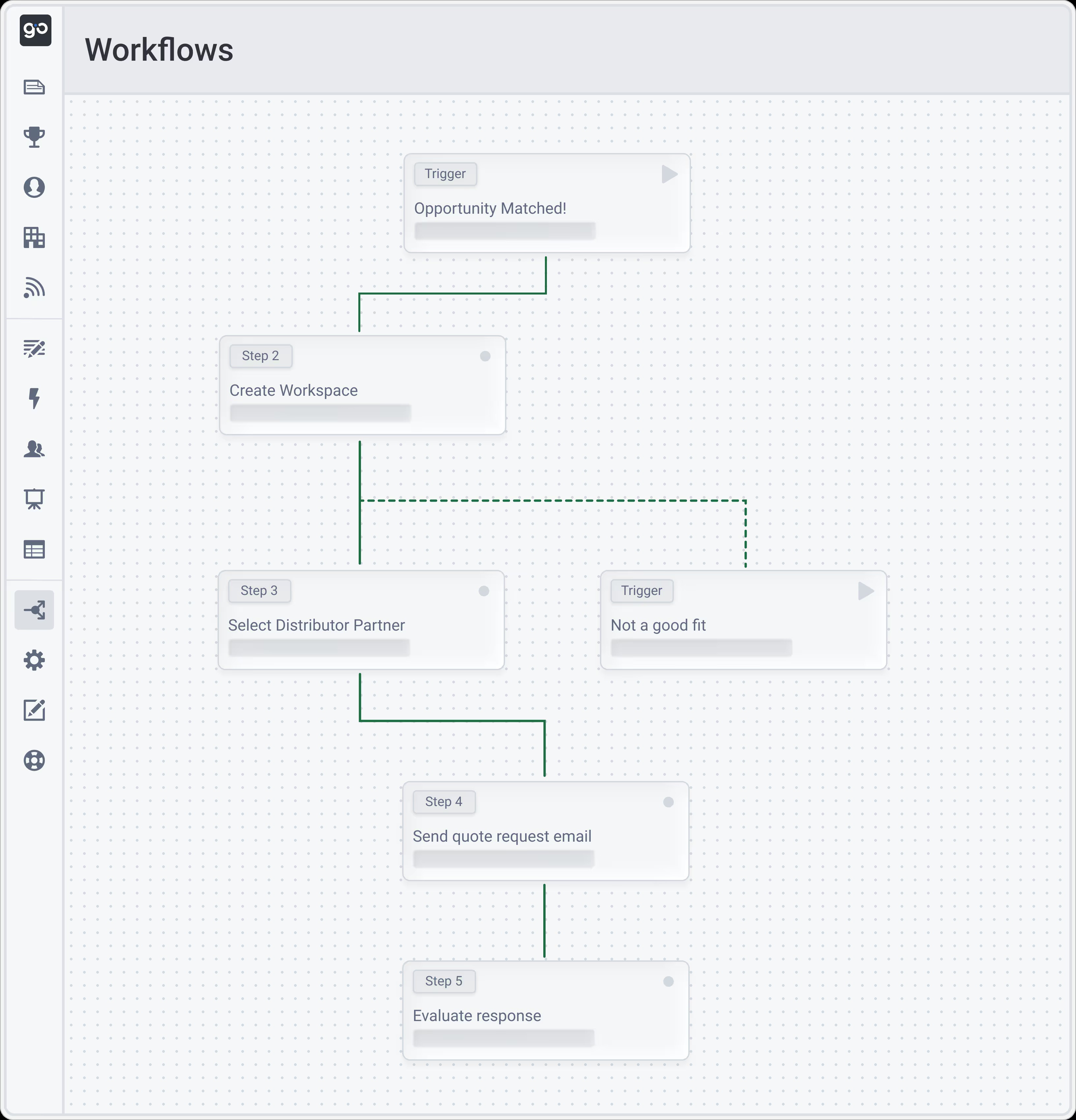
In August 2026, Govly made its data available through a Claude connector for paid accounts. That is an interesting extension of its original idea. A user can ask an AI assistant to run a saved search, compare an expiring award with a fresh solicitation, or follow a relevant contact, while bringing in the team's own CRM or documents through separate connectors. It moves Govly's procurement index into the place where a capture team is already reasoning. It does not change the underlying duty to check the notice, the eligibility rules and the source documents before spending proposal hours.
The company sells a free entry point and paid subscriptions. Its free plan offers recent public solicitations, award data and search; paid plans add historical records, access to certain private vehicle opportunities through partnerships, richer buyer intelligence and collaboration. Enterprise work can include custom automation and consulting. Public list prices for those paid tiers were not established in the material reviewed. The clearer cost figure is on Govly's side of the table: a $9.5 million Series A in November 2023, led by Insight Partners, brought its reported total raised to $13.1 million. TechCrunch reported a $41 million post-money valuation for that round.
A useful lesson from a crowded market
Govly competes with established government intelligence products such as GovWin IQ and GovSpend, and with newer capture tools. It also competes with the stubbornly durable combination of SAM.gov, spreadsheets, email and human memory. Its defensible angle is the relationship between data and permission: a notice is more useful when it arrives beside the right contract vehicle, partner and next step. A broad index alone is easy to admire and easy to ignore.
For a smaller team, the copyable part of Govly's story is plain. Gather the feeds your actual buyers use. Turn recurring notices into narrow saved searches. Record which contract vehicles you can use and which partners can use the others. Assign every promising match to a named person, then record the answer to a hard question: bid, partner or pass? These are habits before they are software features. They fail when eligibility is assumed, when a signal is mistaken for an official solicitation, or when a team has no one able to write the response.
Govly's founders started by making an overflowing inbox legible. The company now sells a broader proposition: procurement work should carry its context with it, from the first sign of agency interest to the people who can respond. There is no romance in forwarding contract emails to a parser. There is, however, a certain elegance in noticing that the missed opportunity was sitting there all along.