The AI go-to-market platform that turns the dullest documents in America - budgets, board minutes, procurement filings - into the next deal.
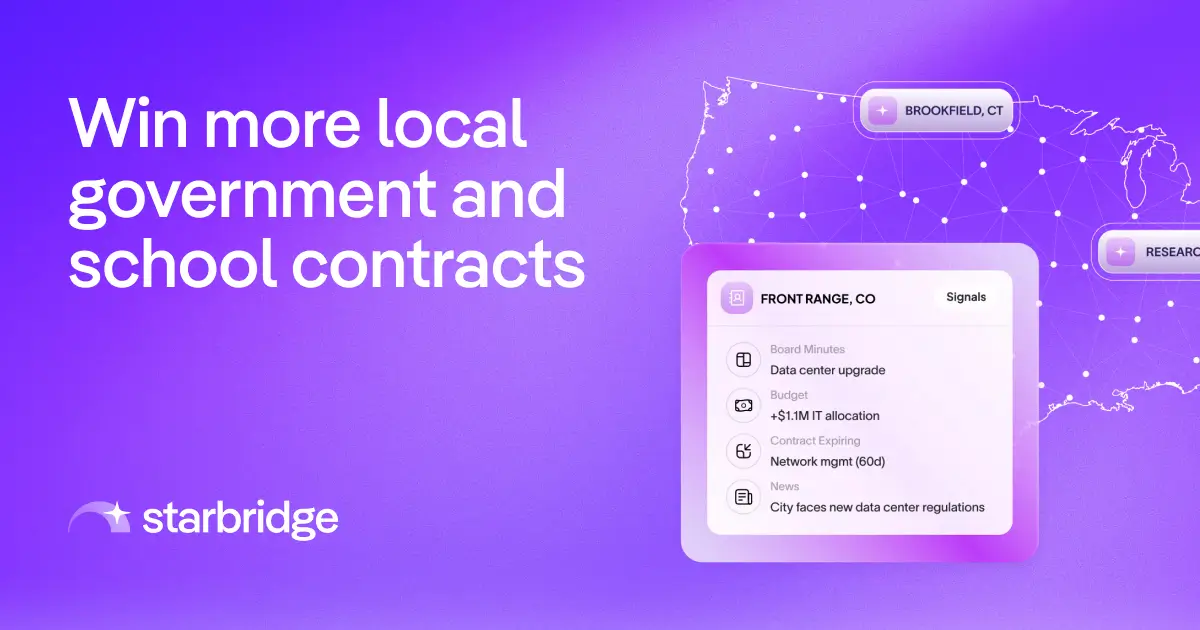
Exhibit A: the pitch on a purple gradient. Starbridge's whole company in one line - win more contracts from the people who run schools, cities and statehouses.
Somewhere right now, a county school board is voting to replace its aging student information system. The motion passes. It is recorded in a 60-page PDF that almost no human will ever open. Starbridge already has.
That is the company in a sentence. Starbridge is a New York software company that monitors hundreds of thousands of government agencies and schools - their bids, budgets, contract expirations, grants and the procurement rules that govern all of it - and tells businesses where the next deal is hiding. Not after the request for proposal goes public, when every competitor sees it too, but weeks or months earlier, when it is still just a line item in a meeting.
By mid-2026 the platform sits inside 160-plus enterprise sales teams that sell to the public sector. It has raised $52 million. And it has done all of it on the strength of a deeply unglamorous premise: the most valuable sales data in the country is public, and almost nobody can use it.
The public sector - state, local, and education, known in the trade by the cheerful acronym SLED - spends staggering sums every year. In theory, it spends in the open. Transparency laws mean budgets get published, meetings get minuted, contracts get filed. In practice, that openness is its own kind of fog.
The information exists, but it is spread across thousands of websites that do not talk to each other, buried in scanned documents, formatted by people who were not thinking about a salesperson's quarter. A vendor who wants to sell to schools cannot simply ask, "Which districts are about to need what I make?" They can only wait for the RFP, by which point the buyer has usually already decided who they want.
Before Starbridge, Justin Wenig spent roughly seven years building Coursedog, a platform for scheduling and curriculum management that sold into higher education and state agencies. He learned the public-sector sales motion the slow way. In 2021 he sold Coursedog to JMI Equity in a nine-figure deal, which is the sort of outcome that lets a person retire, or at least take up a hobby that does not involve procurement law.
He chose procurement law. Wenig came back to solve the problem he had personally hated: it is too hard to find and win government contracts. The bet underneath Starbridge is that modern AI can finally do what no team of analysts ever could - read every public document, constantly, and surface the signal worth acting on.
It helped that he knew the shape of the buyer. Years inside Coursedog meant Wenig had already sat across the table from school administrators and state agencies, had already felt how long the cycle runs and how much of it depends on simply knowing something before anyone else does. Starbridge is, in a sense, the tool he wishes he had had the first time.
The name is not subtle, and it is not meant to be. Starbridge is, by its own account, "building the bridge between business and government." The structure is the metaphor. On one side, companies with something to sell. On the other, agencies with budgets and a genuine need. In between, historically, a chasm of paperwork.
Starbridge aggregates the fragmented public record and turns it into something a sales team can actually use: AI-ranked accounts most likely to buy, real-time alerts on leadership changes and new initiatives, and drafts of the proposals nobody enjoys writing. Here is what is under the hood.
Real-time tracking of bids, board discussions, contract expirations, grants, budgets and procurement rules across hundreds of thousands of agencies and schools.
Verified public-sector contacts plus AI rankings of which accounts are most likely to adopt new technology.
Public spend and competitor contract data showing where money flows - and exactly when a deal comes up for renewal.
Surfaces relevant RFPs and uses AI to draft and automate the responses that were once the bane of every seller's existence.
Points teams at the right public-sector conferences and the right people to meet once they get there.
Two-way sync with Salesforce and HubSpot, so signals land where the work already happens.
// from quiet build to $52M in roughly two years
Conviction is cheap. Capital and customers are not. Starbridge has collected both. The $42M Series A was led by Craft Ventures - the firm co-founded by David Sacks - with Owl Ventures, Commonweal Ventures and Autotech Ventures returning from the seed.
// USD millions raised · source: company & press announcements
Two rounds, eight months apart. The Series A was more than four times the seed - a fast vote of confidence in selling to government.
The pace tells its own story. The seed and Series A landed roughly eight months apart, and the second round came in at more than four times the first. Investors do not usually move that fast on a category that has existed, in some form, for decades. They move fast when they think the ground underneath it has shifted.
And the buyers are not hypothetical. Starbridge is used by teams selling everything from two-way radios to classroom software into agencies and districts. The customer list reads like a cross-section of who actually sells to the public sector right now - hardware, edtech, civic software, even a hospital.
The pitch deck reason for Starbridge is efficiency: faster pipelines, fewer missed RFPs, better-targeted outreach. The deeper reason is quieter. When it is easier for good companies to sell to government, the agencies on the other side - the ones running schools, hospitals and cities - get more, and better, options to choose from.
Starbridge frames its own mission as inspiring entrepreneurs to build for the public good. That is a tidy way of saying the public sector should not be the market that the best companies avoid because the sales cycle is miserable. Remove the misery, the theory goes, and the talent follows.
Starbridge is not the first company to sell public-sector intelligence. GovWin and GovSpend have done versions of this for years. What is new is the moment. Large language models can now read, summarize and rank documents at a scale and cost that simply did not exist when the incumbents were built. The fog that protected the old way of doing business is lifting, and Starbridge arrived with the right tool at the right time.
If the bet holds, the asymmetry that defined public-sector sales for decades - insiders who knew where to look versus everyone else - starts to flatten. The next generation of vendors will not need a rolodex and a decade of relationships to find the deal. They will need a login.
Return, for a moment, to that county school board. The motion to replace the student information system still passes. The 60-page PDF still gets filed where almost no human will read it. But now the right company gets a notification, a ranked account, and a head start on the proposal - all before the RFP is even written.
The meeting did not change. What you can do with it did.
Profile compiled from public sources · figures approximate · last updated June 2026