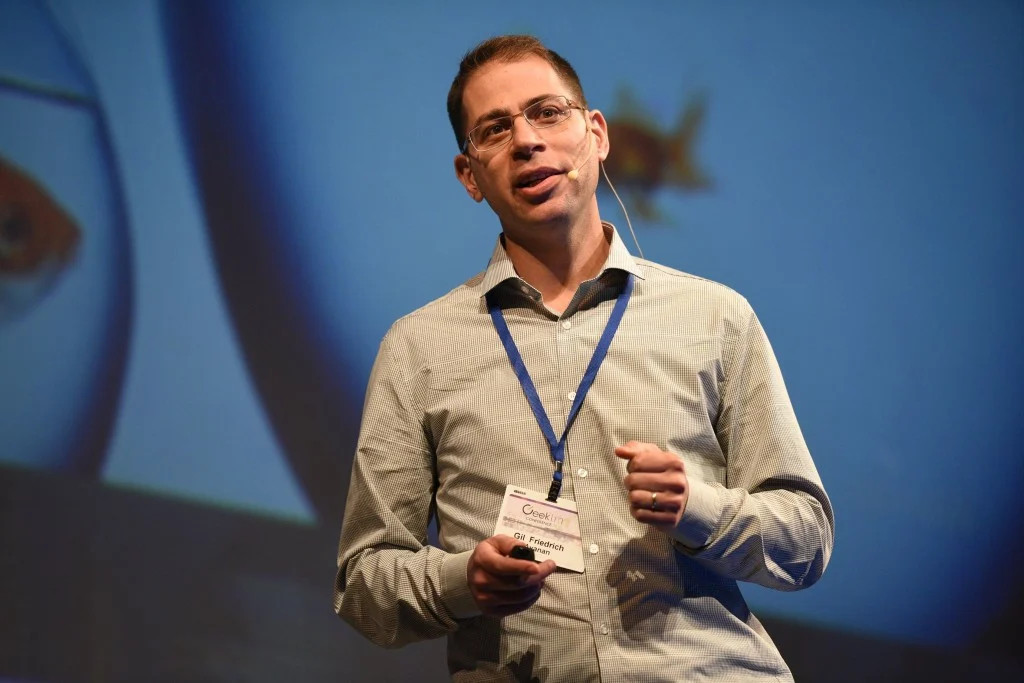
Gil Friedrich needed a job. He had completed the research for his graduate degree, still had a thesis to write, and was running out of money. Asking his professor whether he could work while finishing the manuscript seemed reasonable. The professor had a more immediate proposition: join the company he was starting. Friedrich accepted. An academic scheduling problem had become a career in cybersecurity.
He joined ForeScout at the end of 2000. A few years later he was running research and development; later came a move from Tel Aviv to New York and a role facing customers and partners. His education combined physics and computer science at Tel Aviv University. The job would add another discipline: listening to people explain why the technology that worked yesterday might soon be insufficient.
That beginning is refreshingly short on destiny. There was a professor, an unfinished document, and a practical need to earn a living. Friedrich would eventually co-found Avanan and become its founding CEO. First, he had to finish the thesis. Even a future founder occasionally benefits from having his supervisor conveniently located at work.
The customers were moving out
At ForeScout, Friedrich and his future co-founders were helping protect enterprise networks. Their customers liked what they had. Increasingly, those same customers were moving their communications and data into cloud services. The question kept returning: how would the protection follow them? A successful product had given the team access to the people who could describe its next limitation.
Avanan brought together Friedrich, Roy Rotem, Avi Zelovich, and Michael Landewe. Its New York and Tel Aviv arrangement grew from circumstances rather than a grand geographical theory: two founders were already in New York. Research and development in Tel Aviv, with sales and marketing in New York, followed naturally. The company’s public launch history dates to 2015, the founding year used in Check Point’s acquisition announcement.
For Friedrich, the cloud offered a chance to change the plumbing. Instead of sending communications out through another system for inspection and then back again, software could connect directly to the cloud application through its programming interfaces. He described installation in terms of putting an app on an iPhone. That comparison told customers what mattered: getting protection running should not become an infrastructure project.
The security logic also depended on placement. His team wanted to operate after Microsoft or Google had applied their own defenses, concentrating on attacks those systems missed. Friedrich described training machine learning on that difficult remainder. In his account, the useful opportunity lay inside the service, close to the messages and the context surrounding them.
A friendly yes costs nothing
Then came a less technical question: would anybody pay? Friendly design partners and beta users were willing to try the software. Friedrich later disclosed that none of the initial group became paying customers. Approval had been easy to obtain. A purchasing decision required a different conversation.
The first sales came through new trials where the commercial expectation was explicit from the beginning. If the product did the job, the customer would pay. It is an awkward distinction for an engineer who can demonstrate that something works. A working demonstration and a working business can occupy the same room for months without being introduced.
Growth supplied a second examination. Friedrich identified the jump from roughly 200 to 500 customers as especially difficult. Support, billing, renewals, and customer success needed systems the young business had not yet completed. Some customers left. So did some employees. His account includes the costs that usually disappear from a tidy growth chart.
“Giving up was never an option,” he said. The sentence sounds firmer when placed beside those departures. Persisting meant building an organization capable of serving people after the sale, while continuing to sell. An inbox could be secured by software; a growing customer base required a functioning company around it.
Anyone can knock on the inbox
Friedrich’s explanation of email begins with an ordinary freedom: a stranger can send a message to your organization without asking permission first. That openness makes email useful. It also gives an attacker a route to an employee who can transfer money, open a document, or surrender a password.
“Anyone in the world can send your organization a message,” he observed. Avanan’s answer was to inspect from inside the cloud service while preventing suspicious messages from reaching the inbox. The timing mattered to him as much as detection. Finding a dangerous message after someone had acted on it left an uncomfortable interval in which the damage could already be done.
He also argued that training and technical protection belonged together. Asking employees to recognize every deception placed a considerable burden on the people trying to get their work done. His business rested on reducing how often they had to make that judgment in the first place.
The same concern extended beyond mail. In a 2021 discussion of cloud security, he emphasized visibility across services such as Teams and Dropbox. An organization could see one incident and miss its connection to another application. His ambition was protection across the places where work actually happened, with enough context to understand how those places fitted together. Office life had acquired more doors; security teams needed a view of the building.
- 01Cloud provider’s
native defenses - 02Additional inspection
inside the cloud service - 03Cleared message
reaches the inbox
The board slides nobody claimed
Inside Avanan, Friedrich offered a small example of cooperation. A newly arrived vice president needed slides for a board meeting. The director who had previously overseen the area knew the material, prepared the slides, and took no credit. Friedrich learned about the favor months later, when the vice president described it to him.
It is a modest incident, which is why it survives inspection. Nobody had to announce a cultural transformation. Someone knew the work and helped a colleague look prepared. Friedrich described the company’s culture as emerging partly from the combined behavior of its employees, rather than being centrally issued by the CEO.
He paired that teamwork with attention to detail across engineering, quality assurance, marketing, and sales. Board slides are an apt example: small enough to seem beneath a culture statement, consequential enough to matter to the person responsible for them. A company’s habits become visible in what people do when no applause has been arranged.
His own move beyond engineering depended on a colleague too. Friedrich credited sales leader Don Byrne with teaching him sales and marketing through shared decisions and experiments. He valued being brought into the reasoning. The founder needed people whose expertise could also enlarge his own.
Room for a joke, and better headphones
There is mischief in this working world. Friedrich recalled a late evening when a field engineer asked him to join an urgent customer call involving the FAA. Seeing news of a separate computer disruption, he feared his company’s technology was responsible. The engineer encouraged the misunderstanding before Friedrich learned that their actual problem involved one laptop. He later hired the prankster at Avanan.
His approach to remote work could be similarly practical. When a colleague’s calls included the sound of his wife teaching mathematics in their shared apartment, the team laughed and bought better headphones. The solution was mercifully smaller than a policy document. “Be understanding,” Friedrich advised.
Outside the product discussion, a public post offered another glimpse of his priorities. His daughter joined Check Point’s New York email security team in collecting surplus restaurant food in Manhattan for people who needed it. Friedrich singled out her insistence on carrying the heavier bags. He chose to share a detail about the work itself, and about a child volunteering for the less convenient part.
“Be understanding.”
Gil Friedrich, on managing remote teams
Five thousand customers, then a wider stage
On August 30, 2021, Check Point announced its agreement to acquire Avanan. The announcement described more than 5,000 customers, over 2.5 million protected inboxes, and a workforce exceeding 100. These were company figures at that moment, rather than a present-day tally. They show the distance traveled from trials that produced no sales.
The relationship already had a history. Check Point had been using Avanan’s technology through an OEM arrangement for three years. The buyer knew the product before it bought the business. Friedrich’s stated plan was to use Check Point’s international organization to reach customers across sizes and geographies.
That was a concrete ambition for an acquired founder: put the technology into more organizations. Distribution would now have a different scale. The challenge he had first heard from customers at ForeScout had carried him into a larger company, with his work continuing around email security.
When the reader is an AI agent
The next change concerns who reads the message. In February 2025, Friedrich wrote about deepfakes and the need to verify requests through an independent, trusted channel. A convincing voice or image could no longer settle the question of identity. His argument returned to an old email problem in a new medium: familiarity can be manufactured.
Today, Check Point lists him as General Manager of Workspace Security. His remit includes protection against AI-powered threats and work toward autonomous security tools. In June 2026, the Chicago Engage program listed him alongside CISO Fred Clayton for a session on unified workspace security. The scope has widened from the mailbox to the environment around the employee.
A current webinar with product executive Yoav Shay Daniely brings that shift back to email. AI agents can summarize messages, draft responses, and initiate actions before a human reads the original. Malicious text may influence the software doing the reading. Friedrich and Daniely make the case for stopping harmful content before the agent processes it.
The sequence is familiar even as the reader changes. A service becomes easier to use; work moves into it; an attacker discovers what that convenience permits. Friedrich has spent his career following those movements. The unanswered question is increasingly what a message can persuade software to do. The inbox still receives the mail. It now has company opening it.
More from Friedrich’s world
- Check Point · Workspace Security leadership
- Gil Friedrich · LinkedIn
- Gil Friedrich · Twitter / X
- Avanan · company website
- Watch · Head in the Cloud on YouTube
- Watch · Email Agent Hijacking
- Read · Founding and growth interview
- Read · Teamwork and remote work
- Read · Deepfakes and verification
- Read · August 2021 acquisition announcement
- Listen · Hacking Humans conversation