Germain Lamonde once imagined that five years would do it. Give EXFO enough time to become a solid business, he reasoned, and he could ease off a little. In 2020, thirty-five years after starting the company, he recalled the plan and conceded that the leisurely part had never arrived. The business had proved rather better at expanding than at becoming a hobby.
Its beginning was modest enough: $100, an apartment in Quebec City’s Montcalm district, and a conviction that optical fiber would need people who could measure what it was doing. Lamonde and Robert Tremblay founded EXFO in 1985. The incorporation papers arrived on September 18. There was a large ambition inside that small address: to build a company that could compete around the world in fiber optic testing.
Four decades later, Lamonde was still there. He had run EXFO for more than thirty years, handed the chief executive’s job to someone else, bought out its public shareholders, and watched successive generations of networks create new demands for its instruments and software. In January 2026, EXFO announced that he would assume the CEO role again. The five-year plan had acquired a considerable appendix.
The physics teacher and the dairy farm
Before the apartment came a dairy farm, six siblings and a physics teacher. Lamonde grew up in a family of modest means. He has credited Quebec’s education system with giving all seven children access to university. That memory matters to the way he talks about success: education appears as something that made his own career possible, with a claim on what he does afterward.
A secondary-school teacher’s originality and enthusiasm helped steer him toward engineering physics. He left the farm for Polytechnique Montréal, where he encountered an environment of collaboration, competition and lasting friendships. He earned a bachelor’s degree in engineering physics, followed by a master’s in optics at Université Laval. Later came the Ivey Executive Program at Western University. The education eventually covered both the behavior of light and the behavior of a business.
He had already tried small entrepreneurial ventures as a child. Optical communications gave those inclinations a technical subject. In a 2019 interview, he explained that his studies had made fiber’s potential apparent to him, particularly its capacity to carry multiple wavelengths. He was looking at what the medium could support over time. The company would occupy the practical ground between that promise and the work of making networks function.
Testing is an unusually discreet line of work. People notice the service on a screen; fewer pause to admire the instrument that helped establish whether the connection was fit for use. Lamonde chose that less conspicuous business. His early aim included making fiber testing approachable for workers who were not specialists, so sophisticated infrastructure could be built beyond the laboratory. Ease of use was part of the engineering problem.
An idea has to leave the laboratory
Lamonde’s public discussions of innovation can sound impatient with the ceremony around it. He returns to the customer, the market and the speed of execution. At a Quebec City business gathering in 2019, he argued that an innovative idea needs to turn into market share quickly. An invention that attracts admiration but no orders has missed the commercial point.
At another chamber of commerce event in 2022, he developed the argument through differentiation and timing. Teams should take risks and accept that some efforts will fail. They should also concentrate on particular markets and move quickly enough for a useful distinction to matter. Being the fifth business to arrive with an idea weakens the claim to originality. The calendar gets a vote.
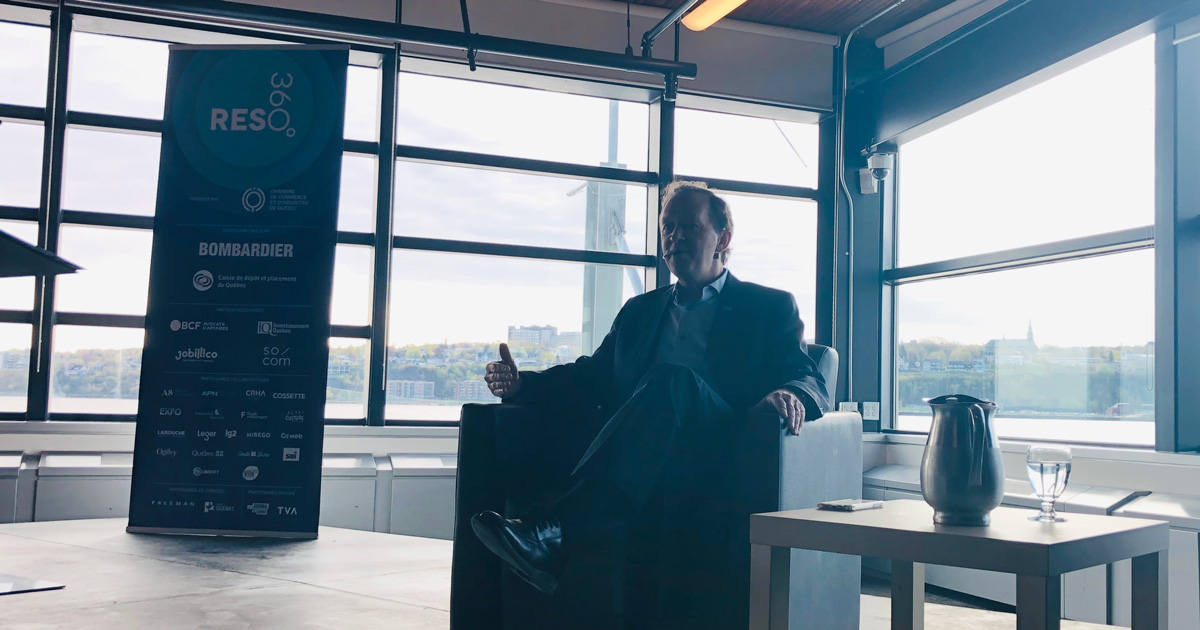
EXFO’s own scope widened with the networks it served. Optical test instruments were joined by monitoring, service assurance and analytics. In a 2018 interview in Barcelona, Lamonde discussed helping operators improve work in the field while also planning for physical and virtualized networks. His concern was how customers could build well, operate efficiently and prepare for new services. The technical discussion kept returning to the customer’s working day.
In 2000, EXFO became publicly traded on Nasdaq and the Toronto Stock Exchange. In April 2017, Philippe Morin became CEO. Lamonde moved into the executive chairman’s role, retaining leadership of acquisitions and involvement in growth, customer relationships and governance. Handing over the title left him plenty to occupy the hours that his younger self had hoped to reclaim.
A trophy, then another kind of investment
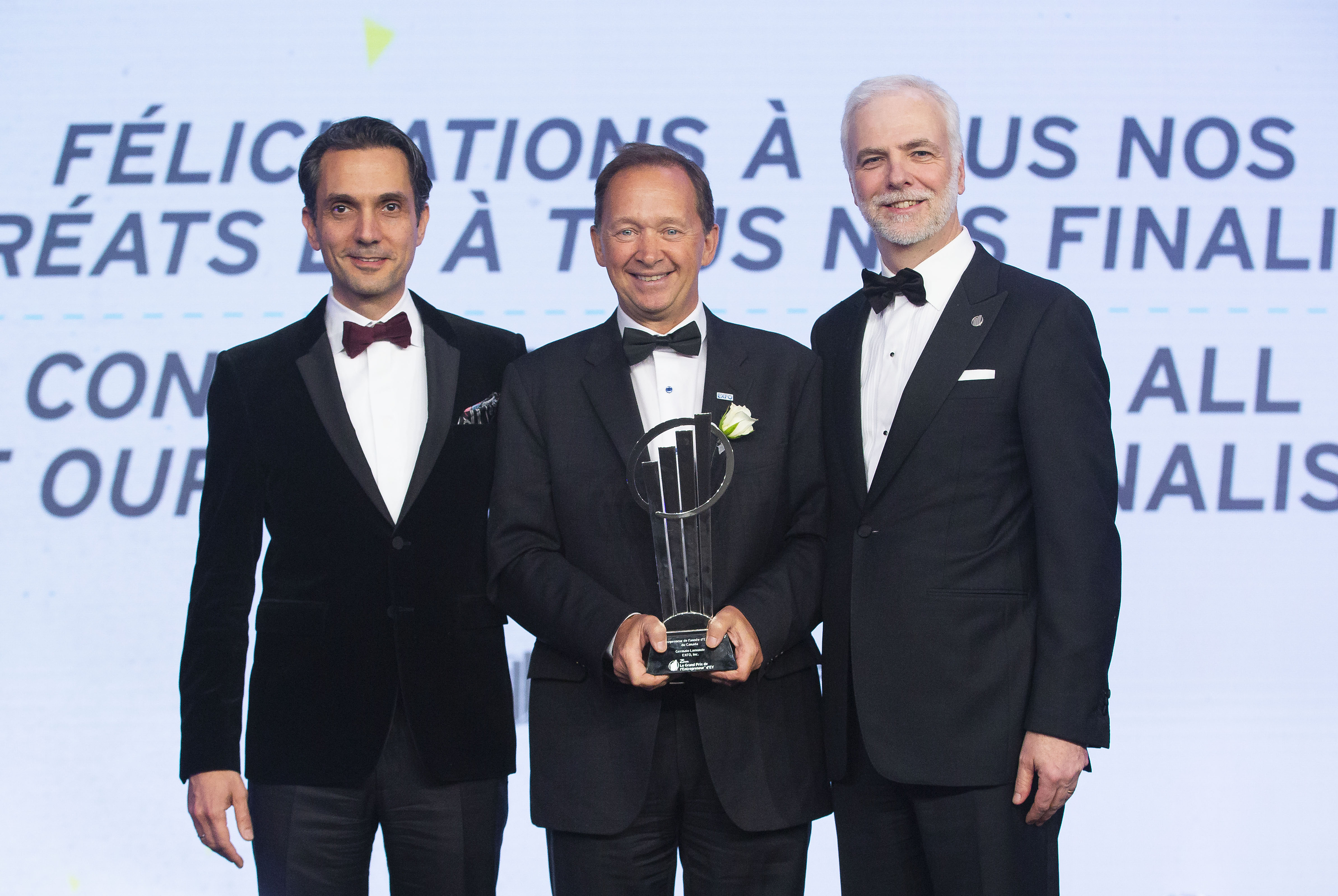
In November 2018, Lamonde won EY’s Canadian Entrepreneur Of The Year award after winning the Quebec competition. The national presentation took place at a black-tie ceremony in Toronto. He stood between EY Canada chairman and CEO Jad Shimaly and the program’s national director, François Tellier, for the award photograph. The following year, he represented Canada at the world competition in Monaco.
The recognition followed an investment in younger people’s prospects. In October 2017, Laval announced a $1 million gift from Lamonde and a further $200,000 from EXFO. The distinction matters: the personal donation and the company contribution were separate parts of a $1.2 million commitment to the Faculty of Science and Engineering. Their uses included laboratory equipment, scholarships and support for technological entrepreneurship through EGGENIUS.
$1m Lamonde’s personal gift
$200k EXFO’s contribution
There is a straightforward connection between the farm and those laboratories. Lamonde sees education as an opportunity he received and can help extend. Scholarships make the next course of study possible; equipment gives students something current to work with. EGGENIUS helps them explore whether a scientific or technological idea can become a business. These are fairly concrete ways to encourage another beginning.
His connections to Quebec’s engineering and business community extend into institutional work. He has served on boards including Laval, the National Optics Institute and QG100, and chaired ENCQOR, the Canada-Quebec-Ontario initiative focused on 5G innovation. He is also a Fellow of the Canadian Academy of Engineering. The roles place him among researchers, company leaders and people trying to turn technical capability into economic activity.
The company was not for sale
In 2021, the question of EXFO’s future became a public contest. A company controlled by Lamonde proposed buying the subordinate voting shares he did not already control for US$6 each. Competitor Viavi pursued EXFO with higher proposals, eventually reaching US$8 per share. Lamonde, already the controlling shareholder, repeatedly declined to support a sale to the rival.
“I am a builder, not a seller.”
Germain Lamonde, July 2021
He compared an unsolicited approach to someone admiring a house and wanting to purchase it: the owner still decides whether to sell. He also said customers had raised concerns about competition and pricing if EXFO disappeared into another supplier. Independence, in his account, preserved a separate business able to challenge competitors and develop its own products.
The interests were not identical. A founder’s wish to continue and an investor’s opportunity to receive a higher price can pull in different directions. Lamonde’s offer rose to US$6.25. In August, the arrangement received approval from 90.95% of the votes cast by eligible minority shareholders, excluding the specified insider holdings. The transaction closed on August 27, 2021, and EXFO began the process of leaving the exchanges.
- 1985A private beginning
- 2000Toronto + Nasdaq
- 2021Private again
The episode made visible something that an award photograph cannot show: continuing to build a company can involve arguments about control, price and whose preferred future will prevail. Lamonde kept the business independent. Shareholders approved the terms on which they would leave. Neither detail needs to disappear for the other to be understood.
The next cable to test
At EXFO’s fortieth anniversary in September 2025, Lamonde described success in geographic terms. The company had customers abroad and consequences at home. He reported nearly $10 billion in cumulative exports and $2.5 billion in wages paid in Quebec since its founding. EXFO then employed about 1,800 people worldwide, including 750 in Quebec. These were the figures he chose to place beside the original $100.
He also urged businesses to look beyond the United States toward Europe and Asia. Remaining rooted in Quebec, in this telling, required looking outward. At the same time, he credited the employees who had worked through four decades of change. A 2022 talk offered a smaller glimpse of that organizational interest: artwork representing EXFO’s values became the cover of a book distributed to employees.
The January 2026 leadership announcement brought Lamonde back to the CEO role as Morin prepared to leave. Étienne Gagnon was appointed general manager of Test & Measurement. EXFO identified AI data centers as a focus for its next phase, applying its optical testing work to the dense networks behind new computing infrastructure. There was another market to serve, another generation of connections to validate.
The apartment is a good beginning to the story. The longer part is the repeated decision to continue: through a listing, a handover, a contested buyout and a return to the operating job. Lamonde once thought five years might be enough to make room for a quieter schedule. Forty years supplied a different answer, and more cables to test.