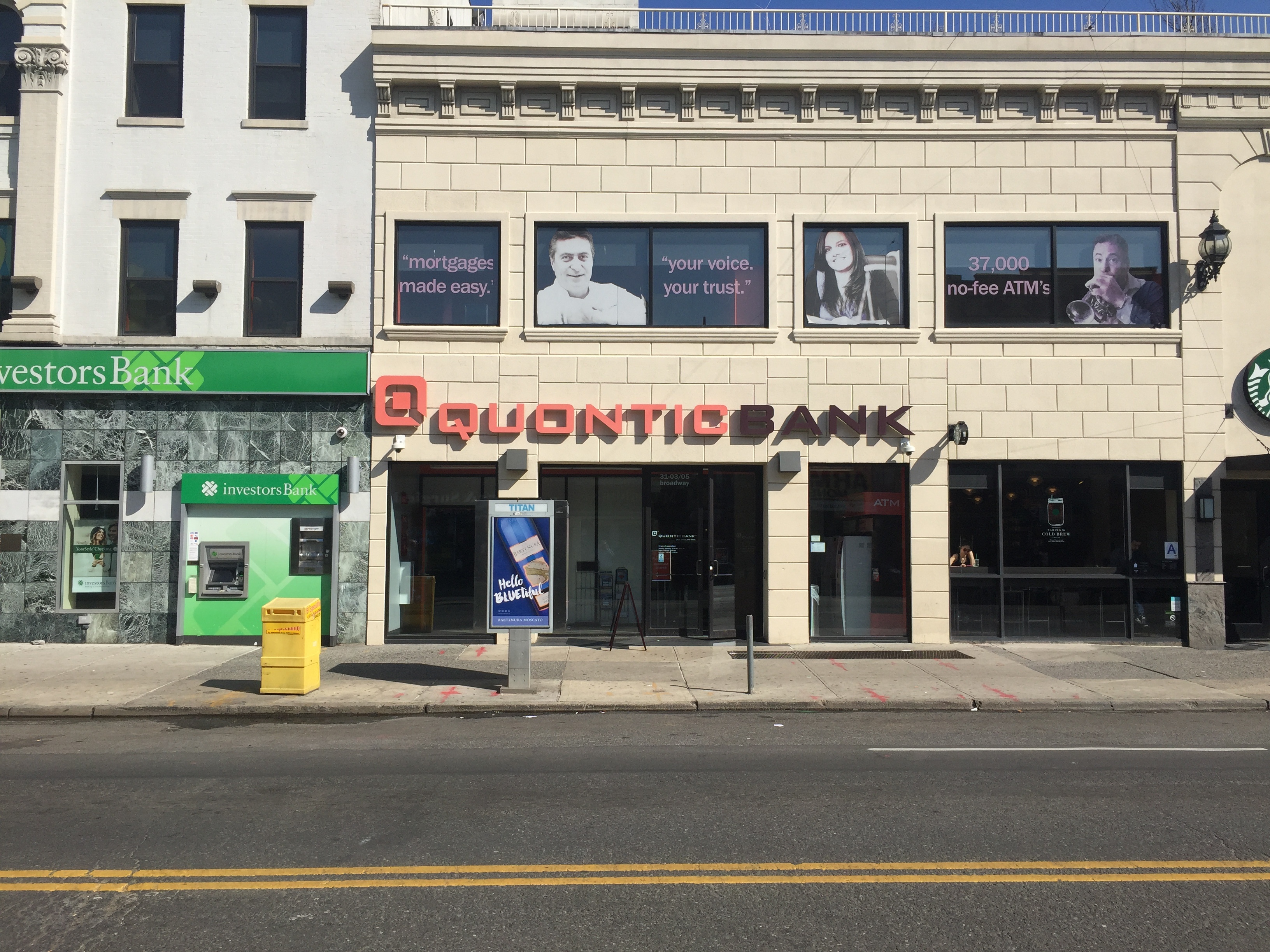
A digital bank can make its address seem almost beside the point. George Lazaridis’s story suggests otherwise. When his business partner Steven Schnall explained why Quontic had made its home in Astoria, he began with George. Lazaridis had lived there for most of his life. Schnall had worked with him before, visited the mortgage division he ran and enjoyed spending time there. Before the national footprint, there was a neighborhood someone knew.
It is a pleasingly concrete beginning for a business that would eventually live on screens across the country. Astoria offered shops, restaurants, customers and the Broadway subway stop. Lazaridis offered a connection to the place. The bank’s bright orange presence was difficult to overlook. Financial services can spend considerable money trying to acquire a personality; a conspicuous building beside the train at least gives the conversation somewhere to start.
A familiar face on Broadway
Schnall’s 2017 recollection places Lazaridis inside the decision about where the bank belonged. He described a longtime friend and business partner, someone whose earlier Astoria operation he had watched with affection. Quontic’s local identity therefore had a personal history behind it. The relationship between the two founders predated the name on the bank.
The neighborhood context matters because it gives the founding story people as well as premises. Schnall talked about small businesses and customers from many backgrounds. He pointed to the King of Falafel & Shawarma, whose owner had banked with Quontic while operating a single food truck outside the branch. This was Schnall’s example of the bank’s community, rather than a claim that Lazaridis personally arranged that customer’s financing. The distinction leaves the story both more modest and more useful.
The business before the bank
Quontic’s beginning in 2009 involved an existing institution. Schnall bought Golden First Bank, a troubled bank in Great Neck, New York, with $24 million in assets. He and Lazaridis subsequently gave it the Quontic name. The bank moved to Astoria. An acquisition supplies a charter and an operating business; it also supplies whatever needs attention. Lazaridis’s memory of the early condition was economical.
“The institution was in disarray.”
George Lazaridis, recalling the acquisition
“The challenge was to fix the mess,” he recalled. The plainness is refreshing. Founding stories often arrive dressed for an awards dinner. This one includes the repairs. A previous owner agreed to take on the institution’s bad loans as part of the deal, helping define what the new owners would inherit and what they would have to rebuild.
Lazaridis brought a mortgage career to that undertaking. His earlier employers included Cambridge Mortgage Group, Lyons Mortgage Services and Prospect Mortgage, previously The New York Mortgage Company. At Cambridge he worked as a group senior loan officer. At Lyons his responsibilities included recruiting and supervising lending staff. By the Prospect chapter, he was a senior vice president and branch manager overseeing 80 employees. The progression combined finding business with managing the people who delivered it.
A bank built by mortgage people
A colleague’s account makes that early business a little easier to picture. Joe Allen was looking for a mortgage company where he could build a career when a friend proposed introducing him to Lazaridis around 2009. Allen had worked in real estate, moved toward mortgage banking and wanted room to help create something. Quontic was just opening.
The friend described an institution designed by “mortgage guys” for loan officers. Allen’s recollection emphasizes products and borrowers whose circumstances called for more individual consideration. His account gives Lazaridis a place in another person’s working life: the introduction to a business that offered reasons to stay. Writing in 2021, Allen looked back on roughly a decade there. A hiring conversation can be brief; the consequences occupy rather more of the calendar.
Another loan officer, Steven Ho, wrote in 2020 about learning from the management group, naming Lazaridis alongside Schnall and Patrick Sells. Ho credited those leaders and the operations team with helping his development. These are colleagues’ accounts of their own experience. They show how the founders’ work reached the lending floor, where a bank’s ambitions have to become decisions someone can actually make.
The people behind the paperwork
Quontic received Community Development Financial Institution certification in 2015. Its stated lending mission includes creditworthy borrowers underserved by traditional channels, among them immigrants and small business owners. The bank offers mortgage approaches accommodating alternative income documentation. That is a particular operating choice with practical consequences for the people applying, and for the staff reviewing their applications.
A person’s finances can be more complicated than the neatness of a form suggests. The attraction of a lending business built around varied circumstances is easy to understand. Delivering it calls for procedures that survive beyond the enthusiasm of an individual loan officer. Someone has to establish what the bank will consider, train the team and maintain the discipline to apply its approach consistently.
Those responsibilities appear directly in Lazaridis’s remit. He sets portfolio lending guidelines and oversees the mortgage division’s daily activities. Staff training covers products, pricing, compliance, underwriting and closing procedures. The list is thoroughly unromantic. It is also the machinery through which a promise to consider a borrower becomes an operating practice. A bank’s choice of adjectives does little for an application waiting to be processed.
- Set the guidelinesDefine the bank’s portfolio lending approach.
- Prepare the teamTrain staff on products, pricing and compliance.
- Carry it throughOversee operations and closing procedures.
The chair gets heavier
By August 2022, Lazaridis was serving as interim CEO after Schnall’s death. A partnership that had helped determine the bank’s beginning had become part of its history. The institution still had employees, customers and decisions to make. Continuity, in that setting, meant carrying on with the obligations the founders had created together.
In August 2023, Quontic appointed Robert G. Russell Jr. as president, reporting to Lazaridis and the board. Russell arrived with experience as a bank CEO, chief operating officer and chief financial officer. His assigned responsibilities included the executive management group and data analytics, as well as helping define strategy and prepare the organization for continued growth.
Lazaridis linked the appointment to the bank’s commitment to its communities and employees after the loss of Schnall. The current executive roster lists Lazaridis as CEO and chief lending officer, with Russell as president. The arrangement adds another chapter to a career that began much closer to individual loans. A chief executive inherits a broader set of questions than a branch manager, even when the mortgage business remains central to the job.
The work that does not fit on a launch poster
The recent history includes regulatory correction. In October 2022, the Office of the Comptroller of the Currency issued a consent order against Quontic. It followed concerns addressed in a 2018 agreement and required changes across areas including oversight, capital and funds management. That chapter belongs in the story of an operating bank, alongside its expansion and its lending mission.
On July 16, 2026, Quontic announced that the OCC order had been terminated effective June 30. The bank described work on governance, risk management, compliance and operations. Lazaridis said the process had offered an opportunity to strengthen the institution’s foundation. His satisfaction was expressed in collective terms.
“I am incredibly proud of what we have accomplished together.”
George Lazaridis, July 2026
A separate action concerned Quontic Bank Acquisition Corp. and Quontic Bank Holdings Corp. The Federal Reserve announced on September 4, 2026, that its July 2023 written agreement with those companies had ended on September 2. The bank’s OCC order and the holding companies’ Federal Reserve agreement were distinct matters. Keeping their dates separate gives a clearer account of what changed during the year.
June 30 - OCC consent order termination takes effect.
September 2 - Federal Reserve holding-company agreement terminates.
Still a neighborhood question
The arc from Astoria to nationwide lending is tempting to tell entirely through scale. Lazaridis helped develop a mortgage network reaching all 50 states. Yet the more revealing thread may be the work that remains necessary as the map grows: choosing people, setting guidelines, maintaining an institution and dealing with its problems. The tasks change in size without becoming less particular.
There is a useful symmetry between the early recollection about fixing an acquired bank and the later account of strengthening its foundations. Neither episode can be reduced to a launch announcement. Both involve an existing institution, people depending on it and work that continues after a public milestone. For Lazaridis, the founding title sits beside an operating job.
Return, then, to the address. Schnall’s explanation for Astoria began with a partner who knew the neighborhood and had already built a business there. Years later, Quontic serves borrowers far beyond that subway stop. The origin still provides a human way into the story: two colleagues with a shared working history, a bank to put in order and a place one of them called home.
Follow the thread
- George Lazaridis at Quontic
- George Lazaridis on LinkedIn
- Steven Schnall on choosing Astoria
- The bank’s acquisition and early repairs
- Joe Allen’s career account
- Steven Ho on the lending team
- Rob Russell’s 2023 appointment
- The October 2022 OCC order
- Quontic’s July 2026 announcement
- The September 2026 Federal Reserve announcement