The first company name was a small act of alphabetical engineering. In 1978, Gene Anguil called his new venture A Energy Systems so it would sit near the front of the Milwaukee phone book. Search optimization once involved paper, ink and the good fortune of owning a surname that began with A. A friend soon improved the idea with a challenge: if Anguil was proud of the work, he should be willing to put his own name on it. Fortunately, the rebrand did not sacrifice directory position. Anguil Energy Systems was born, carrying both a marketing advantage and a personal obligation.
Anguil was 39, one year short of the deadline set by a business book he had read in college. The book offered three routes to the presidency of a firm before 40: climb to the top, buy a company or start one. He was then vice president of engineering at a solid-waste incinerator fabricator. The president, inconveniently for the plot, was in his early fifties and showed no urge to retire. Anguil had no money to buy a business. Option three was less a romantic leap than the only box left unticked.
What followed was a company devoted to machinery most people never see: thermal and catalytic oxidizers, filters, heat-recovery equipment and, later, industrial water-treatment systems. These are the large, practical contraptions installed beside production lines to keep volatile organic compounds, hazardous air pollutants, odors and other contaminants from traveling farther. They live where regulation meets physics and where environmental ambition must coexist with factory schedules. It is unglamorous terrain, which is often where useful engineering makes its home.
I. A return ticket to Rome
Before the factory roof, there was the night sky
Gene, known as Gino, was born in Rome on August 12, 1938. His father directed a bank. The family's life was overturned after Mussolini's racial laws excluded Jewish residents from employment. In 1940, the Anguil family left from Genoa and resettled in Jersey City, New Jersey. The boy who arrived in America took an early interest in drafting, woodworking and electrical trades. A math teacher named Miss Nadal noticed his ability. Beginning at 13, he skipped two grades.
At Stevens Institute of Technology in Hoboken, he studied mechanical engineering, served as vice president of his class and led his fraternity. He also met Brenda, his future wife. A National Defense Fellowship in mathematics took him to Virginia Polytechnic Institute, where he completed doctoral work short of defending the thesis. Then, in 1961, a Fulbright award returned him to his birthplace to study early computer science.
Rome gave the engineer an education that did not fit neatly on graph paper. Most of his Fulbright circle worked in poetry, music and the arts. Anguil later remembered living “a wonderful year with a great community of scholars.” Brenda joined him, and their first child was born there. He reconnected with relatives left behind before the war. The experience sharpened a conviction that would follow him into business: excellence travels farther when the person holding the idea can explain it.
Birth
Fulbright
Apollo work
Founder
Back in the United States, Anguil worked for two aerospace companies. He became the youngest section lead at the first. From 1968 to 1972, at General Motors' research and development operation in Oak Creek, Wisconsin, he worked as a project engineer on calculations connected to the Apollo program. The assignment involved the inertial measurement unit, the instrument that helped a spacecraft know its motion and orientation. His early software work examined changing weight, propulsion, trajectory and orbit in collaboration with GM's AC Electronics division and MIT's Draper Instrumentation Laboratory.
He later moved within GM from computation toward the sale of ideas, developing concepts for federal and industrial programs. One proposed automotive system tested a driver's cognition before allowing ignition, an early attempt to prevent impaired driving. The shift matters. Anguil was learning that the technically correct answer is only half a working solution. Someone must understand it, approve it, buy it and trust the people delivering it.
“Success was done step by step, developing relationships along the way and having the ability to communicate effectively and understand the needs of clients.”Gene Anguil, reflecting on the company's growth
II. The first order
A printer in Brooklyn and a principle with sharp edges
Anguil's first contract took him to a printing company in Brooklyn. During their meeting, the owner removed a revolver from his desk and placed it in a holster on his belt. It is not the sort of sales aid taught in engineering school. Anguil connected the episode to one of four principles he was defining for the young company: “never back down.” He did not mean recklessness. In his telling, the rule applied to the relationship, the problem and the challenge. Stay present when a job becomes awkward. Industrial equipment has a talent for making theory awkward.
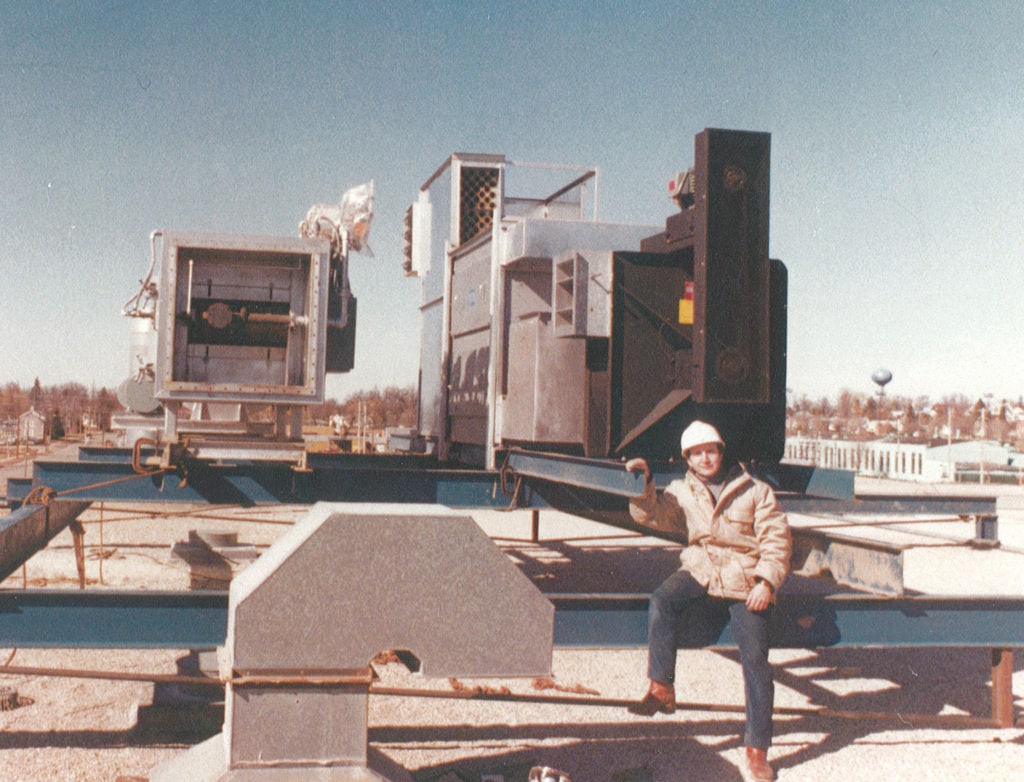
The first catalytic oxidizer order arrived in 1980. In 1987, the business became Anguil Environmental Systems. Annual sales crossed $1 million in 1989. The company installed its first regenerative thermal oxidizer in 1993, formed an Asian operation in 1994 and opened a United Kingdom office in 1995. Headquarters moved to Brown Deer, just north of Milwaukee, in 1996. A home enterprise had become an international supplier, but the sales proposition remained stubbornly local: here is your process, here is the contaminant, here is a machine designed for both.
Anguil also kept inventing. His 1990 patent describes a ceramic filter that collects material from an exhaust stream and cleans itself as a controlled flame moves across its surface. The method addresses an irritating industrial truth: the device that catches the dirt eventually becomes dirty. His 2004 patent turns heat from oxidized waste gases toward generating electric power. Both ideas treat pollution control as a system rather than a penalty box bolted onto the factory.
A filter that cleans itself
A ceramic construction removes particulate matter and uses directed heat to burn away collected organic material.
Waste heat put back to work
A power-generation system uses hot gases produced by oxidizing combustible waste.
This was the useful middle ground of Anguil's career. Factories needed to comply with environmental rules, but they also needed to keep producing. A design that consumed extravagant energy or demanded constant shutdowns would win applause in a brochure and enemies on the plant floor. Anguil framed the task in commercial as well as environmental terms: provide solutions today that help customers remain profitable tomorrow. The sentence is not lyrical. It has the sturdy proportions of a machine base.
III. A surname becomes plural
The family firm learns to outlast its founder's desk
Brenda was the company's first employee. Their children grew up with the business as a member of the household, the sort that could interrupt dinner without knocking. Chris Anguil joined in 1993 as an inside sales coordinator and eventually became president. Deb Anguil arrived by a less direct road, building experience in international sales and operations before becoming chief operating officer. In 2008, the company formally marked a transition to their leadership while Gene continued as chief executive.
There is an elegant tension in that arrangement. Founders can confuse continuity with permanent control; successors can confuse change with erasure. At Anguil, the roles separated. Chris led sales and marketing. Deb oversaw operations, installation, commissioning, service and aftermarket work. Gene's name remained on the company and his engineering habits in its vocabulary. The Small Business Administration recognized the transition in 2013 with its Jeffrey Butland family-business award for both Wisconsin and the Midwest region.
At the company's 40th-anniversary gathering in 2018, roughly 400 employees, former employees, partners, suppliers, sales representatives and friends were expected at Milwaukee's Discovery World. The date, August 12, also happened to be Gene's 80th birthday. He used the occasion to redirect attention. “It's important that we recognize the people and companies that helped us get where we are today,” he said, naming his wife as the first and arguably most important employee before crediting the other contributors.
A company name can begin as a claim. After enough years, it becomes a collection of other people's work.
That is the better meaning of the surname on the door. The enterprise is still family owned, but it is not family sized. Anguil reports thousands of installations across many industries, with operations spanning the United States, Asia and Europe. The company expanded into India in 2020 and, through Anguil Industrial, acquired Cincinnati-based Young & Bertke Air Systems in 2024. In a 2026 interview, Gene could look back at a business approaching its fiftieth year while his children carried the day-to-day authority.
His biography contains several tempting symbols: a child leaving Fascist Italy, a scholar returning to Rome, an engineer helping guide spacecraft, a founder cleaning the exhaust of earthbound industry. Yet the less cinematic details explain the endurance. A teacher noticed. A friend challenged a name. A spouse joined the payroll. Customers presented difficult streams and tighter deadlines. Children found different routes into the same firm. The career advanced by calculations and conversations, each depending on the other.
Gene Anguil still appears in the company's leadership as founder and CEO. He is also described as a tennis aficionado and former school board president, distinctions that suggest he likes both a rally and an agenda. The public version of his character is consistent: tireless, exacting about customer needs, reluctant to abandon a problem. Those traits can sound severe until one notices the recurring emphasis on community, from the Fulbright cohort in Rome to the suppliers and employees thanked in Milwaukee.
The industrial equipment business rarely supplies a perfect ending. A machine ships, starts, needs service, gets modified and eventually gives way to another process. The work is a chain of provisional answers. Anguil's contribution was to make persistence part of the product: keep solving, keep explaining, keep the relationship intact. In 1978, putting his name on the company was a wager on pride. Nearly five decades later, the more interesting fact is how many other names have gathered behind it.