Gaurav Ahuja had a question for David Petraeus. The first time they met, the former general had asked him to explain the business he was building: what was the big idea? Ahuja stumbled. Later, interviewing Petraeus, he returned to that small embarrassment. Why, he wanted to know, was explaining your own work so difficult?
It is a useful scene in the life of an investor. Here was someone accustomed to assessing other people's explanations, briefly struggling with his own. The pitch had crossed the table. Petraeus's answer was practical: ideas need repeated shaping, with other people helping to make them precise. An elegant sentence usually has some untidy work behind it.
Ahuja has made that work unusually public. He founded the investment firm Timeless in 2024 after seven years at Thrive Capital. He is also a cofounder and chairman of Imprint, the company that builds branded credit-card programs. Alongside those businesses, he conducts a series called The 100 Year Conversation. Its subject is endurance. Its guests have had enough time to discover that surviving and staying useful are separate accomplishments.
The founder before the fund
The Imprint story begins with a phone call in April 2020. Daragh Murphy was considering a fintech business, possibly one serving credit unions. Ahuja had heard good things about Murphy and had another proposal: a credit-card platform that would let consumer brands tailor rewards more precisely than older systems allowed.
The two talked on long walks through New York. They developed the idea into Imprint with Michael Pechman, another former Thrive employee. Murphy became CEO; Ahuja became chairman. Choosing the collaborator came before agreeing on the product. Their early discussions left room to change direction, which turned out to be useful.
The company initially pursued direct-to-consumer brands, including Glossier and Away, and struggled to find its fit. Regional businesses such as H-E-B and Westgate Resorts proved more promising. The familiar startup instruction to find your customer acquired a rather literal destination: the grocery store.
Ahuja's idea addressed something consumers already carried in their wallets. A branded card could deepen a customer's relationship with a business, provided the technology underneath it could do more than attach a logo. The opportunity lay in the machinery behind a routine purchase.
The business behind the reward
At Thrive, Ahuja worked across fintech and software. His early career had taken him through McKinsey and technology investing at TA Associates. He studied at the University of Michigan's Ross School of Business. By the time he appeared on the 2022 Forbes 30 Under 30 venture-capital list, he was combining investing with building Imprint.
That combination matters because a credit-card business has two audiences. A shopper wants a reward that makes sense. A merchant wants customers to return. Behind both sits a system that must record purchases, calculate benefits and support lending decisions. The visible product is small; the operational demands are considerable.
In December 2023, Ahuja appeared on ACQ2 to discuss Visa and the payments ecosystem. He had helped the hosts research their Visa episode. The conversation covered interchange fees, real-time payment systems, opportunities for startups and the durability of the Visa-Mastercard duopoly. These are the plumbing questions that determine what a payments company can actually build.
They also help explain his appeal as an interview guest: he had experience funding companies and working on one inside that system. A discussion about an established network gains texture when someone at the table has been trying to make a new business function around it.
A longer clock, with a credit limit
Imprint reached $70 million in revenue in 2024, up from $15 million the year before, according to its reported figures. Ahuja shared the growth publicly in March 2025 and invited people to join the company. His enthusiasm focused on the talent arriving as much as the revenue increasing.
The figures show a business gaining ground. They describe revenue, however, rather than profit. Building a lender requires capital and judgment as well as customers. A successful rewards program still has to account for whether borrowers repay what they owe.
Ahuja put that point plainly: “In lending, some deals are bad deals.” It is a compact corrective to the idea that growth solves everything. A company may need patience to develop; individual decisions still need scrutiny. Enthusiasm for a market cannot replace care over the obligations accumulating within it.
The distinction carries into his work at Timeless. An investor can choose to give a founder more time, but time remains something to use. Imprint gives the abstract language of long-term conviction a concrete setting: transactions, merchant relationships, repayment and the cost of funding the next stage.
What happens after year ten?
Timeless begins with a complaint about the clock. Its stated belief is that the usual five-to-ten-year venture-capital cycle can be poorly matched to the life of a company. The firm says it has been structured to hold its place on a company's cap table for longer.
That is a promise about the investor's behavior. Founders already have customers, employees and competitors imposing deadlines. A financing arrangement introduces another timetable. Ahuja's proposition is that the person providing capital should be able to stay beside a business as it develops.
The name sets a demanding test. Calling a firm Timeless does rather invite people to check back later. For now, its public work makes the intention legible: examine how durable companies were built, support founders and study the long preparation behind technological change.
There is judgment hidden inside the word patience. A founder might need another attempt, or a different product, or a hard decision made today. A long horizon leaves room for those decisions. The interviews Ahuja conducts keep returning to the question of how to tell which one is required.
The interviewer who remembers the configurator
With Michael Dell, Ahuja discussed access to capital, the pressures of public markets and the changing responsibilities of a growing company's CEO. During the conversation, Dell recalled the online tools that let customers customize computers. Ahuja remembered spending hours with the configurator as a child.
It is a pleasingly specific childhood recollection. Some children rearrange a bedroom. Others spend an afternoon deciding how much memory an imaginary computer ought to have. Here, the investor's interest in technology briefly reaches back to the experience of using it.
Ahuja also asked Dell about executives who can grow with a rapidly expanding company. The question treats leadership as a capacity that must develop alongside the organization. Dell's answer emphasized self-reflection, attracting talent and a shift toward strategy and allocating resources.
The conversation therefore travels from a child's encounter with a product to the adult task of keeping its maker effective. It is a good illustration of Ahuja's interests: the device matters, and so does the institution that continues producing the next one.
“I remember. I felt it when I was a child, spending hours on that configurator.”
Gaurav Ahuja, in conversation with Michael Dell
Giving the thesis a difficult guest
The 100 Year Conversation ranges beyond technology founders. Ahuja has interviewed Nicholas Thompson of The Atlantic, former General Motors CEO Dan Akerson, economist Tyler Cowen and Palo Alto Networks CEO Nikesh Arora. The range allows the same question to encounter different kinds of institutions.
Thompson discussed the economics of a publication whose history reaches back to 1857. Ahuja pressed him on difficult decisions in its turnaround, including the paywall. A long-lived magazine still has to persuade readers to pay for the next issue. Heritage can supply a reason to care; the business needs a working mechanism.
Cowen supplied a sharper challenge. Asked about his lasting impact, he rejected the premise, saying he cared about fruitful interactions and helping people now. In a project organized around endurance, that answer creates useful friction. The conversation leaves room for someone to question the value of the stated destination.
Akerson, meanwhile, described leadership in terms of improving a successor's chances. Put beside Cowen's answer, it introduces another way to think about duration: work can matter through what it enables other people to do. An institution's age becomes a less interesting measure than the opportunities it keeps creating.
A history you can leave on the desk
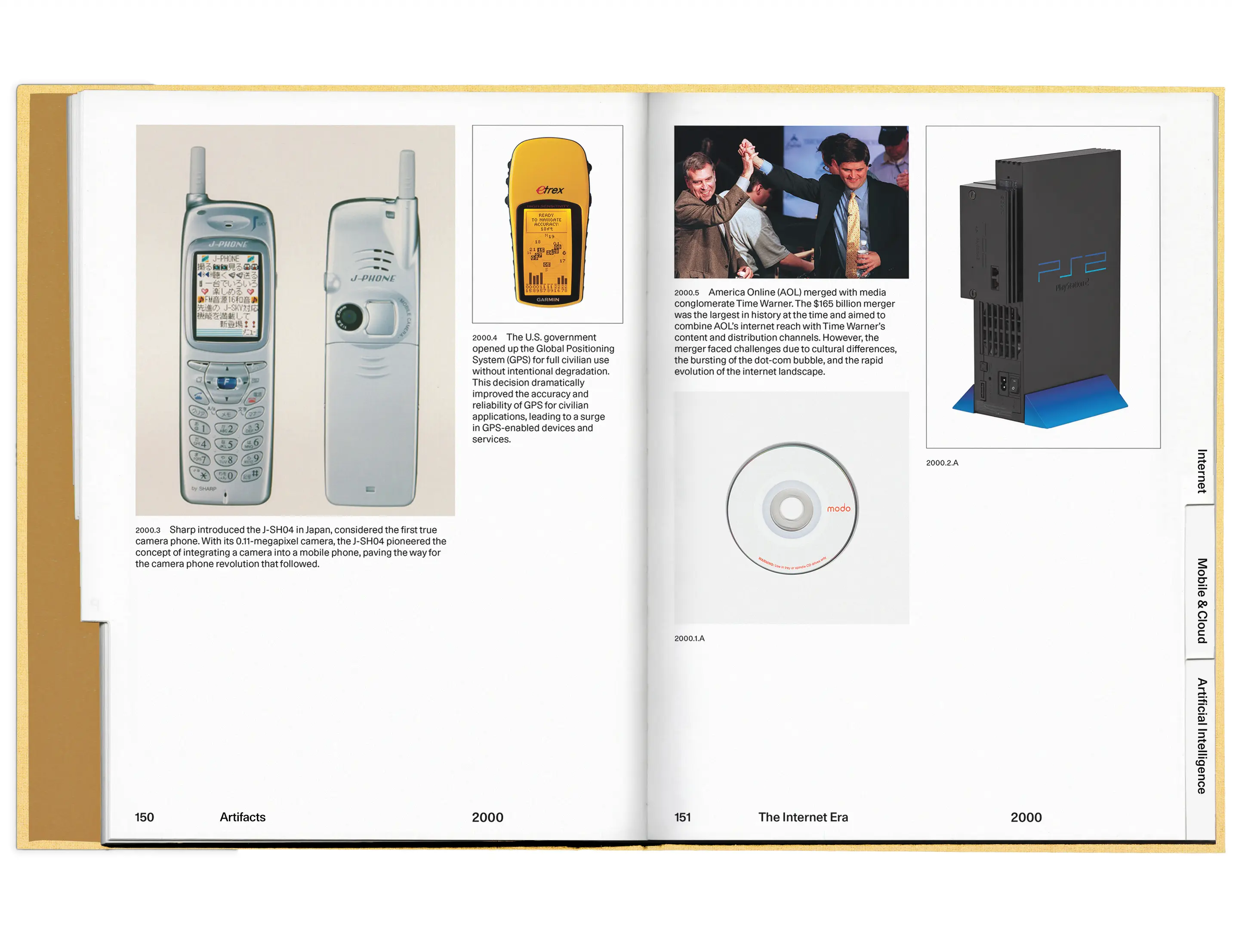
Timeless's research also became a book. Artifacts: A Visual History of Technology from 1965 to the Present grew out of an internal effort to collect the breakthroughs behind major companies. The published volume runs to 258 pages and organizes its material into five eras, from semiconductors through artificial intelligence.
The firm credits HSO with the design and Druckerei zu Altenburg with the printing. Those details are fitting for a project that makes technological history into a physical object. It asks the reader to turn pages and compare things that once represented unfamiliar possibilities.
A book is an interesting choice for an investment firm thinking about what comes next. Its pace permits a longer look. The argument offered by Timeless is that studying earlier developments helps it interpret the present. The volume gives that research a form other people can inspect.
The next attempt
In September 2026, Ahuja published his conversation with Notion cofounder Ivan Zhao. One question went directly to the problem facing a patient investor: how did Zhao distinguish an early product needing more time from an idea that simply was not working?
Zhao described confidence in what his team could build and the need to try again. Ahuja followed the account into finances, customer use and the evidence behind that confidence. The exchange makes endurance specific. Somebody has to decide whether another attempt deserves resources, and somebody has to make it better.
That question connects the founder who helped start Imprint with the investor who started Timeless. It also explains the value of the interviewer: he can ask people who have already made those decisions to describe what they saw at the time. A century is an impressive horizon. The useful part of the conversation is often the next decision.
Follow the conversations
Explore Timeless, its investment beliefs, Artifacts and The 100 Year Conversation. Find Ahuja on LinkedIn and X.
Listen to his ACQ2 payments interview; read about Imprint's early market shift and its credit-card business.