In New Orleans, a relationship is not a line in a database. It is a living thing. It remembers who showed up for the fundraiser, who returned a call during hurricane season, who introduced the museum director to the banker, and who knew that a coffee-roasting class would make unusually good Instagram. Gambel Communications has made a business from this peculiar local physics.
The firm is headquartered in Metairie, close enough to New Orleans that its client list reads like an index to the region: chambers of commerce, museums, hospitals, schools, environmental groups, retailers and public agencies. Betsie Gambel founded it in 2009. Amy Boyle Collins became chief executive in 2020. Around them is a boutique team selling the familiar inventory of a full-service PR agency - media relations, crisis counsel, executive communications, paid media, social strategy, influencer work, events and training.
But the interesting product is not the press release. It is proximity. Gambel calls its special competence connectedness. The word risks sounding soft until you watch it perform hard labor.
The mosquito problem was really a trust problem
Consider the St. Tammany Parish Mosquito Abatement District. Months of scrutiny over finances and operations had pushed the agency's actual purpose - preventing mosquito-borne disease - to the edge of public conversation. Then came a millage-renewal vote. The proposed rate was going down, from 4.2 mills to 2.95, but arithmetic was not the obstacle. Skepticism was.
Gambel's move was to stop treating the election as an election. The campaign centered transparency, scientific competence and value to taxpayers. Staff prepared leaders, rebuilt web messaging, produced plain-language fact sheets and FAQs, coordinated earned and paid media, used radio and direct mail, and put the district in front of homeowners associations and civic groups. The complicated institution became legible.
The renewal passed with 69 percent approval. Residents were projected to save about $4 million while dedicated mosquito-control funding continued. What changed minds was not a clever slogan. It was the sequence: acknowledge the controversy, explain the numbers, show the science, repeat the message through people and places that already carry credibility.
“We have built our business on relationships.”Betsie Gambel, founder
Small campaigns, sharp instruments
The same method gets pleasantly literal at Current Crop Roasting Shop on Magazine Street. The shop wanted more people in its coffee-roasting classes. Gambel did not spray product samples across the influencer economy. It researched local creators, ranked them by audience fit and budget, and set the modest cadence of two collaborations a month. Creators received a private tour, two class registrations, a fact sheet and room to film the tactile business of setup, roasting and cocktail making. Some got trackable discount codes.
Thirteen placements produced a potential reach of 340,000. Class registrations rose 10 percent. The useful idea here is not “hire influencers.” It is that an experience makes better media than an instruction. The creators were given something worth noticing, then enough information to notice it accurately.
The first thing to fail in another campaign was ordinary announcement coverage. Louisiana Children's Museum had hired Tifferney White as its new leader, but the appointment initially drew little local attention. Gambel reframed the task from “announce a CEO” to “introduce a person with a point of view.” A six-week media and community blitz tied White to early-learning access and the museum's educational purpose. Nine prominent stories reached an estimated 4.1 million people, a reported 1,500 percent increase in coverage.
A business built between sectors
Gambel's customers sit where public life gets messy: nonprofits that need donors, executives who need credibility, agencies explaining tax money, institutions recovering from disruption, and businesses that want attention without becoming obnoxious. The company makes money through retainers, projects, training, events, media management and strategic counsel. Private pricing is private, but public work offers scale markers. Records include a $40,000 Louisiana contract for a hurricane-preparedness communications playbook and a Jefferson Parish PR agreement capped at $50,000. School records show smaller communications-plan payments in roughly the $5,000 to $9,000 range.
One disclosed state contract covered a hurricane-preparedness master playbook for superintendents and principals. It is an example of scope, not a rate card.
This places Gambel between the solo consultant and the national agency network. It can assemble a dozen full-time specialists and outside partners, yet its pitch remains senior attention and regional fluency. The alternative is an in-house team or another Gulf South agency. Gambel's difference is the density of its overlap: commerce, philanthropy, public service and culture are not separate address books.
The office is part of the argument
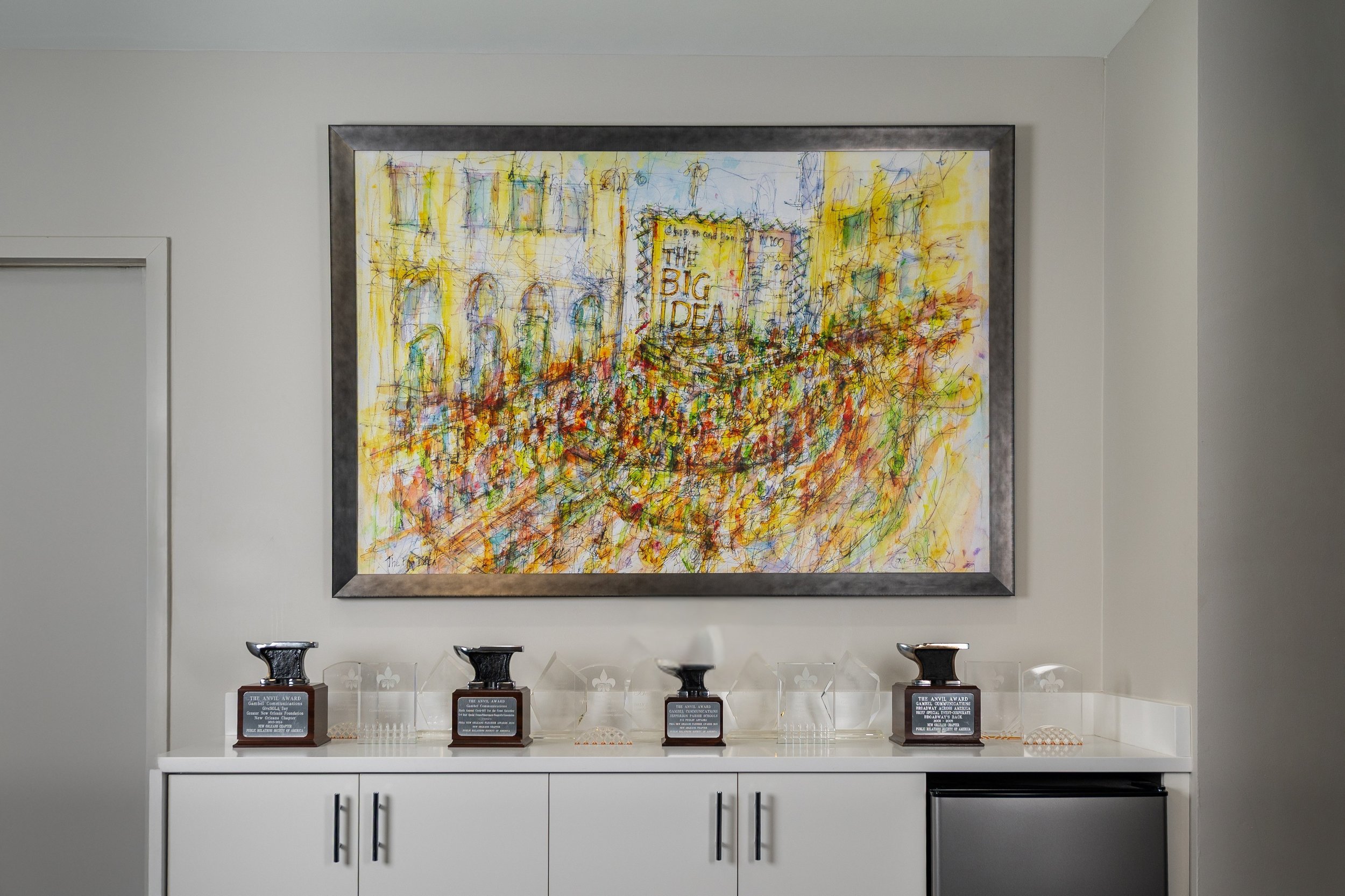
For years, nobody wanted to leave Gambel's 1,000-square-foot Metairie Road office, even after it became absurdly tight. Gambel and Collins once shared an office with the conference table. Sentiment delayed the obvious. In 2019, Gambel found a former swimming-pool business on Ridgelake Drive with an upstairs apartment and a two-story warehouse. The oddest part of the building became the reason to move.
Her architect brother saw that the warehouse could become a large, adaptable conference room. The completed headquarters, occupied in 2020, exceeds 3,000 square feet. The room can hold a class, a press conference, a Zoom meeting or, on one memorable occasion, a staff holiday tearoom. The next day it was back to being a press room. This is not decorative office trivia. A firm promising to convene a community built itself a place where the community could convene.
The repeatable part
Borrow the sequence, not the accent
A reader can copy the operating system. Start with the barrier beneath the brief. Build a stakeholder map before a media list. Equip credible messengers with language they can actually use. Give partners a moment, demonstration or experience worth sharing. Measure the vote, donation, registration or policy result instead of stopping at impressions.
What cannot be copied quickly is the accumulated trust. This approach weakens when a target audience sits outside the agency's network, when leaders refuse transparency, when the underlying service is poor, or when a client wants national scale from purely local relationships. Connections amplify substance; they cannot substitute for it. That may be the most bracing thing about Gambel's cheerful philosophy. Knowing the person who knows the person gets you into the room. You still have to bring something true.