A surgeon has several ways to destroy a troublesome patch of tissue. Heat it. Freeze it. Cut it out. Galvanize Therapeutics proposes a more curious intervention: deliver electrical pulses so brief that the main event is inside the cell, rather than a rise in temperature. The distinction sounds small until the target sits beside an airway, a blood vessel, or something else the physician would prefer to keep.
- What it sells: Aliya, a US-cleared system for surgical ablation of soft tissue, and delivery needles for two procedural routes.
- What it is studying: biological and immune effects of its pulsed electric fields; RheOx for chronic bronchitis symptoms.
- What is settled: Aliya has a soft tissue ablation clearance. A cancer treatment claim is a different, unproven proposition.
The company’s name suggests a single invention in a single garage. The history is more deliberate. Venture firm Apple Tree Partners incubated Gala Therapeutics, Galaxy Medical, and Galvanize Therapeutics as separate businesses. In 2022, the three were combined under the Galvanize name and paired with a $100 million Series B. The portfolio then spanned airway disease, cardiac arrhythmias, solid tumors, and potential drug delivery. A platform story was born, with the expense and difficulty of several clinical programs attached.
The pulse has to meet a procedure
Aliya is the immediate commercial argument. A generator sends short, high-voltage pulses through an electrode into tissue. The pulses disturb cell membranes and can bring about nonthermal cell death. Unlike a pharmaceutical, the product must earn its place in a physical workflow: a clinician must see the target, place a needle, deliver energy, and understand the resulting ablation zone.
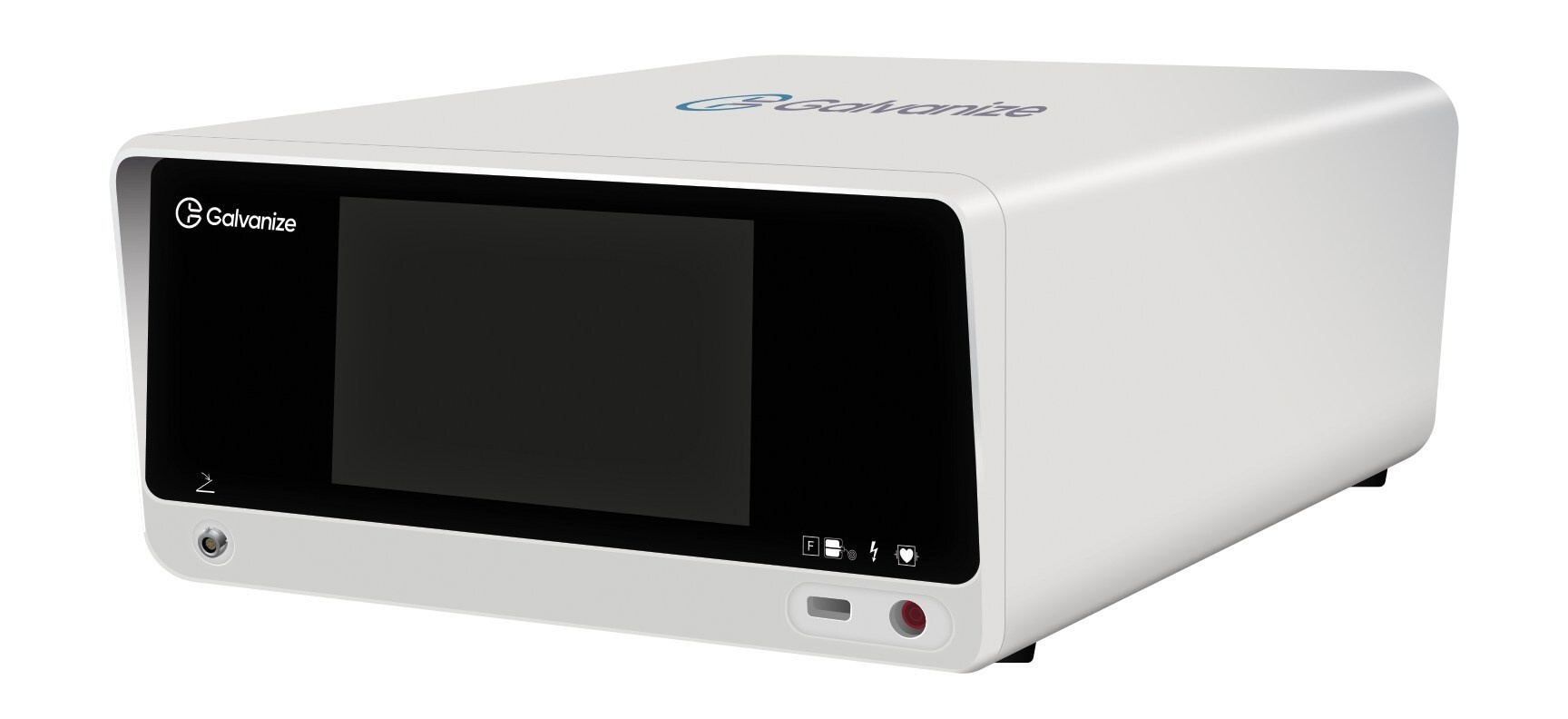
Galvanize offers a 19-gauge needle for a percutaneous route through the skin and a 21-gauge INUMI Flex needle for an endoscopic route through a scope. The latter is designed to fit a session in which biopsy, pathology confirmation, and ablation can occur under the same anesthetic. That is a meaningful kind of design: it respects the clock, the room, and the patient’s repeat visits. It is still a clinician’s decision whether the sequence fits a particular case.
Aliya EX, cleared in the United States in May 2026, added two energy settings. Galvanize announced its first commercial EX procedures that August. Its published specifications describe different ablation dimensions for the settings and needles. That sounds like a product manager’s detail until the desired treatment zone is too small for one target or too large for the anatomy nearby. Choosing the size of an effect is the business of a procedural device.
The most intriguing result is a question
Galvanize’s oncology research asks whether nonthermal ablation does more than remove cells locally. In a 2026 study of early-stage non-small cell lung cancer, investigators compared tissue and blood samples after Aliya ablation with samples from a biopsy-only group. They reported more ablated tumors containing tertiary lymphoid structures with germinal centers - organized immune cell neighborhoods - than in the comparison group. The figures were 47% and 24%.
Those figures describe an exploratory immune observation, not proof that a patient lived longer or a cancer was cured. The study was nonrandomized, and the original concurrent control group was small. Its value is that it makes a biological hypothesis more concrete. A physician can now ask whether the changed tissue environment matters to later therapy, and a trial can be designed to answer that question. The company’s device remains cleared for surgical ablation of soft tissue, without a claim to treat, cure, prevent, or mitigate a particular disease.
“What survives an ablation may be as scientifically interesting as what dies.”
The airway program takes the other road
RheOx applies the company’s pulsed-field thinking to chronic bronchitis, where excess mucus and cough can dominate daily life. It uses a bronchoscopic catheter and electrosurgical generator to target abnormal mucus-producing airway cells while aiming to preserve the surrounding tissue scaffold. Earlier studies and European commercial cases supplied experience. In the United States, RheOx remains investigational. Its future depends on clinical evidence and regulatory review, not on the fact that Aliya has a separate clearance.
This split is also an unusually clean view of medical device economics. Hospitals and specialist physicians are the customers and users of the commercial ablation equipment. A generator needs compatible procedure devices, training, service, and a reimbursement path. Galvanize offers patient-access and coding support. Public prices are not posted, so a hospital’s full adoption cost cannot be responsibly reduced to a number on this page. The business case is judged against familiar alternatives such as radiofrequency, microwave, and cryoablation, as well as other emerging pulsed-field devices.
A platform is only as useful as its next case
Founder Jonathan Waldstreicher brought a rare pairing of medical training and venture investment to the early business. Co-founder and chief medical officer William Krimsky brought interventional pulmonology. Doug Godshall, who led Shockwave Medical before its sale to Johnson & Johnson, became Galvanize’s chief executive in 2025. That handoff tells a familiar device-company story: invention gets the first procedure; execution has to get the hundredth and the thousandth.

The disclosed capital is substantial: a $100 million Series B alongside the 2022 combination, then a $100 million Series C led by Sofinnova Partners in September 2025. The later round was earmarked for commercial expansion and more clinical and development work. That is what this sort of progress costs in visible financing, before counting earlier funding or a hospital’s own time and equipment. The first things that had to change were organizational: three businesses became one, and later a new chief executive took over as the company pushed deeper into commercialization.
There is a useful lesson here for anyone building a technical product. Galvanize did not merely ask whether an electrical waveform could work. It built the access tools, mapped the procedural steps, sought a specific regulatory clearance, and then kept testing the larger biological claims separately. The approach would lose force where the target cannot be reached safely, the ablation zone cannot be controlled, studies fail to show a meaningful patient benefit, or hospitals cannot make the workflow and payment work. The clever pulse is a beginning. The case after it is the argument.