Gajen Kandiah’s father gave him a practical rule for getting through life: pay attention to the equipment you were issued. Two ears. Two eyes. One mouth. The proportions suggested a sensible division of labor. Listen, look, then speak. For someone who would spend his career explaining what technology could do next, it was a useful instruction to begin with.
Kandiah grew up in Sri Lanka during civil conflict and arrived in the United States as a teenager. He has described passing up college to help support his family, learning instead through manuals, questions and work. His account of those years connects urgency with empathy: circumstances could change abruptly, and the person across the table deserved to be heard. That is the personal history he brings to a business vocabulary usually crowded with platforms and quarterly targets.
A founder learns to join the pieces
His early career included Cambridge Technology Partners, where he became global vice president of Interactive Solutions. He then co-founded NerveWire, a management consulting and systems integration business acquired by Wipro. Those two activities belong together. Consulting asks what a business should change; systems integration requires somebody to make the change work with the machinery already installed.
It is a revealing apprenticeship for the career that followed. Kandiah repeatedly took responsibility for businesses whose value depended on assembling different kinds of expertise. Strategy needed delivery. Software needed industry knowledge. A promising idea needed an organization capable of selling it, supporting it and answering the telephone after installation.
He joined Cognizant in 2003. His assignments stretched across systems integration, testing, business process services and industry practices. Manufacturing, logistics, media and communications were among the areas he led. The range matters: the customer’s problem changed with the industry, even when the underlying technology looked familiar. A solution arrived carrying somebody else’s working habits, commercial pressures and existing systems.
At NerveWire, he served as chief operating officer during the firm’s beginnings, helping grow it from an idea into a profitable business with $50 million in revenue. Culture was part of his remit alongside growth. That pairing would reappear much later in his discussion of Rackspace: the people doing the work were part of what the customer was buying.
His business process services responsibilities at Cognizant also included developing automation and management offerings that combined technology with new delivery and commercial arrangements. He appeared at the MIT Sloan CIO Symposium in 2012. The language of business process services belongs to an earlier technology conversation, but the underlying assignment is familiar: change how work gets done, decide how to deliver it and make the economics hold together.
The strange usefulness of anthropology
By 2016, Kandiah was executive vice president and president of Cognizant’s Digital Business. The title sounds comfortably technical. Some of the people doing the work had rather different training. That December, he described the addition of more than 500 anthropologists and behavioral economists over six months to help companies think through how technology would change their businesses.
There is a pleasing disturbance in that detail. A company could commission another application and discover that its customers behaved exactly as before. Understanding those customers required observing people, including the inconvenient things people do when a neat diagram says they should do something else. The anthropologist had a place beside the engineer.
In 2017, Kandiah described a market moving beyond exploratory digital projects toward changes that mattered to a company’s operations and customers. He argued for involving the IT organization early and drawing on several disciplines. The executive who had learned by looking and listening was making room for professions built around those habits.
“Being digital also means being more human.”
Gajen Kandiah, 2017
His digital remit also involved acquisitions, including Softvision, Netcentric and Idea Couture. Software engineering, marketing technology and design brought different capabilities into the business. The practical challenge was to give customers something coherent rather than a shopping bag of newly purchased companies.
When he said goodbye to Cognizant in June 2019, Kandiah addressed Francisco D’Souza and his colleagues. He recalled beginning with Advanced Solutions and Testing, and singled out the opportunity to lead the digital pivot as especially rewarding. The farewell was affectionate, but specific about the work. It read like somebody remembering assignments rather than collecting titles.
Cognizant’s annual revenue rose from $368 million in 2003 to more than $16 billion in 2018, the endpoints he used in that farewell. That growth belonged to a large organization and its many employees. Kandiah’s place in it was substantial enough without handing him everybody else’s work: he helped build businesses inside a company that was itself changing scale.
Then the software met the railway
On July 13, 2020, he became chief executive of Hitachi Vantara. Toshiaki Tokunaga would remain chairman after the transition. Kandiah inherited a portfolio spanning storage, analytics, services and industry applications, within a group whose expertise extended into physical infrastructure. His job again involved bringing capabilities together, with a different set of consequences attached.
In Hitachi’s 2021 integrated report, he explained the attraction of joining: an opportunity to apply digital technology to society in more meaningful ways, alongside the challenge of helping transform Hitachi itself. The industrial setting gave the word “digital” some welcome weight. Trains and power systems have operating demands that persist long after a presentation ends.
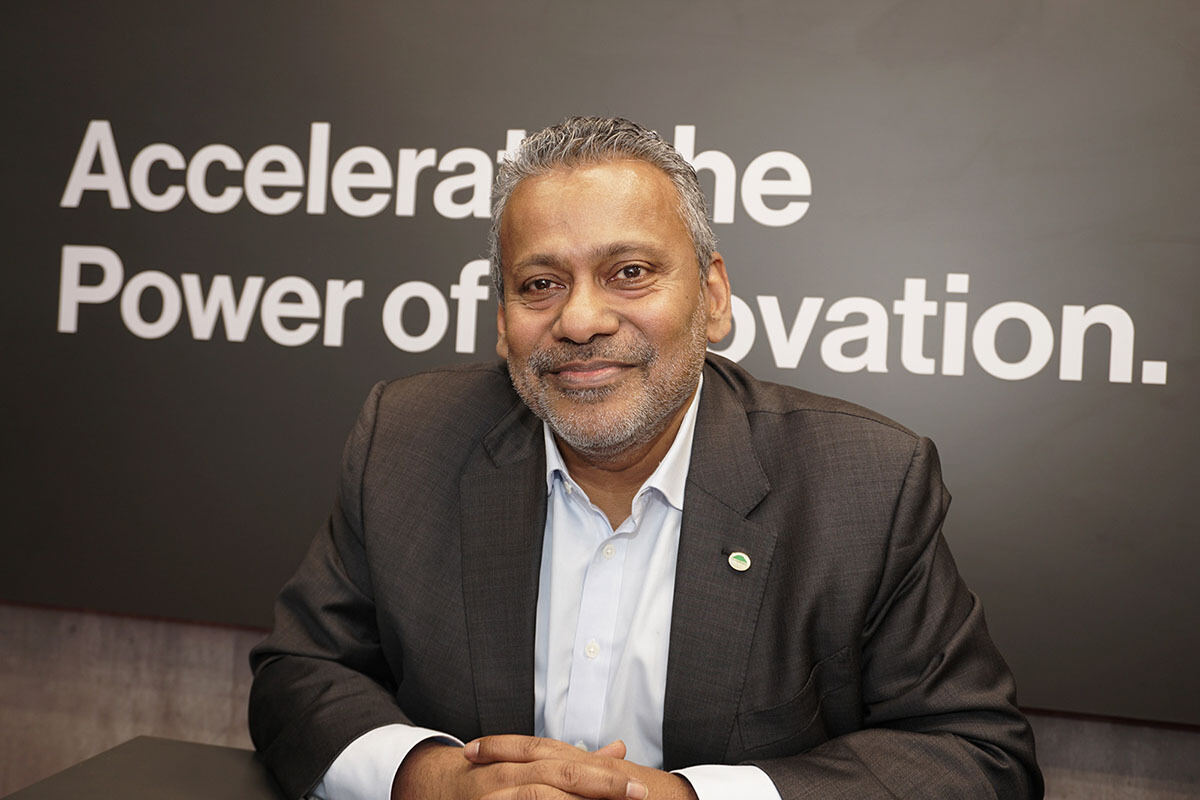
By the time of CES 2025, Kandiah was president and chief operating officer of Hitachi Digital. Hitachi’s exhibits included experiments with AI, augmented reality and industrial maintenance. In an interview around the event, he discussed the value of connecting the group’s technologies into proposals shaped around customers. A railway, for example, involved rolling stock, energy and digital operations working together.
That setting helps explain his continuing interest in the space between a successful experiment and a dependable service. A demonstration can be arranged around favorable conditions. An operating business must handle the rest of the week. Industrial customers bring that distinction into the room early.
Three principles, before the shopping list
In his Hitachi writing on AI, Kandiah set out three principles: define the desired outcome, build for the particular industry and data, and make responsibility and reliability part of the work. He described stalled pilots as a problem extending beyond technical choices. Buying tools came after deciding what the organization was trying to achieve.
Choose the outcome
Give the project a purpose that can be evaluated.
Fit the setting
Build around the industry and its data.
Earn reliability
Include responsible operation in the design.
He also helped make the learning process public. Hitachi’s “All Things AI” video series put him in conversation with researchers and industry figures. In a separate series introducing the company’s generative AI journey, he argued for sharing the decisions being made along the way. The approach gave an executive a job beyond announcing certainty: asking useful questions while the technology was still moving.
Another strand of his writing concerned sustainability. In April 2023, he described it as a continuing responsibility, requiring decisions attentive to the people who would live with their consequences. Read alongside his AI principles, the connection is clear: an organization remains responsible for what its technology consumes and produces after the launch has passed.
Rackspace, and the morning after installation
Kandiah became Rackspace Technology’s chief executive on September 3, 2025, succeeding Amar Maletira. The appointment brought his experience in services and industrial technology to a company operating customers’ cloud environments. His stated priorities included cloud management, private AI, partnerships and execution across sales, delivery and operations.
His emphasis on the company’s “Racker” culture was telling. A managed service depends on people accepting responsibility for other people’s systems. Rackspace’s AI strategy offered a new assignment for that existing relationship: help customers move into production across private, public and sovereign environments, then continue operating what had been built.
During 2026, that intention acquired concrete partners. A February agreement with Palantir was followed by a July operating framework combining Foundry and AIP with Rackspace infrastructure, engineers and managed services. Rackspace also committed to using those platforms across more than 70 percent of its own back-office operations through its OneOS program. The commitment described an internal deployment ambition, rather than proof that all of it had already happened.
In August, Chetan Gupta joined as chief AI officer after years in AI research at Hitachi. His remit covered strategy, research, governance and adoption. The appointment brought industrial AI experience into Kandiah’s team and gave the production argument an organizational home. In September, Rackspace announced membership of NVIDIA’s Cloud Partner Program and an architecture intended to combine Blackwell computing with Palantir software and governed operations.
The numbers still get a vote
The commercial test remains demanding. Rackspace reported second-quarter 2026 revenue of $670 million, compared with $666 million a year earlier. Private cloud grew while public cloud declined. Its net loss widened to $68 million from $55 million. These are the conditions in which Kandiah is trying to turn the AI strategy into a business.
Company results for the quarter ended June 30, 2026.
Those figures give his familiar insistence on outcomes a useful edge. Partnerships and infrastructure plans create obligations before they produce returns. The next judgment will come through customers choosing the service, deployments holding up and the economics improving. A career spent building new businesses supplies experience for that work; it supplies no exemption from it.
There is continuity in the path from NerveWire to this assignment. Kandiah has repeatedly worked where a company’s ambitions encounter its actual systems, customers and people. The names on the software change. The work of understanding the setting, bringing the right disciplines together and accepting responsibility keeps returning. His father’s arithmetic remains relevant: enough listening to understand the assignment, enough observation to notice what fails, and then something useful to say.
Keep reading. Keep listening.
- Rackspace: Gajen Kandiah
- Watch: Marketopolis conversation
- Early career and NerveWire
- 2019 Cognizant farewell
- Digital business and human behavior
- Cognizant’s anthropology investment
- Hitachi Vantara appointment
- 2021 Hitachi reflections
- CES 2025 interview and photograph
- His AI principles
- The generative AI journey
- All Things AI conversations
- Sustainability essay
- June 2025 personal interview
- Rackspace appointment
- Palantir operating framework
- Chief AI officer appointment
- NVIDIA announcement
- Second-quarter 2026 results