There is a revealing detail in Fruit Street’s diabetes-prevention program: you choose a day and a time. For a business built around apps, wireless scales, and remote care, this sounds almost comically ordinary. But the recurring appointment explains the company better than the gadgetry. Prevention becomes something on the calendar, with a registered dietitian and other people expecting to see you.
- A yearlong program built around 26 live group Zoom classes.
- Dietitian feedback, food photos, activity tracking, and connected scales.
- $600 posted annual self-pay price; $0 for eligible Medicare participants.
Fruit Street occupies the space between being told to change your habits and figuring out how to change them. Its central customers are people with prediabetes. Its commercial relationships include health plans and employers; clinicians can refer patients. The product is structured help before a risk becomes a diagnosis.
First, give the software a job
Laurence Girard founded Fruit Street in 2014. In a later podcast interview, he described volunteering in an emergency room while studying nutrition epidemiology. He began wondering about the conditions that brought patients through the door. An education nonprofit using video for tutoring supplied another piece of the idea: perhaps a useful conversation did not require everyone to travel.
“I just thought that we could do more on the prevention side,” Girard said.
The first business centered on telemedicine software for clinicians. A 2020 sponsored interview described three years spent developing the platform and searching for product-market fit. That is the early difficulty worth studying: useful capabilities still needed a sufficiently specific purpose. According to that account, advice from a Fitbit executive helped prompt the move into the CDC’s Diabetes Prevention Program in 2017.
The shift gave Fruit Street a defined population, curriculum, and goal. Rather than asking a practice to imagine uses for software, the company could offer a particular service. This is the copyable business lesson: sometimes the next useful feature is a narrower answer to the question, “Who is this for?”

The classroom comes home
The current program runs for 12 months and includes 26 one-hour Zoom sessions. Classes begin weekly, then become less frequent. A registered dietitian serves as lifestyle coach. Participants discuss eating, movement, sleep, and stress, with other people working through similar problems. The curriculum makes room for inconvenient realities: triggers, stalled weight loss, eating away from home, and starting again.
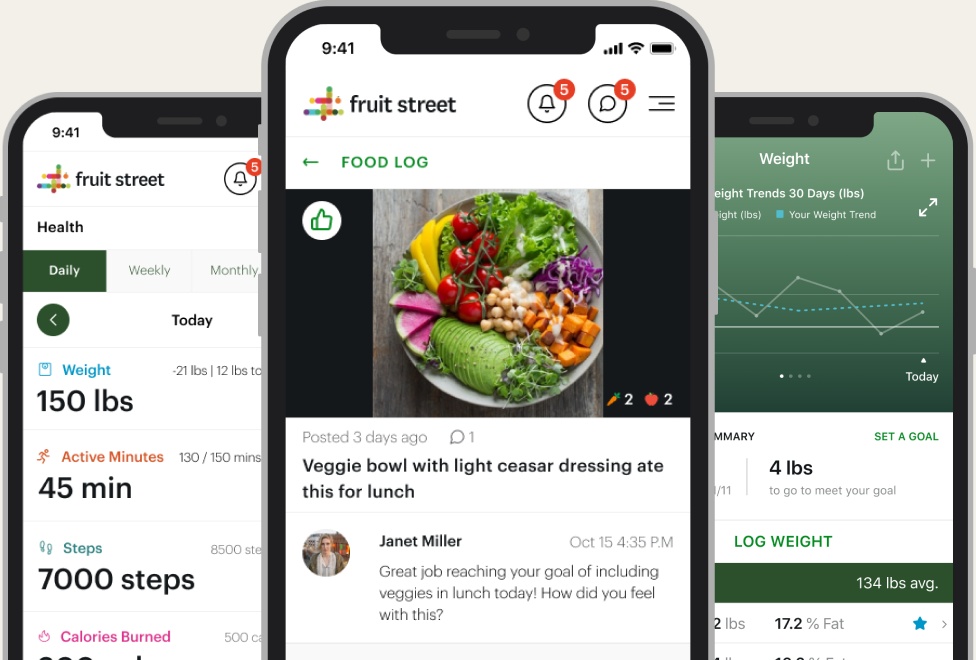
Between classes, the mobile app provides a place to record activity, share meal photographs, and message a coach. A compatible wireless scale can send weight readings into the record. The website describes purchasing a scale as optional. This is an ongoing service relationship, with devices supplying information for the conversation.
The human feedback is the interesting part. A food diary can document lunch without changing dinner. Here, the photograph can become a question for someone with nutrition expertise. The app supports continuity between appointments; the group gives participants a scheduled place to talk about what happened.
The big number needs its history
Diabetes-prevention marketing often reaches for a striking figure: 58%. In the original Diabetes Prevention Program research, lifestyle intervention lowered the incidence of type 2 diabetes by 58% compared with placebo over about three years. Among participants aged 60 and older, the reduction was 71%. These were results of the underlying research, rather than a trial of Fruit Street.
That distinction matters. Fruit Street delivers a version of an established intervention; the research supplies a reason to take prevention seriously. It does not promise that a particular participant will achieve the same result. The program’s goals include modest weight loss and increased physical activity, supported over time.
“I just thought that we could do more on the prevention side.”
Laurence Girard · Digital Health Transformers
Fruit Street’s position is therefore partly about delivery. The market includes other virtual prevention providers and local, in-person programs. Live dietitian-led group sessions are its central offer. Someone who values a scheduled discussion may find that appealing. Someone who cannot reliably join a video class may need another format. Removing the journey to class still leaves the work of attendance.
Who pays for showing up?
The pricing page currently lists $600 for a year paid upfront. It advertises no-cost participation for eligible Medicare patients. Fruit Street announced Medicare Diabetes Prevention Program supplier approval in October 2024. Medicare’s coverage has specific eligibility rules, so a prediabetes concern alone does not establish that a person qualifies.
In March 2026, Fruit Street announced a collaboration with Aetna Better Health of Illinois to offer eligible Medicaid members the program at no cost across all 102 Illinois counties. Aetna’s provider newsletter also describes the relationship. This gives the company a route through a health plan to people who may face barriers to preventive care.
The financing history has its own unusual constituency. In March 2020, Fruit Street said it had raised $17 million in total from more than 300 physicians, at a reported $55 million valuation. Those are historical company-reported figures. The attraction of physician investors was partly practical: medical knowledge could inform what the company built.
Advice has to survive Tuesday night
Fruit Street also advertises optional meals through ModifyHealth and a Labcorp testing partnership. An earlier, 2020 agreement with Purple Carrot paired nutrition advice with plant-based meal kits. These arrangements acknowledge a stubborn gap: understanding a recommendation and having dinner ready are separate problems.
The same gap explains the company’s limits. Video access, time for classes, and the ability to act on advice remain necessary. Coverage depends on eligibility and the payer. Group coaching cannot supply every form of medical care. Fruit Street’s useful proposition is concrete: a year of appointments, feedback, and practice for people trying to change daily habits before type 2 diabetes arrives.