The short version
- Frontline connects wildfire tracking software to custom roof, eave, facade, and perimeter sprinklers.
- It uses water and biodegradable Class A foam, with batteries plus WiFi, cellular, and satellite links as backups.
- In the 2025 Los Angeles fires, 59 of 61 Frontline-protected homes remained intact. Two did not.
- The system is custom-quoted and adds a recurring controller subscription; it complements hardening and defensible space rather than replacing them.
- The company now sells to homeowners, builders, insurers, and operators of commercial facilities.
The evacuation order contains a strange division of labor. People leave. Houses stay. The family grabs the photographs, medicine, dog, laptop, whatever will fit. The house gets no vote and no instructions. It simply waits for the smallest, hottest mail imaginable: a windblown ember slipping beneath a roof tile, into a vent, or against a wooden fence.
Frontline Wildfire Defense was built around that lonely interval. Its system watches wildfire data, alerts the owner, and can activate exterior sprinklers automatically when a tracked fire comes within seven miles. Roofs, eaves, landscaping, and perimeters are soaked with water and biodegradable Class A foam. If the grid fails, there is battery backup. If ordinary internet fails, there are cellular and satellite connections. The ambition is not to extinguish a forest fire. It is to make one particular property irritatingly difficult to ignite.
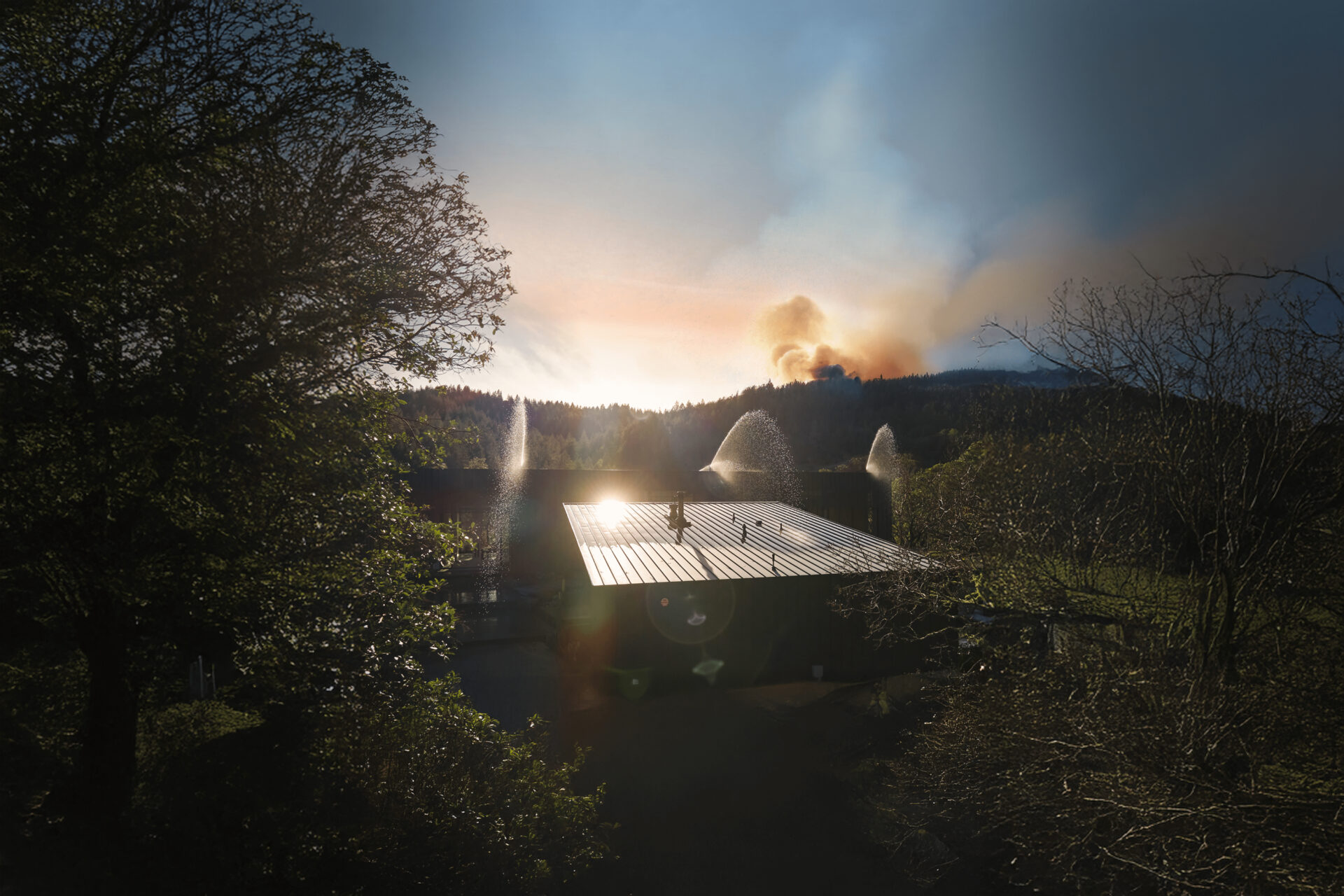
The tiny enemy
Harry Statter did not arrive at this idea through home automation. He studied landscape ecology at the University of Michigan, then ran Firewise Landscapes, managing roughly 50,000 acres of private forest in the Rocky Mountain region. Around 2010, he began asking the useful, slightly impolite question: why, exactly, do houses burn?
The cinematic answer is a wall of flame. The operational answer is often an ember. Wind can carry burning fragments well ahead of the fire front, where they collect in gutters, roof seams, vents, landscaping, outdoor furniture, and the small combustible transitions that architects rarely photograph. Once Statter centered the ember, the product changed. It would not chase the wildfire. It would prepare the surface the wildfire was about to visit.
He filed early patent work in 2012, gathered firefighters, engineers, and designers, and founded Frontline in 2017. The first system went into service near Jackson, Wyoming, in 2018. That same year, an early installation at Hoback Ranches faced the Roosevelt Fire. Frontline says the home survived while 55 of the subdivision's 150 homes were destroyed. It was a small data point with a large consequence: the system graduated from plausible plumbing to a company.
Three jobs, one nervous system
A plain roof sprinkler is a nozzle waiting for a person. Frontline's distinction is the nervous system around it. The company joins monitoring, activation, and sustained exterior defense into one loop.
See the fire
Tracking software, maps, alerts, and preparedness tools turn scattered incident data into a property-level warning.
Beat the ember
Zoned sprinklers hydrate roofs, eaves, vegetation, facades, and perimeters with water and Class A foam.
Stay online
Batteries and multiple connection paths keep control available after evacuation and during utility disruption.
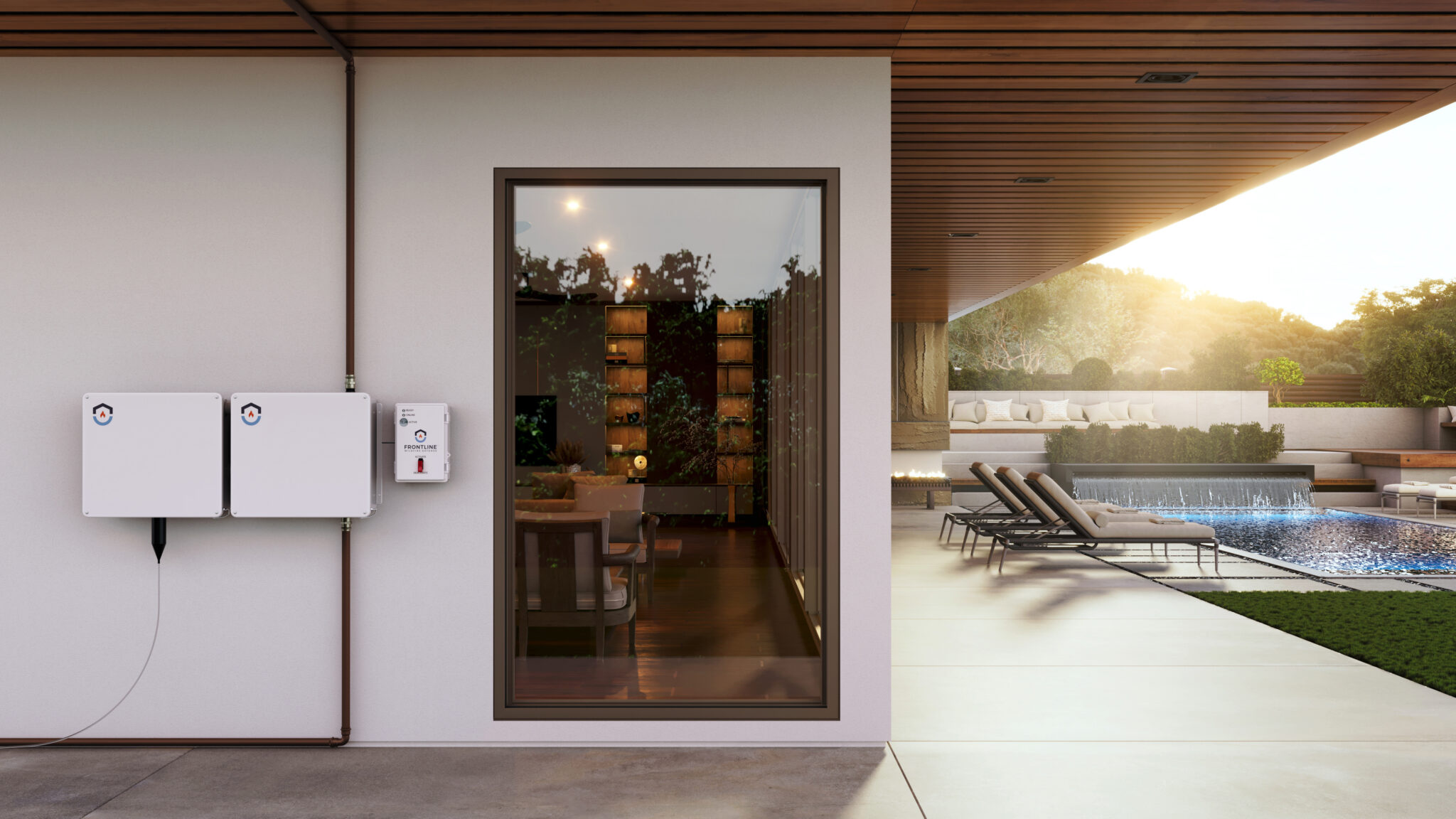
The hardware is purpose-built and discreetly installed, but it is not off-the-shelf. Frontline studies the structure, roof geometry, water supply, pressure, vegetation, and likely ignition points, then designs zones around the property. Its free app supplies alerts, fire maps, danger indexes, evacuation checklists, and emergency contact groups. Installed-system customers add remote controls, automatic tracking, firmware updates, and connected monitoring through an annual controller subscription.
Sixty-one houses meet Los Angeles
January 2025 supplied the test no product team would ask for. As the Los Angeles fires spread under violent Santa Ana winds, 61 properties with Frontline systems activated. Fifty-nine remained intact. The company describes some minor damage and notes that not every home stood inside the official burn perimeter, so this was not a controlled experiment. Still, the result gave Frontline a field record large enough to change the conversation.
The two losses are the most instructive part. Frontline attributes one to direct, sustained flame contact in a steep canyon. In the other, embers entered the interior. An exterior soaking system is designed primarily to prevent exterior ignition; it cannot make bad siting, an open window, vulnerable vents, or intense flame contact disappear.
Where the protection thins
Performance depends on site conditions, maintenance, water availability, power, and connectivity. A system may have batteries, satellite service, and auxiliary storage, but those redundancies still need to be designed, tested, and maintained. Direct flame, interior ember entry, insufficient water, or an unprotected outbuilding can exceed the design. Evacuation always comes first.
That candor makes the copyable lesson clearer. Wildfire protection is layered: clear fuels, harden vents and roofs, choose resistant materials, plan the evacuation, secure water, then add active exterior defense. Automation is useful precisely because the humans should be gone. It is not useful as an excuse for them to stay.
The price of a custom answer
Frontline quotes each property after assessing coverage, water, pressure, installation, and hazard. Financing is available. Connected monitoring and automatic features require an annual controller subscription, and optional annual system checkups cost extra; public materials say both vary by region and setup.
This model puts Frontline somewhere between a contractor, a hardware company, and a software service. The installation is a one-time capital purchase. The controller subscription supplies recurring revenue. Maintenance keeps technicians in the loop. A five-year limited warranty covers defects in parts and labor, while an optional annual visit checks firmware, connectivity, batteries, foam, flow, zones, and remote activation.
The buyers have widened accordingly. There are individual homeowners, but also architects and builders specifying protection before a house exists. There are wineries, summer camps, schools, municipalities, and risk managers. The Commercial Defense System, launched in 2026, scales the same logic across warehouses, data centers, healthcare campuses, resorts, and mixed-use properties. Interior sprinklers react after fire gets inside. Frontline's pitch is to make that moment less likely.
Fire-resistant roofs, vents, windows, and defensible space reduce the places an ember can win.
Fire departments and private response crews fight an active incident under scarce time and dangerous conditions.
Maps, cameras, alerts, and forecasts tell people what is happening and when to leave.
Frontline connects the warning to automated exterior action before ignition.
When mitigation becomes money
Frontline's most consequential sale may not be a sprinkler. It may be an argument an insurer can price. At Wayfare Station, a planned 151-home community in Santa Clarita, the number of willing insurers reportedly fell from seven to two and early premium estimates increased tenfold. Woodside Homes paused the project for more than a year. It later specified Frontline on every home, and construction resumed. Wildfire defense had moved from a safety upgrade into the arithmetic of whether housing could be built.
In May 2026, Frontline went further, partnering with California insurer Stand. Stand's model simulates how fire, wind, vegetation, moisture, and materials affect a specific home. For Frontline-equipped properties, the insurer says it has modeled risk reductions of up to 60 percent, potentially opening coverage and lowering premiums. The important word is modeled. But the idea is concrete: reward a house for becoming harder to lose.
That is also what attracted $48 million from Norwest in October 2025. By then, TIME had named Defense System 2 one of its Best Inventions of the year and reported roughly 2,000 installed homes across 12 Western states. Frontline had stopped looking like an elaborate sprinkler vendor. It looked like an infrastructure company for the wildland-urban interface.

Five things worth stealing
- Design around the ember. Seal and harden the small entry points before buying dramatic equipment.
- Make evacuation the constraint. Any active system should work remotely or automatically because people should not remain to operate it.
- Test the boring backups. Water, batteries, connectivity, valves, foam, and firmware fail more quietly than fire arrives.
- Protect the whole property. A dry fence, trailer, vehicle, or shrub can carry fire back to an otherwise hardened structure.
- Ask the insurer early. Documented mitigation can matter to coverage, project feasibility, and premiums, but recognition varies by carrier and location.
A Frontline system will not work everywhere. A remote site without adequate stored water may need expensive infrastructure. A complex campus may require substantial custom engineering. Direct flame exposure can overwhelm wet surfaces; an ember already inside is beyond the system's main line of defense. And a neglected system is a collection of hopeful pipes. The company itself says there is no guarantee against loss.
But the underlying insight travels well. A house in fire country should not be conceived as a precious object waiting to be rescued. It can be a participant - hardened, informed, supplied, and able to act while its people do the only sensible thing left to them: leave.