The Stanford Dorm Algorithm That Turned a Spin Bike Into a Rhythm Game
freebeat took the music algorithm two Stanford students built in a dorm, wired it into a $599 bike, and bet that people will exercise longer if the workout scores them like a video game. So far the bet is holding.
Every January, the exercise bike arrives. Every February, it becomes a coat rack. The connected-fitness industry has spent a decade and billions of dollars fighting that decay curve with celebrity instructors, louder classes and bigger screens. freebeat looked at the same problem and drew a different conclusion: the bike isn't hard to stick with because you lack discipline. It's hard to stick with because it's boring. So the company built a bike that keeps score.
freebeat is a direct-to-consumer fitness company that makes AI-powered smart indoor cycling bikes - the premium Lit Bike and the value-priced Boom Bike. The hook is deceptively simple. As you pedal, the bike tracks whether your cadence lands on the beat of the music. Hit the beat and you rack up combo points, an on-beat percentage and a score; a leaderboard populated with 3D avatars shows you where you stack up. It is closer in spirit to a rhythm game than to a spin class, and that is entirely the point.
01 / The originA music algorithm, not a bike
The unusual part of freebeat's story is where it starts. Before there was a bike, there was a music algorithm - code built by Stanford students to sync movement to sound. The company that grew around it, legally Stochastic Technology LLC, didn't set out to be a hardware brand. It set out to make a beat feel like something you could ride. The bike came later, as the delivery device for the algorithm.
That order of operations shows up in the product. Rivals treat music as a soundtrack playing behind an instructor. freebeat treats the music as the workout itself - the beat sets your target cadence, the choreography is generated around the track, and your score is a measure of how well you rode the song. The team assembled around that idea skews credential-heavy: alumni of Stanford, Wharton, UC Berkeley and the University of Toronto, with operators pulled from Apple, Microsoft, the NBA, Morgan Stanley and SoulCycle.
02 / The productTwo bikes, one loop
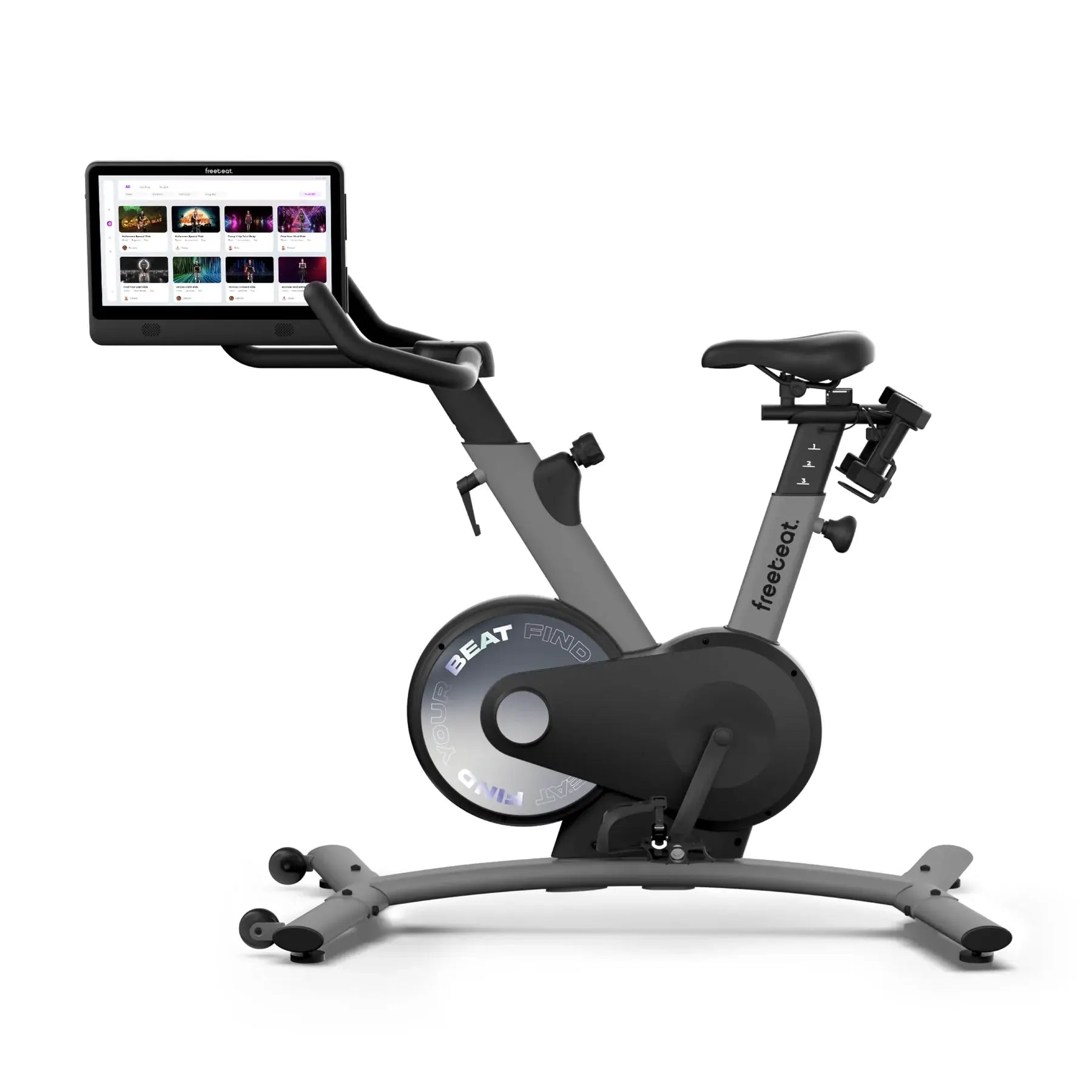
The lineup splits along price. The Lit Bike is the flagship: a 21.5-inch rotatable HD touchscreen, an Auto Resistance System that adjusts difficulty for you, and Smart Saddle Detection that knows when you're on the bike. It lists around $999, down from $1,799. The Boom Bike is the volume play - a 15.6-inch rotating touchscreen, magnetic auto-resistance and the same smart-saddle sensing at roughly $599, down from $1,299. A stripped-down Boom Bike Basic targets small apartments, and a Commercial Bike serves studios.
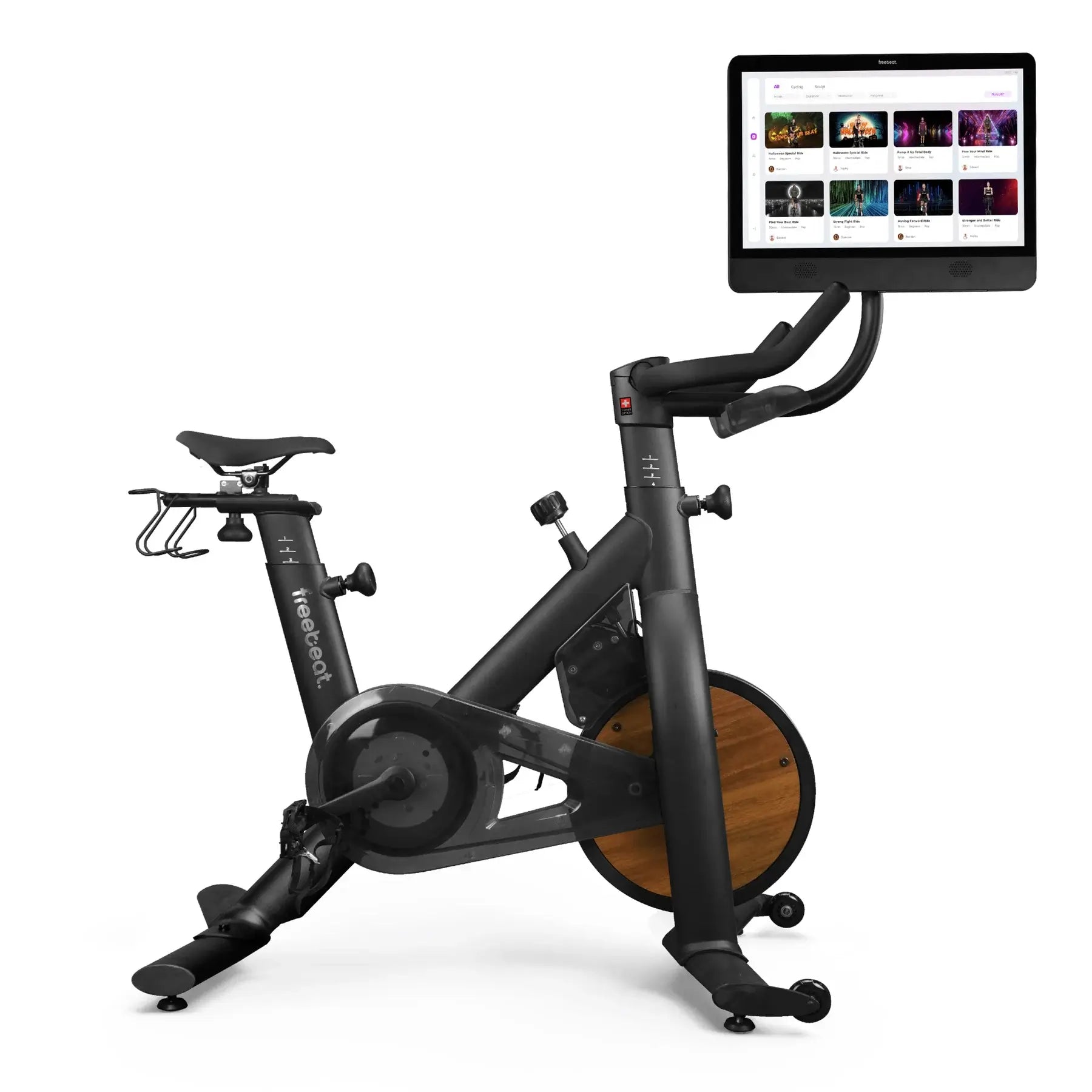
The rotating screen is a quiet tell about how freebeat thinks. Spin it away from the bike and the same class becomes a floor workout - HIIT, stretching, dumbbell work - so the hardware you paid for doesn't sit idle the moment you climb off the saddle. Underneath the ride sits a subscription of about $39 a month for classes, challenges, licensed Les Mills content and the AI features, with Klarna financing spreading the hardware cost over 24 months at 0% APR.
The retention loop - hardware gets you in the door; the game is why you come back.
03 / The AI turnA class built from your playlist
In April 2024 freebeat leaned into the part of its DNA it had always owned. It launched an AI platform that generates entire cycling, HIIT and stretching classes tailored to a user's own music - point it at a playlist and it choreographs a session around those tracks. The same release introduced custom AI instructor avatars: you design a coach, and the AI animates it to lead your class. It is the logical endpoint of a company that started as a music algorithm - the workout, the coaching and the soundtrack all generated on demand.
04 / The competitionAttacking Peloton from below
The connected-fitness field is crowded - Peloton, Echelon, NordicTrack's iFIT, and content-only players like Apple Fitness+. freebeat's wedge is not a better spec sheet; it's a different feeling at a lower price. Peloton built its brand on aspiration and instructor charisma, and priced accordingly. freebeat sells a game you happen to sweat through, and undercuts the incumbent by roughly half on hardware.
The trade-off is real and worth naming. freebeat is a small company - around 22 people, with estimated annual revenue near $3.1 million - going up against brands with sprawling class libraries, live studios and marketing budgets to match. Reviews reflect that: cyclists praise the addictive, gamified rides and the price, while some flag app performance and a shallower content back-catalog than the giants. The rhythm-game core is the reason to buy; it's also the reason freebeat can't be judged on class count alone.
05 / The money$20M and a lean bet
In August 2021 freebeat raised $20 million in strategic funding led by Susquehanna International Group (SIG) and GSR Ventures, with StartX and Edge Ventures also in the mix. SIG is notable here: it was an early backer of ByteDance, TikTok's parent - a fitting investor for a company whose whole thesis is that the right algorithm plus the right music can keep people engaged far longer than willpower can. In 2024 freebeat joined the Stanford StartX Spring Cohort, tightening its ties to the accelerator community that produced it.
The business model is the familiar connected-fitness two-parter - one-time hardware sales through a Shopify storefront, plus recurring subscription revenue - but run by a deliberately small team. That leanness is the bet. Rather than out-spend Peloton on studios and star instructors, freebeat is wagering that a genuinely different experience, generated cheaply by AI and priced for the mainstream, can win the customers the premium brands price out.
06 / What you can copyThe reframe, not the hardware
The transferable lesson here isn't "build a bike." It's the reframe. freebeat stopped selling fitness - a thing people know they should do and mostly don't - and started selling a game they want to replay. Same cardio, same machine, a completely different retention curve. Any product fighting the same February-coat-rack problem, where the hard part is not capability but the will to return, can borrow the move: make the boring-but-good behavior score points, put it on a leaderboard, and let an algorithm make tomorrow's session feel made-for-you.
Where would it not work? When the core activity can't be made intrinsically fun, or when your buyers genuinely want the premium, instructor-led, status-signaling version freebeat deliberately isn't. Gamification masks a boring task; it doesn't fix a broken one. And a small team leaning on AI-generated content has to keep that content good enough that the novelty doesn't wear off before the habit sets in. freebeat's whole company is a running test of whether it can.
freebeat - links & sources
- Websitefreebeatfit.com
- AI platformfreebeat.ai
- LinkedInfreebeat-live
- Instagram@freebeatfit
- X / Twitter@freebeat10
- Facebook/freebeatfit
- YouTube@freebeatfit
- TikTok@freebeatfit
- Funding news$20M round
- AI launchAI platform