It is 6:47 a.m. in a one-bedroom apartment in Brooklyn, and a screen on the wall is having opinions. The user, a 34-year-old who has not been inside a gym in three years, is mid-goblet squat. The screen counts the reps, draws a faint skeleton over the figure, and offers a small correction. Knees out. Chest up. Two more, and we go heavier. Nobody else is in the room. The coach, technically, is software.
That is Tempo, more or less. A San Francisco company selling a tall, slim console with a touchscreen, a set of smart weights, and a depth sensor that watches your form while you sweat into the rug. It is part hardware company, part subscription service, part computer vision lab. It is also the rare connected-fitness product that does not ask you to ride a bike, run on a belt, or look at yourself in a mirror you cannot avoid.
Strength training is intimidating, lonely, and easy to do wrong.
Walk into any commercial gym at 7 p.m. and you will see the same scene: rows of perfectly engineered machines, none of them being used correctly. The bench press with no spotter. The deadlift with the spine of a question mark. The squat that does not really descend. Personal trainers cost $80 an hour, on average, which means almost nobody outside of professional athletes and weddings actually has one.
This is the gap Tempo set out to fill. The pitch, as the founders have repeated through interviews, is unromantic: most people who try strength training quit, not because they lack motivation, but because they get hurt or they get bored. A trainer fixes both - if you can afford one, and find one, and tolerate small talk at six in the morning.
Two founders, one camera, a slightly mad idea.
Moawia Eldeeb is the kind of founder whose biography reads like a screenwriter pitched it. Born in Egypt, immigrated to New York, lost his family's apartment to a fire at 12, lived in a homeless shelter, was trained for free by a YMCA coach who took stay-in-school as payment, became a personal trainer himself, then put himself through Columbia studying computer science. With co-founder Josh Augustin, he started a company called SmartSpot in 2015 inside Y Combinator. The original idea was to put cameras in real gyms. The pivot - sell the cameras directly to the home - came later, and it was the right one.
The bet underneath the bet was that depth-sensing, the same family of technology that once shipped in Microsoft's Kinect, had gotten cheap and accurate enough to do something useful: not just see a person, but understand their movement in three dimensions, frame by frame. If you could do that, you could grade a squat. If you could grade a squat, you could coach one. And if you could coach one in a living room, you might just disrupt a gym.
Moawia Eldeeb · Josh Augustin
Eldeeb runs the company; Augustin co-built the early product. Both lifted weights before they wrote a single line of code for Tempo. The team grew from two people in a Y Combinator batch to roughly 220 today.
A gym you could lose to, hidden in a closet.
Tempo Studio is, physically, a 6-foot-7 monolith with a 42-inch vertical touchscreen, a column of integrated weight storage, and a 3D depth sensor that emits pulses of infrared light to map the human body in real time. There is no camera in the conventional sense. Tempo is at pains to say so - what gets streamed back is a wire-frame skeleton, not video of you in pajamas.
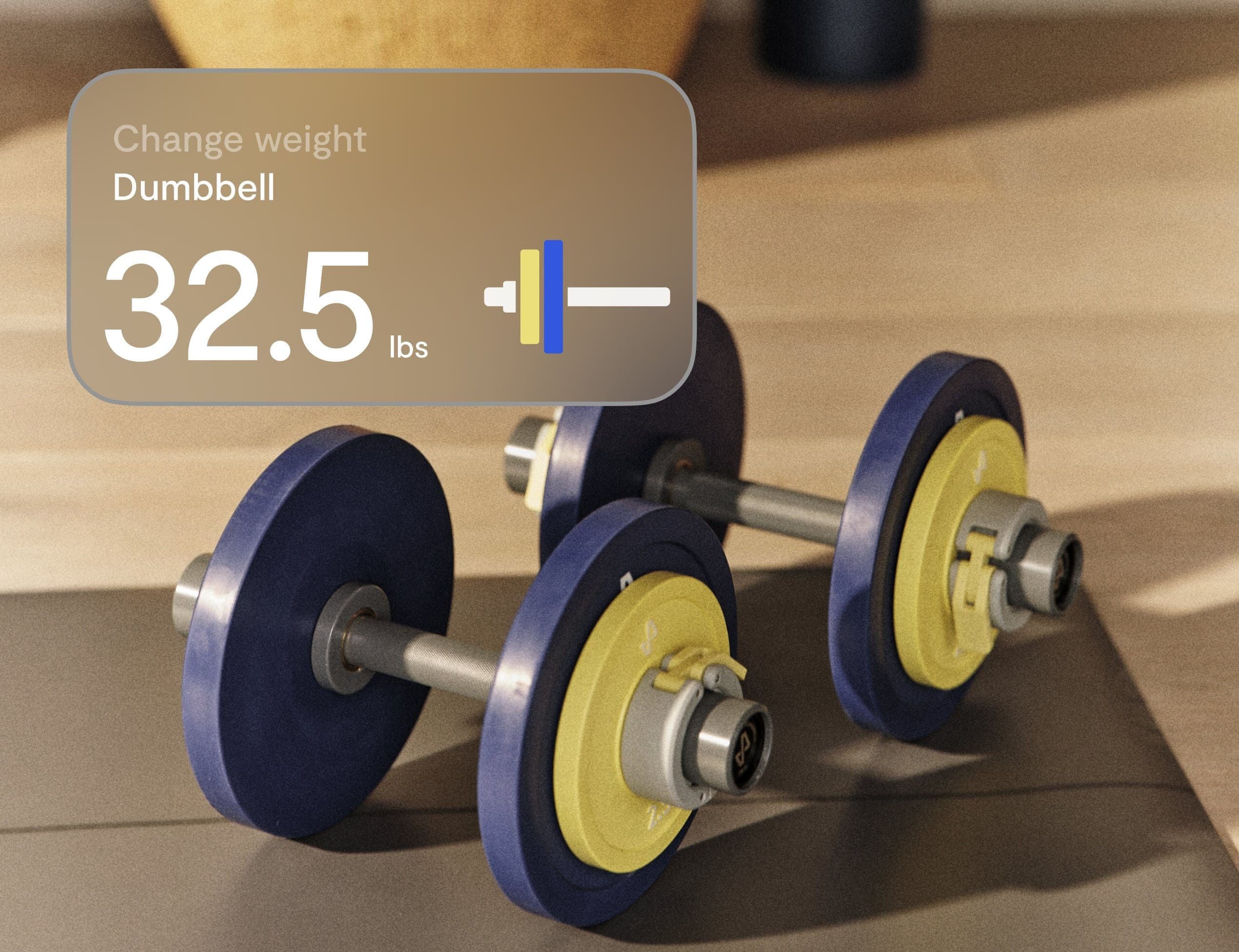
The hardware ships with smart dumbbells, plates with collars, and bands. The weights are color-coded - bright, almost cartoonish - because the AI uses computer vision to read them. Pick up the orange pair, the screen knows you went 15 pounds. Swap to the teal pair mid-set, and the screen knows that too. There is something quietly funny about a multi-hundred-million-dollar AI system reading colors off a dumbbell like a kindergartner, and it works.
On top of the hardware sits a $39-a-month subscription. Live classes, on-demand classes, strength programs, HIIT, mobility, recovery, the usual modern fitness catalog. The studio bundle starts at $2,495. The Pro tier, with 230 pounds of plates, a squat rack, a folding bench, and a kettlebell set, runs $3,995. The math, if you do it on a napkin, is that the Studio pays for itself versus a high-end gym membership in roughly two years and versus a personal trainer in about three months.
A Company in Six Bullet Points
The numbers, charted, with feeling.
Investors don't normally write $220 million checks for cardio equipment. They wrote one for Tempo in April 2021, with SoftBank leading and General Catalyst, Norwest, and Founders Fund along for the ride. Total funding stands above $316M. The valuation reportedly crossed $650M post-Series C. Estimated annual revenue sits around $15M, which is small next to the funding but consistent with a hardware-plus-subscription business model that is still scaling membership.
Funding by round, in millions
Make the trainer cheap. Make the gym kind.
Eldeeb tells the story of his first coach often, because it is the company's reason for existing. A free trainer at the local YMCA - one human being - changed his entire life, his physiology, and his odds. The thesis of Tempo is the unromantic version of that story: most people will never meet a coach like that. So build one, in software, and ship it.
This is the slightly subversive part of the company. The dominant aesthetic of fitness, for two decades, has been intimidation. Tempo's interface is closer to a cooking app. The voice in the speakers is encouraging, not military. The form corrections are specific and small. The product treats new lifters like new lifters, and lets advanced ones load 230 pounds. Strength training, but with the social anxiety stripped out.
Tempo's pitch, distilled
"We want to give everyone access to a personal trainer through AI - so strength training stops being intimidating and starts being personal." That is roughly the line they will say in any interview. They mean it.
Connected fitness got humbled. So did Tempo.
The pandemic gave home-fitness companies a hallucinatory two years. Peloton, Mirror, Tonal, Hydrow, iFit, Beachbody - every one of them raised at valuations that assumed the bedroom would replace the gym forever. The bedroom did not. In March 2022 Tempo cut roughly 10% of its staff, joining the rest of the category in a more sober era. The product kept shipping. The membership kept growing, more slowly. The bet is no longer on explosive growth but on a quieter thesis: that the AI loop - watch a lift, correct it, adapt the next set, adapt the next program - eventually becomes too useful to give up.
Interviews & product demos.
Back in Brooklyn, 6:47 a.m.
The user finishes the last set. The screen says nice work, not in a slick voice, just a normal one. It logs the volume, suggests the next session, asks if the knee is bothering anyone today. The phone on the counter buzzes with a calendar event. Coffee is starting to brew. There is a small puddle on the mat. The session took 38 minutes. Nobody was watched in any way that felt creepy. Nobody asked for a spotter.
Tempo is not the only company chasing this future, and it is not the largest. But it is the one most committed to the harder version of the problem: not cardio, not vibes - the actual mechanical correction of how a human moves under load. Whether the connected-fitness category recovers or not, that capability is going to live somewhere. Tempo has spent a decade and roughly $316 million making sure it lives in their living room first.
The coach, technically, is still software. But it is, finally, very good at its job.