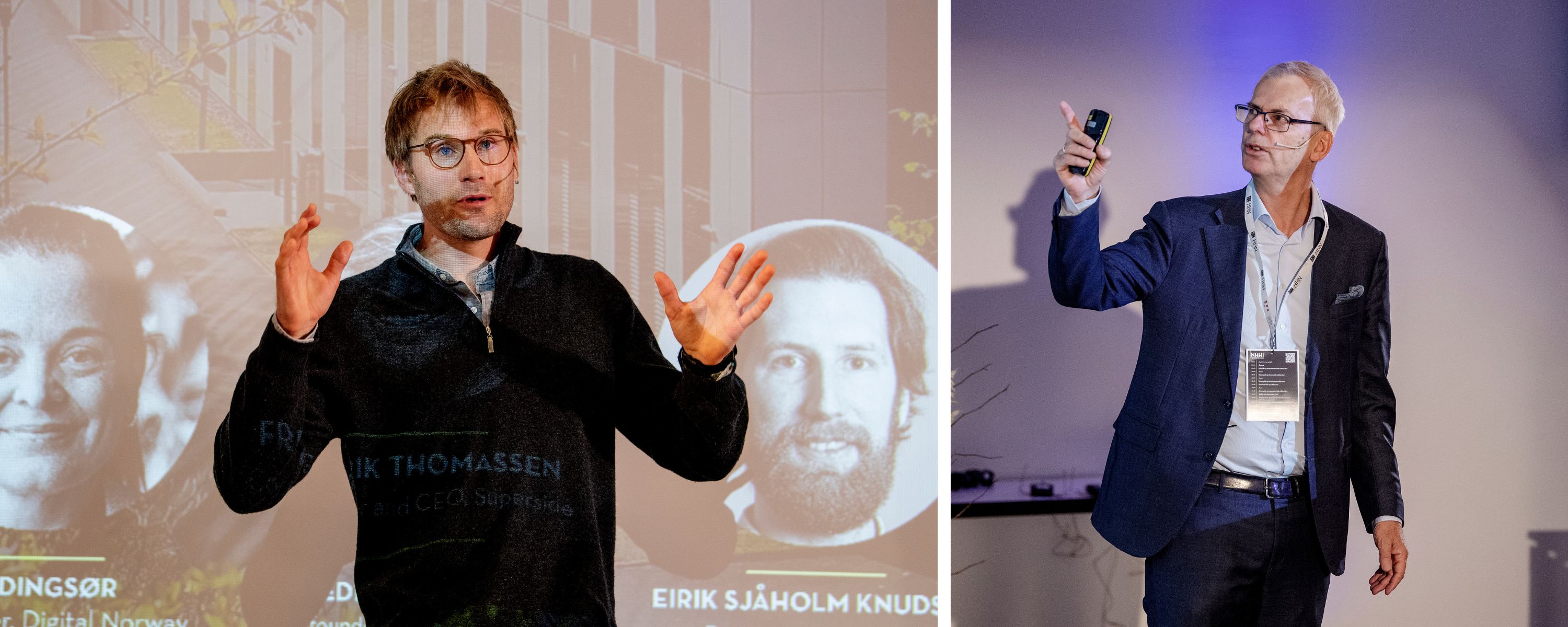
Fredrik Thomassen had gone to the cabin with his family and done something unusual: left his laptop at home. Then the bank became a problem. Superside had roughly 500 million Norwegian kroner at First Republic Bank, and its chief executive was worried about what would happen to the money. The weekend had acquired an agenda.
He worked the phones. Eventually, a bank employee in New York helped him buy government bonds with the deposited funds. Recounting the episode at the Norwegian School of Economics in 2023, he described a situation that had demanded action while the bank was offering reassurance. A company spread around the world could still find itself dependent on a single conversation.
The detail about the laptop is almost too obliging. Here was an advocate for work without geographic limits, briefly discovering that work could follow him quite efficiently. For Thomassen, freedom has always involved a fair amount of responsibility tagging along behind.
A better job, without the plane ticket
Before Superside, there was a newspaper, a consulting firm and an online fashion business. Thomassen worked as a journalist at Agderposten and a consultant at McKinsey. He studied at the Norwegian School of Economics and the London School of Economics. He also tried a PhD. The credentials offered several respectable directions; he kept looking for more independence.
Leading Zalora Indonesia gave that search a concrete subject. He worked with talented people whose location imposed a substantial discount on their opportunities. In his telling, the same person could earn dramatically more by moving to America. The skill had not changed. The market around it had.
“We wanted to create that magical teleport.”
Fredrik Thomassen, on connecting talent with opportunity
The metaphor made the ambition clear. A person should be able to reach international customers without first moving house. The commercial difficulty lay in making that connection dependable. Customers needed somebody to accept the brief, assemble the right people and deliver. A directory of names would leave plenty of work for everyone involved.
His consulting experience supplied another clue. McKinsey had internal creative support that could take work off consultants’ desks around the clock. Thomassen knew the relief of handing over a presentation to people equipped to improve it. He also knew how much time could disappear into finding and managing outside help.
That combination mattered: an argument about opportunity on one side, an irritating business chore on the other. The people buying the service did not have to subscribe to a theory of global employment. They needed their work finished properly. A useful company would have to satisfy both sides of the arrangement.
First came the orders
The business began in 2015 as Konsus. Its early operation was remarkably manual. A website promised services; the founders then scrambled to deliver them with people recruited online. One assignment involved measuring roofs on Google Maps for a British business assessing potential solar-panel customers. The future of work had briefly taken the form of looking at somebody else’s roof.
“We had absolutely no tech,” Thomassen later recalled. The breadth of the service created its own difficulties. Data entry, websites and creative work required different skills and different ways of managing delivery. Eventually, the company concentrated on design and subscriptions. He places the decisive shift around late 2018, after more than three years of searching for a model that worked.
Konsus begins
Broad business tasks
Y Combinator
Winter batch
A narrower focus
Design + subscriptions
Brand Brain
Context across projects
Getting into Y Combinator had given the young company access to a different business culture. The founders’ application described a curated freelancer service with project managers handling orders and checking quality. They were bringing an answer to a familiar complaint: hiring help could become another job.
That application also recorded a longer friendship. Thomassen and Sondre Rasch had met on their first day as undergraduates, years before they applied. Their shared projects had included economics articles, conferences, parties and trips. A startup adds financial pressure to a friendship; at least these two had some experience of making things happen together.
At the accelerator, Sam Altman and Geoff Ralston were their group partners. The founders’ account of the experience includes an early lesson in brevity: their carefully prepared explanation of the business was still too long. They shortened it. A company could be complicated to operate and still owe a stranger a plain answer about what it did.
The lesson extended beyond the pitch. Early questions about pricing and automation gave way to attention to the product and its customers. There is an appealing economy to that advice, particularly for people capable of turning any decision into a research project. The company needed more evidence from use, and fewer dials adjusted in anticipation.
The boss has to be wrong sometimes
Superside’s current Y Combinator profile describes more than 800 people across over 70 countries, working through a subscription that combines creative specialists, AI workflows and its Superspace platform. Amazon, Microsoft, Reddit, DoorDash and Intuit appear among its customers. Those company-reported figures describe an operation far removed from the founders finding people to fill individual orders.
Current company description on Y Combinator · Figures describe Superside, not personal wealth.
Managing that distance requires more than a reliable calendar invitation. Thomassen repeatedly returns to kindness, truth-seeking and speed. Each puts a different demand on the others. Fast decisions become expensive if nobody can question the premise. Courtesy offers little help if everyone politely avoids the problem.
He has argued that kindness makes disagreement possible. An aggressive culture can proclaim its love of truth while teaching employees to keep unwelcome observations to themselves. The leader receives a pleasingly smooth account of events, and the actual difficulty carries on elsewhere.
“But being kind should be the aspiration,” he wrote publicly. He included himself among the people who cannot manage it perfectly all the time. That qualification makes the value more usable. It asks for effort and correction rather than requiring colleagues to pretend that impatience has been abolished.
His argument about hiring follows the same concern with what gets overlooked. A conventional résumé and interview can reward a familiar background or an accomplished performance in conversation. Superside has worked on structured assessments of skills and values. For a company seeking talent across borders, the method of recognizing ability is part of the business itself.
He also wants managers to help when needed, removing obstacles that stop others doing their work. His phrase “speed is safety” expresses the urgency behind that approach. Waiting carries a cost of its own. A team can spend so long avoiding a possible mistake that it misses the chance to learn something useful.
The borrowed playbook goes back on the shelf
Thomassen has become more willing to discard advice that fails in practice. Superside tried objectives and key results, the management framework commonly shortened to OKRs. He found that it generated bureaucracy and encouraged people to construct measures that would present their performance favorably at the end of a quarter.
The company moved toward sharing its biggest problems instead. The change suited his developing confidence in his own judgment. A system admired elsewhere still had to earn its place at Superside. Otherwise, the team could become highly competent at maintaining the system.
He described this shift in 2025 alongside another admission: becoming a better CEO required deliberate work on himself, including executive coaching. Independence had brought him the authority to choose. Experience was teaching him to inspect the choices, including the ones he had borrowed from apparently successful people.
Leave room for the forest
For someone running a creative business, Thomassen has a useful suspicion of excessive direction. When Superside undertook a rebrand, he looked into architecture and spoke with architects about the client’s role. How much instruction helps a commissioned work, and when does the instruction begin to suffocate it?
He gave the creative team room to decide. They asked about his preferences, and his affection for nature, particularly old forests, entered the work. It was a personal contribution with some restraint attached. He could supply an interest without personally choosing every leaf.
The interest extends beyond branding. He has spoken about restoring ancient forests in Europe. There is a pleasant distance between the patience of a forest and the urgency of a service business. A person can care about both without making them illustrate the same management principle.
He is similarly direct about the tradeoffs of building a company. He describes working through much of the time he is not with his family, and objects to presenting entrepreneurship as an effortless exercise in balance. The admission belongs beside his talk of freedom. Choosing the work does not make it small.
A brief that remembers
His newer experiments concern how AI changes the work itself. Thomassen favors giving creative people room to concentrate independently. He has questioned the assumption that strong creative work must emerge from a group gathered in a room. A remote company has good reason to take individual concentration seriously.
AI adds another way to reorganize the process. Superside has used it to help customers prepare briefs and to support production. Thomassen has emphasized keeping up with changing tools and passing efficiency gains to customers. The question becomes quite practical: what can a team produce with the time and budget available?
In March 2026, Superside introduced an updated Superspace built around Brand Brain. The system carries guidelines, earlier decisions and feedback into subsequent projects. AI agents use that context in briefing and creation; creative experts contribute judgment and execution. The promised improvement is cumulative: less explaining the same brand again from the beginning.
It is a recognizable next problem for a founder who started by connecting people. Once the people can work together across an ocean, they still need to understand one another. A good brief, a remembered preference and permission to question the boss are modest things. Thomassen’s career has repeatedly returned to how much work depends on getting them right.
Keep the conversation going
- Superside ↗Company website
- Fredrik on LinkedIn ↗Public writing and professional profile
- Fredrik on X ↗@f_thomassen
- The early days of Superside ↗Antler · September 2022
- Thinking for yourself as CEO ↗Not Another CEO · February 2025
- Watch: the AI creative future ↗Lead the Team · YouTube
- The conversation about global work ↗This Anthro Life
- The cabin and the bank ↗NHH · June 2023 · Norwegian
- Inside Brand Brain ↗Superside · March 2026
- How the founders got into YC ↗Superside · September 2016