The app your half-million-dollar house never had. "Shopify for Homebuilders," bringing the buying and owning of a new home online.
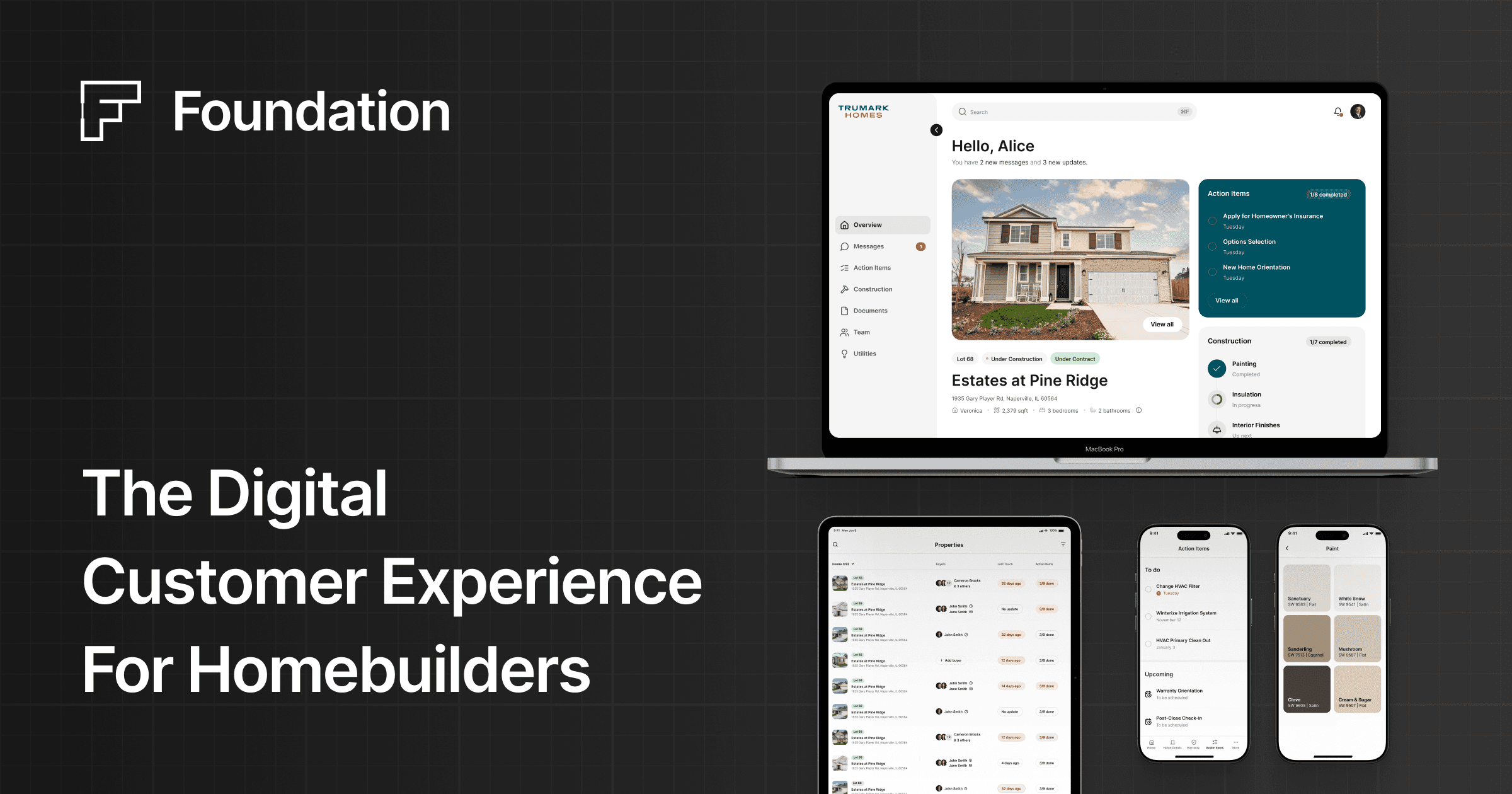
The pitch fits on one screen: a homeowner named Alice, a house called Estates at Pine Ridge, and every milestone in her pocket. This is the interface Foundation thinks the biggest purchase of your life deserves.
Here is a fact that Foundation likes to point out, because it is both true and slightly embarrassing for the entire homebuilding industry: you can watch a twelve-dollar pizza travel from the oven to your doorstep on a live map, complete with a little animated scooter, but the half-million-dollar home you just agreed to buy comes with a three-ring binder and a phone number that goes to voicemail. One of these purchases has better software than the other, and it is not the one with the four bedrooms.
Foundation is a company that decided this was a solvable problem. Its self-description - "Shopify for Homebuilders" - is the kind of pitch-deck shorthand that usually means nothing, but here it is closer to accurate than most. Shopify handed every small merchant the storefront technology that used to belong only to Amazon. Foundation is trying to hand every regional and local homebuilder the digital buyer experience that, until recently, only the largest national builders could afford to build in-house. Same idea. Considerably higher price per transaction.
The company was founded in 2023 and went through Y Combinator's Summer 2023 batch. Its founders did not arrive at homebuilding by accident. They met at Opendoor, the company that spent the last decade trying to make buying and selling existing homes feel like a normal internet transaction. There they built the partnerships channel into what the company describes as its first billion-dollar-plus business - which is a polite way of saying they spent years staring directly at the exact places where homebuilders lose customers, drop handoffs, and turn happy buyers into annoyed ones. Then they left to build the software they wished had existed.
Figures reported by the company and Y Combinator. The $250B market figure and 2-6M home shortage frame the opportunity, not Foundation's revenue.
"Why do you have an app for tracking your pizza delivery, but not one for the biggest purchase of your life?"
A builder plugs Foundation into the systems they already run, and their buyers get a white-labeled app that carries them from signed contract to warranty claim - and, ideally, to buying the next house.
White-labeled mobile and web apps with milestone tracking, media-rich construction updates, document access, and messaging - so a buyer can actually watch their house get built.
A control center for sales, closing, and operations teams to manage buyers and milestones, coordinate handoffs, and automate the routine communication that usually eats the day.
A post-close homeowner app and portal for warranty requests, home details, and ongoing engagement - the part of the relationship most builders drop the moment the keys change hands.
An AI-accelerated warranty management system for builder warranty teams. Unglamorous, and precisely where reputations quietly live or die.
A curated vendor marketplace and re-engagement layer that turns a builder's owner base into a recurring revenue and referral channel instead of a list of people who never call back.
Here is the business logic underneath the pretty app, and it is worth pausing on because it is the reason Foundation is a company and not a feature. A homebuilder spends months and real marketing dollars to win a buyer. Then the buyer closes, gets the keys, and - in the traditional model - is never heard from again. The most expensive customer the builder will ever acquire simply evaporates the moment the transaction completes.
Foundation's whole thesis is that this is insane. Repeat buyers and referrals are dramatically cheaper than advertising to strangers. So the platform is built to keep the relationship alive after closing: the ownership app, the warranty tooling, the owner network. The buyer experience is the hook; the lifetime relationship is the point. It is a subtle inversion - the software that looks like it is for selling homes is actually, in the long run, for selling the next one.
The other quietly clever bet is about where the difficulty actually lives. Anyone can design a nice-looking homeowner app. The hard, unsexy work is wiring that app into the tangle of construction software, CRMs, and ERP systems that a builder already depends on and will not rip out. Foundation's defensibility is less about pixels and more about plumbing - and plumbing, as any homeowner will tell you, is where things get expensive to replace.
By the end of 2025, builders on the platform were collectively selling more than 10,000 homes a year - roughly the volume of a top-10 public US homebuilder, assembled out of many smaller ones.
15+ years as a founder, PM, and product executive at venture-backed startups. Ran partnerships at Opendoor alongside Derek.
15+ years in homebuilding. Former GM of Opendoor's homebuilder business - which he grew into its first billion-dollar channel - and previously at Lennar.
One of the earliest people on the original version of Opendoor Mortgage, bringing the financing side of the home transaction.
Foundation joins Y Combinator's Summer 2023 batch, pitching "Shopify for Homebuilders."
First builder customers go live, including national builders selling tens of thousands of homes a year, plus regional and local players.
The company grows 5x; by year's end, platform builders collectively sell more than 10,000 homes a year.