The origin story begins with a rejection. Michael Reitblat and Liron Damri, two Israelis living in the United States, tried to register a domain for the company they were building. The card was declined. The domain was forter.com. It was the kind of minor digital indignity most shoppers meet with a sigh and a second card. For two fraud specialists, it was product research delivered as a punch line.
The problem was not that the payment system knew too little about cards. It knew too little about people. A legitimate shopper with a complicated trail of addresses, devices and travel could look suspicious to a merchant meeting that person for the first time. Rules written to stop thieves could also stop customers. Every false decline protected the fraud budget while quietly damaging revenue, loyalty and the chance of a second purchase.
Forter, founded in 2013 by Reitblat, Damri and Alon Shemesh, set out to automate that judgment. All three had worked at Fraud Sciences, the Israeli fraud company PayPal bought in 2008. They had watched skilled analysts review transactions by hand. The work could be accurate, but thousands of reviewers were not a plausible operating system for global commerce. Forter's answer was software that could decide quickly, learn across merchants and accept financial responsibility for certain mistakes.
The product is an invisible yes
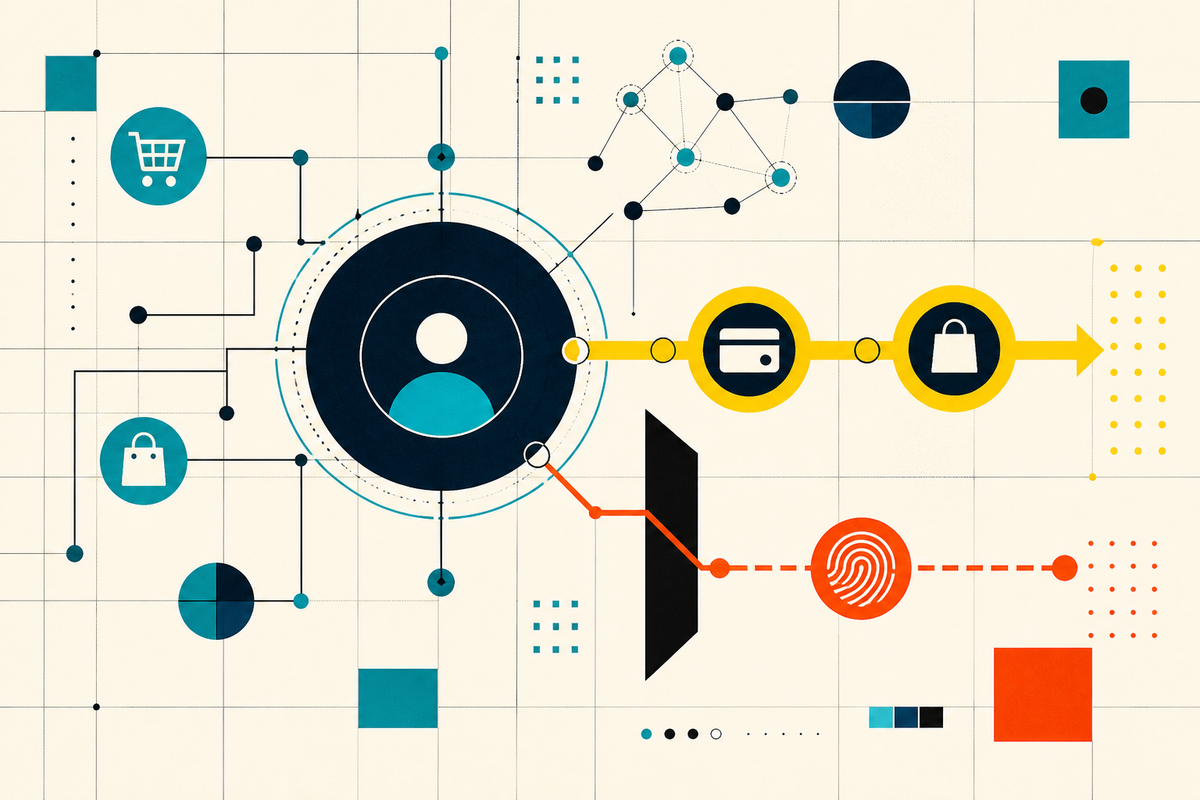
Forter sits behind the storefront. It receives signals around a digital interaction, compares them with patterns in its identity graph and returns a decision through an API. The company says 99 percent of its decisions arrive in under 400 milliseconds. That is fast enough to disappear inside the normal rhythm of a checkout, login or refund request.
Speed matters, but the more interesting claim is recognition. A customer may be new to a particular shoe store, airline or delivery app yet familiar to Forter's wider network. The system links signals such as account history, devices, locations and behavior to form an identity. Forter calls some of these connections “soft links” because they can associate activity without relying on one obvious shared field. The merchant does not have to begin every relationship as an amnesiac.
This creates the flywheel at the center of Forter's pitch. More merchants contribute more interactions. More interactions expose more patterns. Better patterns can improve the next decision, which makes the network more useful to another merchant. In June 2026, Forter described that network as more than two billion shoppers and nearly one million businesses. Those figures include the broad reach of partners and platforms, not simply a count of direct enterprise contracts, but they convey the intended scale.
The system is not selling suspicion. It is selling the confidence to say yes.The commercial logic behind identity intelligence
Fraud is only one way to lose a sale
Classic payment fraud remains the foundation: stolen cards, fabricated identities and transactions likely to become chargebacks. Yet an online merchant can leak money well before and after payment. An attacker can seize an account, drain loyalty points, exploit a promotion, claim an item never arrived or repeatedly return used merchandise. A legitimate buyer can abandon a purchase after a clumsy authentication challenge. A bank can decline a sound transaction because it receives the wrong signals.
Forter's product menu followed those problems outward. Fraud Management covers payment decisions, chargebacks and false declines. Account Protection watches sign-up, login and profile changes for account takeover or fake accounts. Abuse Prevention handles returns, coupons, reseller behavior and item-not-received claims. Payment Optimization works on authentication, Smart 3DS, tokenization and issuer performance. Dispute Management automates evidence gathering and representment after a chargeback arrives.
The buyer is usually a large retailer, marketplace, travel company, direct-to-consumer brand or payment provider. Forter names Nordstrom, Instacart and Priceline, while its site displays companies including eBay, Wayfair, HelloFresh, ASOS and Grubhub. For these customers, a small improvement multiplied across millions of sessions can justify an enterprise contract. Forter does not publish a price list. Its model is B2B software and risk decisioning, with contracts shaped by transaction volume, product mix and the protection attached to a decision.
The difference is the crowd
Forter competes with Riskified, Signifyd, Sift and Ravelin, as well as the risk products bundled into Stripe, Adyen, PayPal and other payment platforms. A large merchant can also assemble its own rules, models and manual review team. The alternatives differ on guarantees, integrations, geographic coverage and how much of the customer journey they watch.
Forter's answer is that an isolated model sees only an isolated history. Its identity graph is meant to recognize relationships across businesses, channels and time. The decision engine combines that shared context with machine learning and the judgment of fraud experts who tune the system as attacks change. The product is therefore not merely a score. It is an outsourced decision, delivered quickly enough to shape the customer experience.
That framing changes the budget conversation. Fraud tools are often treated as loss prevention, a digital security guard paid to keep bad orders out. Forter asks merchants to count the good orders kept in: fewer false declines, fewer needless challenges and more successful authorizations. On its platform page, the company reports that merchants switching to Forter see average reductions of 72 percent in chargeback rates and 46 percent in false declines. Those are vendor-reported averages, not guarantees for an individual business, but they show what Forter wants a chief financial officer to notice.
A blocked fraud attempt appears in a dashboard. A good customer who was wrongly declined may simply disappear. Forter's growth argument depends on making that invisible loss visible.
Now the shopper may be software
Forter's boundary is moving again. In 2025 it introduced Trusted Agentic Commerce with AWS, aimed at transactions initiated by AI agents. The old question was whether a person presenting a card could be trusted. The emerging question is whether a software agent has legitimate authority from a real person, and whether the merchant can preserve the useful identity signals that disappear when a bot stands between buyer and store.
Forter also launched Prism, an AI copilot for commerce teams. In June 2026, it expanded Prism with five purpose-built agents. The Analytics Agent investigates performance and decision rationales. The Dispute Agent helps automate chargebacks. The Abuse Agent builds and adjusts policies in plain language. The Payments Agent looks for authorization improvements. The Integration Agent is designed to help customers connect Forter to existing systems faster. Early access to Forter's Model Context Protocol connection lets merchant teams bring its commerce intelligence into tools such as Claude and ChatGPT while retaining corporate permissions.
The move is sensible and delicate. Forter's advantage comes from being trusted with sensitive commercial signals, so every shortcut must coexist with access controls, auditability and privacy obligations. An AI assistant that can explain a decision is useful. An assistant that confidently invents one would be expensive. The company is selling faster access to context, not permission to relax the controls around it.
A well-funded private layer of commerce
Forter raised $3 million from Sequoia Capital in 2014, then $15 million in its Series B, $32 million in Series C and $50 million in Series D. A $125 million Series E in 2020 pushed its valuation above $1.3 billion. Six months later, Tiger Global led a $300 million Series F at a $3 billion valuation. The disclosed rounds total $525 million.
The 2021 price belongs to a different funding climate and is not a current market appraisal. Forter remains private and does not publish current revenue. Its LinkedIn page places the company in the 501-to-1,000 employee range and recently displayed roughly 700 associated employees. The company lists offices in New York, Denver, Tel Aviv, London and Singapore. Its partnership map includes AWS, Shopify, Salesforce and consultancies, while a global McDonald's relationship puts its decisioning inside one of commerce's most recognizable systems.
Where does Forter fit? It is part fraud platform, part payments infrastructure and part customer-experience software. Cybersecurity vendors usually protect systems; Forter protects commercial decisions. Payment processors move money; Forter tries to determine whether moving it is wise. Customer platforms know what a buyer likes; Forter tries to know whether the buyer is the person they appear to be.
When Forter works, nothing dramatic happens. The right customer gets through.The quiet product behind the Buy button
That quietness is the durable appeal. A fraud team gets fewer cases to review. A payments team gets another route to higher authorization. A customer gets a checkout that does not suddenly demand a small autobiography. The fraudster gets a refusal, ideally before discovering which clue gave the game away.
The founders' rejected card remains a neat summary of the company. The card network saw risk; the human saw an absurd mistake. Forter has spent thirteen years building machinery meant to close that gap. The checkout may know more than a card number now. The important question is whether it knows enough to let the right person pass.