In 1854, five cents could open a savings account in Newburyport, Massachusetts. It was a fine proposition, and an admirably literal one, so the institution called itself Newburyport Five Cents Savings Bank. Then 165 or so years passed. The nickel remained in the name. The bank acquired ten branches, roughly 180 employees and $1.6 billion in assets. What had once sounded welcoming now sounded long, antique and hard to carry into a new market.
This is the sort of problem FMS likes. It is neither a pure advertising problem nor a cosmetic one. The name was accurate. It was also getting in the way. Research conducted for the assignment pointed to the bank's real advantage: it helped people navigate a financial life with unusually personal attention. The old name became Newburyport Bank. The thought underneath became “journey well.” Nautical illustrations, a cleaner identity, a launch film, customer mailers and an employee guide followed.
The interesting move was not removing three words. It was deciding what could replace the meaning those words carried. FMS is a 30-person agency in Franklin, Tennessee, built around that decision. It does names and logos, certainly, but also employee surveys, focus groups, mission statements, merger architecture, media buying, branch graphics, videos, social campaigns and training. Its public line is wonderfully direct: “We help banks become brands.”
A logo changes the sign. A brand changes the meeting.
Banks are peculiar creative clients. Their products are easy to copy, their language is regulated, and their most consequential service moments are often invisible. A customer does not photograph the underwriting judgment that saved a deal. A local business owner does not post a selfie with a well-timed credit line. Yet these are exactly the moments community banks believe distinguish them from national competitors.
The first thing to fail, then, is usually translation. A legacy market knows the bank by habit; a new market sees another building with a rate on the window. Employees in one branch tell the founding story; staff acquired in a merger tell another. Marketing fills the gap with familiar adjectives - trusted, local, personal - that every competitor can borrow before lunch.
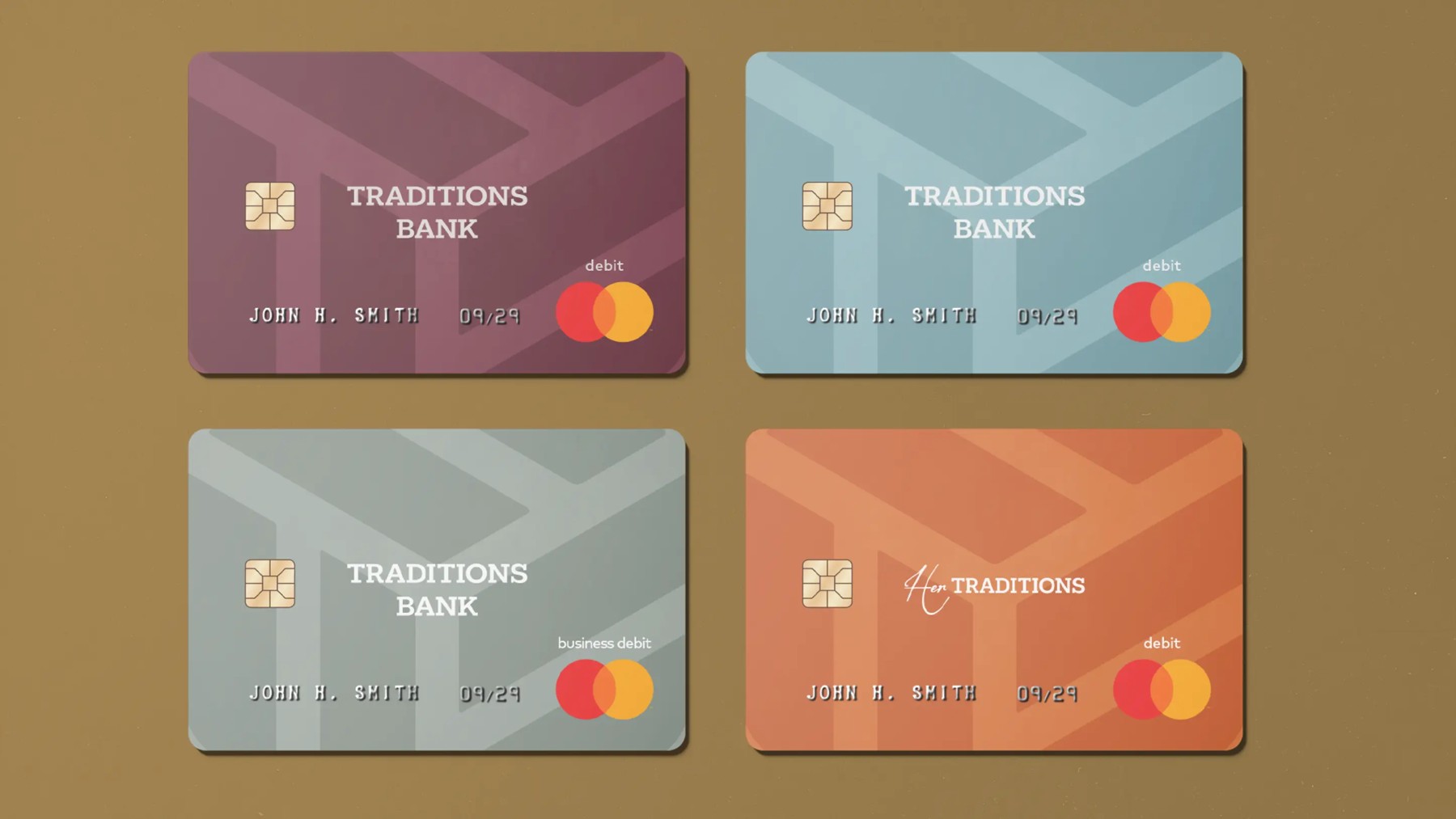
FMS's answer is to postpone the visual excitement. Its process starts with interviews and evidence: surveys across the organization, focus groups with leaders, employees, customers and non-customers, a competitor review and an audit of what the institution already says. This is where minds change. At Traditions Bank, the flourishing York Traditions Bank wanted to expand beyond York, Pennsylvania. Discovery made the limitation hard to ignore: the geography embedded in the name excluded the very places the bank hoped to enter. “York” left. The six values that had guided the founders stayed, encoded in the new mark.
Listen across the bank, the customer base and the market before prescribing an answer.
Turn the evidence into position, language, identity, values and a usable creative system.
Launch inside the organization and outside it, from employee training to mass media.
Review, refine and extend the brand as markets, people and business goals move.
“Successful branding is a reflection of who you really are.”FMS, on why discovery comes first
The niche is narrower than it looks
Many agencies can make a handsome bank ad. FMS has chosen the less glamorous advantage of knowing why the bank cannot approve it. Financial institutions have compliance constraints, conservative boards, many product owners and customers who notice instability. A rebrand can touch debit cards, lender presentations, mobile screens, branch walls, uniforms, community sponsorships and the language a teller uses on Monday morning. The buyer is not shopping for a picture. The buyer is managing an institution-wide change.
That specialization places FMS between a general branding studio and an in-house marketing department. Its customer is typically a community or regional institution confronting a threshold: expansion has outrun its hometown identity, a merger has created competing cultures, a dated identity undersells a healthy bank, or years of separate campaigns have produced noise instead of equity. The alternatives include specialist bank agencies, generalist shops and doing the work internally. FMS's difference is the span - strategy through production, internal culture through external media - and the insistence that one finding should connect them.
The ordinary brief
“We need a new logo and a campaign before the next branch opens.” The deliverable leads; the organizational question waits.
The FMS question
“What is already true here that a competitor cannot credibly copy?” The answer decides whether the name, culture or communication must move.
Consider S Bank. The institution had changed its name, but had not sufficiently explained the lonely “S” to staff or the market. Confusion cost it traction. FMS turned the letter into “strive” and built a launch around the wonderfully plain introduction, “Hello. We're S Bank.” At Armstrong Bank, the name held real family equity, so it stayed; the identity and story evolved around “Strength Runs In Our Family.” Same agency, opposite prescription. That is what following the evidence looks like.
The brand box comes before the billboard
The most revealing objects in the portfolio are not ads. For Adirondack Trust, an employee launch included a brand book, promotional pieces, custom ties and scarves. For Newburyport Bank, a guide showed employees what a “good journey” meant in everyday banking. Field & Main's “Modern Craft Banking” became specialty paper, letterpress printing, values posters and leadership films. FMS treats the employee as the first media channel. A promise repeated on television but contradicted at the desk is merely an expensive sentence.

There is a pleasing correspondence between that philosophy and FMS's own succession. Tim and Laurie Pannell founded the company in 2004. In 2021, ownership passed to four longtime leaders: Sean Hockenbery, Amber Farley, Clark Hook and Zach Pannell. Hockenbery had joined in 2005 as one of the earliest hires. The founders did not sell the culture to a stranger; they handed it to people who had helped make it.
The business model is custom professional service. Clients buy research, strategic definition, creative systems and execution, with ongoing development available after launch. Scope expands with the surfaces and people the work must change. Naming and a visual system is one kind of engagement. Research across markets, employee activation, branch environments, video, media and annual stewardship is another. The practical cost is therefore not just creative production. It is the attention required from executives, employees and customers to arrive at an answer the institution can actually use.
A merger creates two banks before it creates one
The niche becomes clearest during consolidation. On paper, a merger joins balance sheets. In life, it joins histories, local loyalties, job titles, habits and two different answers to “how we do things here.” Picking one legacy logo may settle the sign and aggravate everything beneath it. Inventing an entirely new name may look even-handed while discarding trust that took decades to earn. The branding decision is inseparable from the integration decision.
FMS lists mergers and acquisitions among its capabilities because its discovery machinery is suited to that awkward middle. Competitive research can show which name travels. Employee conversations reveal where resistance will form. Brand architecture decides how products and divisions sit together. Internal launch tools give the combined workforce a vocabulary before customers receive the announcement. The creative output matters, but sequence matters more: staff hear the case, understand their role and then carry it into the market.
That logic also explains the agency's national reach. A Franklin shop does not need to know every town better than the local bank does. It needs to know how to make local knowledge legible. In Field & Main, that meant “Modern Craft Banking,” a phrase broad enough to support a growing institution and specific enough to guide tactile paper, letterpress work, films and values posters. In First State Bank, discovery found equity in the existing name but weakness in the visual system and awareness outside legacy markets. “Built on belief” organized an old institution around the values it was already living.
Change only what blocks the next chapter. Newburyport's long name obscured relevance, so it shortened. Traditions' geography constrained expansion, so it widened. Armstrong's family name carried useful trust, so it remained. A rebrand earns credibility by knowing what not to replace.
This restraint is easy to overlook because portfolios reward dramatic before-and-after pictures. Yet continuity is the harder design problem. Community banks cannot behave as if they arrived yesterday. Their age, relationships and local memory are strategic assets. FMS's best work takes a familiar truth and gives it enough structure to operate in a new place. The goal is not to make an old bank look young. It is to make the reason it endured understandable to someone meeting it for the first time.
Do not begin by asking what the new thing should look like. Interview the people who deliver it, the people who buy it and the people who chose someone else. Write down the one truth a rival cannot claim. Keep the parts of the old identity that still carry trust. Then make the employee launch as concrete as the customer launch.
The thing that cannot be rushed
This method has conditions. It works when leadership will expose assumptions to research, when employees can speak candidly, and when the institution has the time and authority to change more than artwork. It is a poor fit for a company seeking only a fast promotional campaign, a committee determined to preserve every inherited phrase, or a bank unwilling to carry the promise into operations. Discovery without the permission to act becomes expensive anthropology.
FMS's deeper product is alignment. The name, the branch, the employee and the ad are asked to make the same claim. That sounds obvious until one remembers how many organizations cannot say in a sentence why a customer should care. A five-cent name can survive for more than a century. The difficult part is noticing the moment when history stops explaining the bank and starts hiding it.