Comedy has an accounting department. Somewhere beyond the joke, the cartoon and the impatient thumb hovering over a screen, somebody must work out how the whole enterprise will last. Firas Al Otaibi’s career takes place in that less photographed part of entertainment: the space where a creative company learns to become a business. It is an appropriate place to find a mathematics graduate, even if the degree offers no known formula for making an audience laugh.
Al Otaibi is the co-founder and CEO of Kharabeesh, the Arabic entertainment business whose name means scribbles. He is based in Dubai; the company’s story began in Jordan. Animation, comedy and the possibilities of online distribution brought its founders together. Business development became his particular responsibility before he took the chief executive role in 2022. The progression stretches across years, several ventures and a regional media industry learning how to sell work made for the internet.
His route offers a useful way into that history. A comedian can hold a room with a microphone. A company needs contracts, distribution, colleagues and enough money to make the next thing. The relationship between those two kinds of work is the subject of Al Otaibi’s story. The punchline is visible. Most of the preparation happens elsewhere.
Before the scribbles, a mathematics degree
At the University of Jordan, Al Otaibi studied mathematics from 1994 to 1999, earning a bachelor’s degree. His professional biography still gives that education prominent billing. On LinkedIn he describes himself as “a mathematician by education” before turning to his work in new media. It is a compact introduction with an appealing mismatch: a discipline associated with exact answers followed by a business whose audience can change its mind halfway through a video.
His early career moved through management and creative work. In 2001 he worked as a manager at clicomm. A creative director role at Rama Vision followed in 2002. In 2004 he co-founded Untitled Studios, where he also served on the board. Consultancy at JHCP and a period as managing director of Al Atheen added further stops before the long association with Think Arabia and Kharabeesh.
Those jobs place design and management beside each other well before the CEO title. They also make the career less tidy than a familiar founder biography might suggest. There is no single leap from university lecture hall to entertainment network. There are businesses, roles and practical experience accumulated along the way. The eventual chief executive had already spent time with the making of things and the running of companies.
Six weeks of unglamorous help
One revealing episode concerns ThinkArabia, the media group he built with his partners. Its founders needed financial expertise that was expensive and difficult to obtain locally. Through Endeavor, they were connected with an Ernst & Young programme. A consultant came from the Netherlands for six weeks to organise the company’s finances and train the team. Al Otaibi later said the help saved thousands of dollars.
The result was infrastructure for growth. By the account published in winter 2013, ThinkArabia’s workforce had risen from 23 to more than 100, and its expansion included offices in Tunisia, Egypt and Dubai. These were figures for ThinkArabia, the group, rather than a count of Kharabeesh employees. The distinction matters: Al Otaibi was learning to operate across an organisation with several businesses.
It is a wonderfully unspectacular episode to preserve in an entertainment biography. No one goes online hoping to watch a financial management system. Yet the episode gives his work a human scale. Experienced founders can still need someone to come in, explain a process and leave the team able to use it. Asking for help was part of building the company.
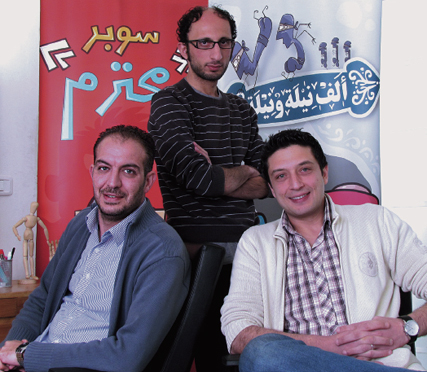
Five founders, many kinds of entertainment
Kharabeesh brought together Al Otaibi, Wael Attili, Mohammed Asfour, Wafa Nabulsi and Shaher Al Otaibi. The company is commonly dated to 2008. Its origins lay in a group of creative businesses; by 2013, the founders had brought their efforts together around the entertainment network. Al Otaibi’s own career record dates his co-founder role to 2009. The company’s beginnings and the dates on an individual résumé need not be squeezed into one anniversary.
Animation supplied an early vocabulary. Short videos could speak Arabic, draw on regional experience and find viewers through online platforms. Kharabeesh developed beyond cartoons into other entertainment formats. For a founder concerned with business development, that variety meant a company with more than one kind of work to bring to a partner, and more than one route to an audience.
In 2015, its commercial relationships included Samsung, Pepsi and Axiom Telecom. The work covered political, social and educational subjects. Those details put the venture at an interesting junction: a place where cultural expression met the demands of advertisers. A company making cartoons still had to explain its value to clients. Someone had to bring those conversations into the same room.
A billion views still leaves questions
By the end of 2014, Kharabeesh had reached one billion lifetime YouTube views, a figure Attili gave at the time. The business then had 35 employees and a wider network of freelancers, alongside approximately 10,000 videos produced since its founding. It was also still unprofitable. All those figures belong to that period; they describe a young company confronting the distance between attention and a durable income.
The scale can distract from the complication. One billion is an easy number to put on a slide. The cost of making the next video is a quieter subject. For an entertainment business, a large audience creates possibilities without settling every commercial question. That is the territory occupied by business development: finding a workable relationship between what people enjoy and what partners will support.
Al Otaibi served as chief business development officer from 2013 until 2022. During that span, the company’s financing included a $5 million Series B reported in early 2017. His role belonged to an enterprise trying to turn regional cultural relevance into sustained operations. The job title sounds dry beside a comedy channel. In practice, it sits close to the question of whether another season can be made.
Learning the platforms, learning the audience
His training record contains a small parallel history of the business. In September 2015, he obtained YouTube’s Audience Growth certification. In August 2020 came the Venture Deals Spring 2020 course from NovoEd. Meta’s Third-Party Partner Essentials followed in July 2021. The subjects move from viewers to financing to platform relationships, a fairly economical inventory of the concerns surrounding a digital entertainment company.
Kharabeesh’s then-CEO Mohammed Asfour described another practical concern in 2017: reaching a pan-Arab audience required attention to particular stories and dialects. North Africa, the Levant and the Gulf could not simply be treated as interchangeable. He described a sequence of developing talent, understanding audiences, improving distribution and eventually earning revenue. Those were Asfour’s observations about the shared business, rather than quotations from Al Otaibi.
For the business development side, that creates an exacting brief. A regional ambition has to survive contact with local tastes. A creator needs room to sound like themselves; a commercial partner needs a reason to participate. There is no mathematical guarantee that the arrangement will work. There is, however, plenty to organise, negotiate and learn.
- 2015YouTube
Audience Growth - 2020NovoEd
Venture Deals - 2021Meta
Partner Essentials
A signature in Dubai
Al Otaibi became CEO in 2022, taking on the executive role after years as a co-founder and business development leader. Later that year, a partnership announcement placed him at Al Mashhad’s offices in Dubai, signing an agreement with the broadcaster’s general manager, Tony Khalife. The plan was to co-produce a satirical talk show presented by Arab YouTubers and distributed across Al Mashhad’s platforms.
The proposed programme would address social, cultural and political affairs through humour, with young Arab audiences at its centre. For Kharabeesh, the agreement brought creators associated with online video into a collaboration with a broadcaster. It is a concrete example of the connections a CEO must make around creative work: a partner, a format, presenters and places for an audience to encounter the result.
Al Otaibi greeted the announcement warmly in a public post at the end of 2022. “Being blessed with great team, unique partners and investors,” he wrote. The sentiment assigns the occasion to a group. A signing photograph tends to give a deal two faces. An entertainment programme requires rather more people than can fit comfortably beside the document.
The work that makes room for other people
By 2023, Endeavor’s entrepreneur retreat material identified him as Kharabeesh’s current CEO and co-founder, describing a platform for entertainment rooted in Arabic culture and everyday life. Endeavor Jordan continues to list him among its entrepreneurs. The company’s own presentation spans comedy, animation, technology, gaming, travel and other genres, with digital creators at the centre of its proposition.
That breadth returns the story to the work behind the screen. A business built around personalities needs people who can arrange the conditions for those personalities to work. Al Otaibi’s public career connects creative direction, company formation, financial organisation, audience training and partnerships. Taken together, the roles show how much of an entertainment company exists outside the finished performance.
“Now is the time to give back, to create a change within society.”
Firas Al Otaibi · winter 2013
His ambition to support others is an apt closing thought for a founder whose own business received practical help. The degree was in mathematics. The career has involved people: partners to build with, specialists to learn from, creators to work alongside, and audiences who retain the right to find something else funny.