Ronak Shah had a question that ought to have been easy. How much free cash did his supplement company, Obvi, have? His bookkeeper could not say. The books were still being closed. In Finaloop’s account of the episode, the answer could wait until 20 days into the following month. A business launching products at speed had acquired a peculiar accessory: financial information that arrived after the decision.
- Finaloop combines ecommerce accounting software with expert service.
- Inventory costs, sales and payments feed the same financial records.
- Brands can outsource the work or use the platform with their own finance team.
The accountant who had to wait
The irony is that Finaloop’s founder understood accounting perfectly well. Lioran Pinchevski was a CPA and a former PwC partner. Then he became a DTC brand founder. According to Finaloop’s origin story, the conventional bookkeeping he tried could not keep pace with the business. He spent time explaining ecommerce to bookkeepers and waiting for numbers. Expertise had not spared him the administrative queue.
That experience changed what he wanted from the books. Keeping records was necessary; getting information in time to price products, manage cash and make decisions was the more demanding job. Finaloop dates its platform launch to 2020. Its wager was that consumer brands needed accounting designed around how they actually sold.

Give every sale a paper trail
Consider a checkout. The customer sees one payment. Behind it sit an order, fees, perhaps a refund, a processor payout and a bank deposit. Those records describe related events, but they do not necessarily arrive together or carry the same amount. A bank feed alone leaves much of the story untold.
Finaloop’s service documentation describes three-way reconciliation: order, payout, bank. Its integrations include Shopify, Amazon, Walmart and Stripe, alongside advertising, payroll and warehouse systems. The purpose is to join the fragments before anyone mistakes the deposit for the complete economics of a sale.
The product includes its own general ledger and financial statements. Accountants review exceptions and complicated entries, with input from the business. Automation handles volume; expertise handles the awkward questions. Buyers can let Finaloop run the work or give an existing finance team the platform. That choice matters: the customer may need better infrastructure without needing to outsource every decision.
The stockroom is hiding in the profit statement
InventoryIQ makes the company’s approach particularly concrete. It connects purchase orders, warehouses, stock movements and landed costs to the accounting. Landed cost includes getting the product to its destination: freight, duties and other procurement expenses, as well as the supplier’s price. A cheap-looking item can become rather less charming after its journey.
InventoryIQ uses first-in, first-out costing, or FIFO. Older stock costs are applied before newer ones. Here is an illustrative calculation, not a Finaloop customer’s data: a brand sells 15 units, taking ten from a $10 cost layer and five from a $12 layer. Cost of goods sold is $160. Pricing all fifteen at the older cost would understate it by $10.
Cost of goods sold. The price on yesterday’s box cannot explain every box sold today.
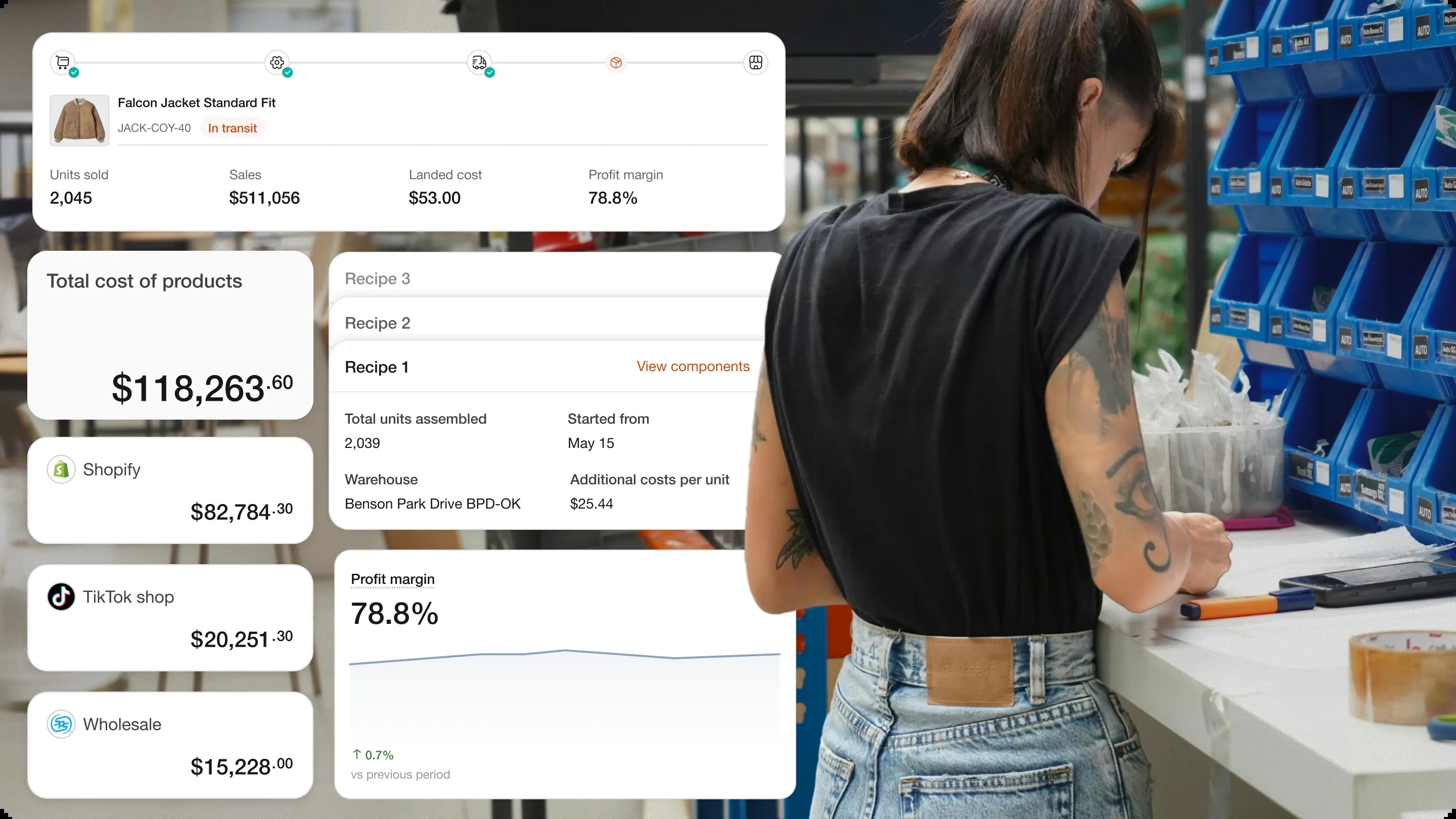
That becomes useful when purchasing costs move. In Finaloop’s &Collar case study, finance executive Mark Brown describes using FIFO and landed costs amid tariff changes affecting Chinese production. Tracking the cost of a particular batch helps the team understand the margin it will carry when sold. The warehouse becomes part of the pricing discussion.
What changed when the numbers arrived
Obvi’s case study supplies a practical before-and-after. Shah compared Finaloop’s financial data with the numbers from his existing bookkeepers, then switched. Finaloop reports that, after almost a year, Obvi had saved over $65,000 on bookkeeping and fractional CFO costs and reduced monthly bookkeeping time by 94%. Its financial setup still included an internal VP of Finance and a fractional CFO for strategic work.
“If we don’t have that, we’re really just flying blind.”
Mark Brown / &Collar, in Finaloop’s case study
&Collar reports cutting operating expenses by 30% over 12 months, with clearer financial views contributing to the effort. These are customer stories published by the vendor. They show what those teams say changed; they cannot promise the same savings to the next buyer. The interesting behavior is repeatable: look at current costs, question them, then act.
A subscription with people inside it
Finaloop occupies the territory between a collection of accounting tools and a broader ERP implementation. Its pitch competes with arrangements such as QuickBooks or Xero plus a bookkeeper, connectors and inventory tools. A business already happy with that arrangement has a migration decision to make. Consolidation has value when coordinating the separate parts has become work in itself.
The current published Starter price is $245 a month, for brands with up to $1 million in annual gross revenue and no more than four years in business. Other plans are quoted by revenue, complexity and services. Inventory, analytics, tax and CFO services can add to the bill. Historical catch-up can also cost extra. A 14-day trial lets buyers examine the fit.
In June 2024, Finaloop announced a $35 million Series A led by Lightspeed, taking disclosed funding to $55 million. Its stated expansion plans included inventory, wholesale workflows and accrual automation. By August 2026, help-center documentation described a Supply Chain page following purchases through warehouse receipt. The ambition has moved further into operations.
Copy the discipline before the software
The lesson an operator can borrow is to follow one sale all the way through: order, payout, deposit, inventory cost. Then ask whether marketing and finance use the same definition of profit. Finaloop’s analytics product connects channel and SKU performance to reconciled records; a handsome graph is more useful when its arithmetic agrees with the books.
There is work left for the brand. Inventory setup requires opening balances and operating details. Some channel quantities need manual updates or uploads. Foreign companies face US-focused eligibility conditions. A business unable to supply those inputs, or unwilling to move its accounting, should resolve that before subscribing. Even quick numbers need someone to notice them. The useful advantage is having time to change the next decision.