Before there were startup pitches, there were shots on goal. On November 20, 2011, Filip Sasic scored four times for St. Francis College against Brown in the third-place game of the Eastern Championship. St. Francis won 16-10. Sasic was named Player of the Game. In that particular afternoon’s accounting, the contribution was easy to count.
His present work has a less obliging scoreboard. As CEO and founder of Entrepreneurs for Global Change, he helps young founders meet people, test ideas and understand markets beyond the ones they know. A useful conversation rarely arrives with a final whistle. Its value may become apparent months later, when a founder changes a pitch, abandons an assumption or finds a customer.
The connection between those two lives is the team. Sasic played for one before he began assembling the conditions in which other people might build theirs. The vocabulary has changed. The need to work with people has followed him out of the pool.
A scholarship across the Atlantic
Born in Zagreb, Sasic spent part of his childhood in England, grew up on Korčula and moved back to Zagreb. Swimming and water polo began on the island; training continued at Mladost in the capital. Moving repeatedly meant learning to find his place among unfamiliar people. After England, even speaking Croatian required an adjustment.
In 2008, sporting and academic achievements took him to New York on a scholarship. He had wanted to study oceanography. College introduced other possibilities, including finance, international business and entrepreneurship. The ocean would have to manage without him.
He continued playing water polo while exploring work beyond sport. He now calls New York his first home, while describing Korčula as the place where he feels most comfortable. It is a useful pair of reference points for a career spent moving between smaller communities and a city with an extraordinary appetite for introductions.
The detour through diplomacy
Sasic had been a member of Croatia’s junior national water-polo team and became captain of his college team in his senior year. He completed his bachelor’s degree in 2012. His early professional route included studying in Rome and working at the United Nations Interregional Crime and Justice Research Institute, followed by time in the Netherlands and a return to New York.
At Network 20/20, his responsibilities grew around partnerships, international outreach and entrepreneurial diplomacy. The work connected research with practical questions about business development. Later, as managing director for Southeast Europe, he helped develop initiatives supporting technology ventures and relationships with public and private institutions.
He also earned a master’s degree in Russian and Eurasian Studies at Uppsala University, with a focus on geopolitics and energy security in Southeast Europe. That background matters to the shape of his work. A startup exists inside a place, with its own institutions, relationships and opportunities. Helping a founder enter another market requires some understanding of both places.
Young people as a regional resource
By 2020, Sasic was writing publicly about the opportunities ahead for the Balkans. His work included development, entrepreneurship and advocacy projects involving Southeast Europe, Ukraine and Iran. He had also co-authored the 2017 report A Plan B for the Western Balkans.
The connecting interest was the region’s young, educated population and what it might make possible. International affairs offered one way of thinking about that question; private-sector development offered another. His career began to bring them into the same room.
That helps explain why his later organization concentrates on founders from emerging ecosystems. The person with an idea is already there. The difficult work is arranging the next encounter: with expertise, with a market, with someone who knows how an unfamiliar business environment operates. It is a practical expression of a longer interest in international exchange.
Fifteen founders in Buffalo
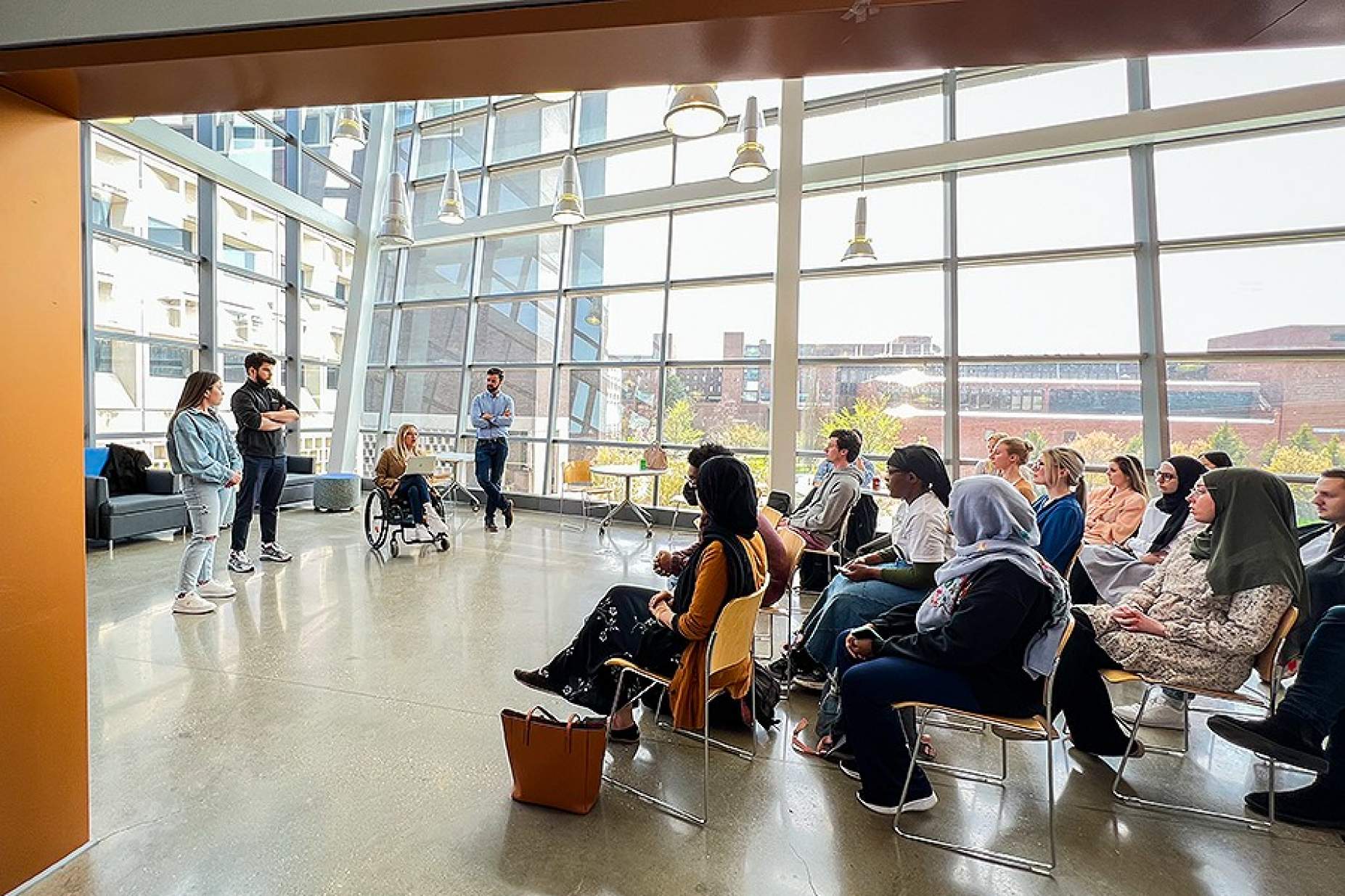
In May 2022, a group of 15 young entrepreneurs from Bosnia and Herzegovina took part in a three-week BOLD boot camp at the University at Buffalo. Sasic was the project lead and Network 20/20’s managing director for Southeast Europe. The program had support from the U.S. Embassy in Sarajevo.
The fellows worked with faculty and staff, developed their ventures and visited parts of Buffalo’s startup community, including 43North, Buffalo Angels and the TReC Niagara incubator. Students from different places could exchange experiences while working on actual ideas. Entrepreneurship became something they practised in company.
Sasic wanted the program to expand across the region. The ambition already contained the outline of his subsequent work: give aspiring founders a concentrated experience abroad, then connect that experience to opportunities at home. A return ticket was part of the logic. So was the possibility that the people learning alongside one another might keep helping one another afterward.
“I build bridges between emerging startup ecosystems and global markets.”Filip Sasic · LinkedIn profile
A place for the unfinished idea
Today, the BOLD Fellowship sits within Entrepreneurs for Global Change’s programs. Its general eligibility page addresses residents of Bosnia and Herzegovina, North Macedonia and Serbia, aged 18 to 25, whose ideas are between ideation and the stage before a minimum viable product.
That is early enough for questions to outnumber answers. The fellowship uses practical exercises to help participants test an idea and understand a market, with exposure to New York’s entrepreneurial community. Travel, accommodation, meals and program activities are funded, and the program takes no equity.
Those details make the invitation concrete. Someone with an unfinished idea can participate without already having a company capable of paying for an international learning trip. Sasic’s work occupies this awkward beginning, when ambition is real but the product may still be mostly conversation. It gives that conversation an audience likely to ask useful questions.
Croatia, New York, then a pitch
Scale 2.0 addresses a different starting point. Run with Infobip Startup Tribe, it works with Croatian teams that already have a minimum viable product and early traction. Its route joins Infobip’s campus in Vodnjan, New York and a pitch opportunity at the Shift conference in Zadar.
The structure puts preparation before exposure. Product and market strategy receive attention alongside pitching and introductions. Founders can work through their assumptions, meet people in another ecosystem and present what they are building. The program covers travel, accommodation, meals and activities without taking equity.
For Sasic, this is another version of the access problem, adapted to a team further along. A functioning product creates new questions about positioning and expansion. Being able to demonstrate software does not automatically mean being ready for an unfamiliar buyer. Scale 2.0 creates a sequence in which those questions can be worked on, across locations with different audiences and expectations.
- 01VodnjanProduct & positioning
- 02New YorkMarket conversations
- 03ZadarPitch at Shift
The classroom reaches Ibadan
The geography has widened. In 2025, EGC collaborated with CampusLabs on an accelerator for student founders in Nigeria, supported by Syracuse University’s Orange Innovation Fund. Its format combined three weeks of virtual teaching with a week of residency, bringing business fundamentals, marketing, fundraising and pitch preparation into one program.
The cohort described at launch included 28 youth-led ideas from 10 universities across nine cities. Sasic explained the partnership through EGC’s interest in building young founders in emerging ecosystems. The numbers describe a program reaching across institutions rather than depending on a single campus.
At the University of Ibadan’s April 13 Demo Day, Sasic served as one of the lead mentors. Ventures included PlastiBuild Creative Solutions, which turns waste into technology-enabled products, and ScholX, an academic platform. He called the cohort “highly promising.” Here, the founder-development work had specific names, products and a date on which participants had to explain themselves to an audience.
AI tools, human company
LeapX extends the work into AI startup building with Leap2Peak. The program describes five weeks from an idea toward a first paying customer: four weeks online followed by an immersive week in the Canary Islands. Sasic is listed on its business and startups team alongside Chadi Nemr, with Belal Haikal on technology and AI.
His own public posts keep returning to the people in that process. After interviewing applicants from countries including Nigeria, Vietnam, the United States and Norway, he observed that founders using AI still wanted mentors. He has also described combining pitching with hiking and selling with kayaking. Apparently even a beach holiday can acquire a go-to-market strategy.
The enthusiasm comes with a consistent preference for company: peers to build alongside, mentors to question an assumption, and people who can offer practical support. The tools may change quickly. His attention stays on the founder using them and the conversations that help that person make decisions.
What happens after the introduction
In his essay on turning ideas into reality, Sasic argues for starting small, listening to potential customers and assembling people with complementary abilities. He makes room for an imperfect first product. “Think simple, small, in most cases ugly, and cheap,” he writes. It is refreshingly modest advice in a field that can make even a prototype sound like a coronation.
EGC’s April 2026 reflection describes more than 450 aspiring and early-stage entrepreneurs supported over three years and more than 1,000 sessions delivered. These are the organization’s own reported figures. Its next priorities include stronger support after programs, continued mentorship and connections with investors, corporate partners and diaspora networks.
The after-program work is central to the ambition. An introduction creates a possibility; someone still has to follow up, refine an offer and do the work. Sasic’s career has moved from a sport with a visible score to a profession in which progress often belongs to somebody else. The founder who leaves with a clearer question may be carrying the most useful thing in the room.