He taught machines to spot scooter thieves. Now he is teaching banks to recognize their own customers.
Farbod Nowzad. The unflashy operator behind a very flashy number: $90 trillion.
Walk into almost any bank and the customer you think you know is actually scattered across a dozen systems that have never been introduced to each other. One database has a checking account, another a mortgage, a third a trust set up for a grandchild. Cashmere, the company Farbod Nowzad runs, exists to make those records shake hands. Its promise fits on a bumper sticker: turn fractured data into decision-ready intelligence.
That is the version of the company in 2026. The idea arrived dressed differently. When Cashmere launched in 2022, it was pitched as an AI client-acquisition engine for wealth managers - software that would hunt down promising prospects, research them, and start the conversation. The wedge was sharp and the math was seductive. As Nowzad likes to point out, almost nowhere else can you land a single non-enterprise client worth fifty to a hundred thousand dollars a year who then stays put for two or three decades.
The deeper Cashmere dug, the more it found the real bottleneck was not outreach. It was the data underneath. Advisors could not act on signals they could not see, because the signals were buried in disconnected records that no one had stitched together. So the product grew down into the plumbing: identity resolution, deduplication into single golden records, enrichment with outside signals, and trigger-event detection that flags the moment a life changes and a financial decision follows.
Today Cashmere counts top-10 US banks and top-25 global institutions among its customers, names like M&T Bank and Wilmington Trust. The backdrop is a generational handoff economists keep circling: roughly $90 trillion expected to move between hands in the United States over the coming decades, sitting on top of $60 trillion-plus already under management. Whoever can read that data fastest gets to keep the relationships.
Nowzad is clear-eyed about why this market was wide open. Finance, he says, was never first in line for new tools. "Financial services are historically not necessarily like the early adopter of technology." That lag is the opportunity. The firms that adopt now, he argues, are the ones still standing later.
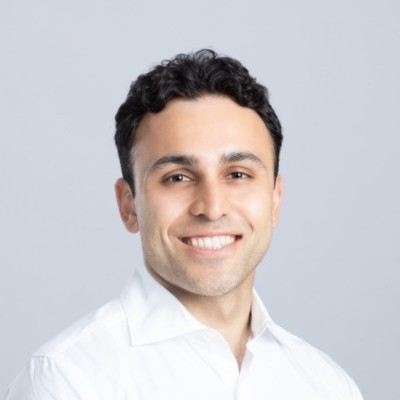
"There's essentially no other industry where you can acquire a non-enterprise client that generates $50k-100k per year in revenue and sticks around for 20-30 years."
The partnership at the heart of Cashmere predates the company by more than a decade. Nowzad and his co-founder and CTO, Eshan Govil, met in high school. One went on to become UC Berkeley's first data science graduate; the other landed at Goldman Sachs as a machine learning engineer. Years later they pooled those two halves - a product-and-data founder and a Wall Street ML engineer - into one cap table.
Nowzad's own apprenticeship was unglamorous and useful. At the scooter company Lime, he sat on the anti-fraud machine learning team, learning how to find the small dishonest signal hiding in an ocean of legitimate noise. It is not a stretch to see the through-line: catching a faked ride and surfacing a hidden wealth signal are, mathematically, cousins. Stints as a data scientist and engineer at CloudKitchens and Ripple rounded out the resume before he tried building something of his own.
That first attempt was Pludo, a social audio startup that arrived during the brief moment when the whole industry was convinced the future would be spoken aloud. It drew real money from real names - General Catalyst, Canaan Partners, Makers Fund. Social audio cooled. The experience did not go to waste. It taught Nowzad what it feels like to raise from top-tier investors, ship to consumers, and read a market that turns on you. He carried those scars into a less fashionable, far stickier corner of the economy.
What is striking about Nowzad's account of building Cashmere is how little of it is about him. He credits Chase Gilbert, the CEO of construction-finance company Built, as a model for keeping ego out of the chair. The clearest expression of that comes in an interview where he describes his own job as conditional.
"If somebody came along who was better than me at being a CEO for this company, I would happily step aside."
The bet is bigger than lead generation. Cashmere wants to be the layer the entire financial industry reasons on top of - identity, signals, and the next best action, all in one place.