An index fund is a wonderfully incurious invention. It does not ask whether you worry about water shortages, dislike weapons manufacturers or already own too much of your employer’s stock. It buys according to a rule. That indifference helps make indexing useful. It also creates the opening for Ethic: two people can want the same market exposure and have quite different ideas about what belongs in the account.
- The product: custom portfolios built for advisors and institutions.
- The mechanism: own individual securities, then adjust holdings around risk, taxes and values.
- The catch: every preference creates a trade-off. The software must keep score.
Ethic’s proposition begins with a conversation that conventional finance can find inconvenient. What, exactly, does this investor care about? Climate change might be one answer; religious beliefs, worker treatment or women’s rights might be another. “Sustainable” is a roomy word. The company’s job is to make it small enough to trade on.
First, make the preference precise
Founded in 2015 by Doug Scott, Jay Lipman and Johny Mair, Ethic built its business around financial advisors rather than a consumer investing app. The advisor brings the relationship. Ethic supplies investment management, research and technology. Its institutional audience includes family offices, foundations and endowments, where a portfolio may need to satisfy several stakeholders before anyone gets near the buy button.
Lipman described the original ambition plainly in 2021: “our mission was to mainstream sustainable investing.” That meant fitting the preference into an investment process people already understood. With direct indexing, investors own individual securities in a separately managed account instead of shares in a pooled index fund. Holdings can then be adjusted while the portfolio seeks to stay close to a chosen benchmark.

The important word is “seeks.” Excluding a company changes the portfolio. Excluding a sector changes it further. Ethic’s optimization has to weigh values alignment against investment exposures and taxes. A client can ask for something quite personal; the resulting portfolio still has to behave like a portfolio.
A conscience meets a cost basis
Imagine an investor who wants to remove a holding that has appreciated for years. This is an illustration, not an Ethic client story. Selling immediately might satisfy the preference while creating a capital-gains bill. Keeping it avoids that immediate bill but leaves the unwanted exposure. A gradual transition offers another route. None makes the conflict disappear.
Ethic’s 3D Active Tax Management framework explicitly considers impact, tracking error and taxes together. The work includes tax-loss harvesting, choosing which tax lots to sell and moving securities in kind. “Passive” describes the investment objective; it hardly describes the amount of maintenance.
The economics deserve the same attention. Ethic provides asset-based investment management, and its disclosure says Active Tax is an opt-in service that generally carries an additional fee. Select model portfolios are available without an added Ethic fee. That phrase covers a particular charge, not the investor’s entire cost of ownership.
Tax-loss harvesting also needs losses to harvest. Restrictions can shrink the available securities; highly appreciated holdings can complicate transitions. Trades in outside accounts can cause wash-sale problems that Ethic cannot fully monitor. A tax-exempt account changes the rationale again. The sensible comparison is the full fee against the usefulness of customization and tax management in that particular account.
The research needs a stopping rule
Values alignment depends on the evidence used to classify companies. Ethic describes combining company reports, third-party research, watchdog information and news, then checking observations against company and industry baselines. Questionable data is quarantined until validated. That is an unusually useful detail: a dubious number does not become respectable merely because it has entered a model.
There is another problem. Follow every indirect consequence of corporate behavior and eventually everything implicates everything else. Ethic’s sustainability research applies a two-hops rule, limiting connections to two degrees of separation. The boundary keeps the exercise focused. It also admits that a portfolio screen needs a scope, not merely a moral ambition.
A dubious number does not become respectable merely because it has entered a model.THE EDITOR’S TAKE
Readers can copy that discipline without buying anything. Name the behavior you care about. Specify evidence that would count. Decide how far indirect responsibility extends. Revisit the rule when the evidence changes. Otherwise, “invest according to your values” risks becoming a flattering instruction with no operational meaning.
The back office gets a vote
Ethic now combines direct indexing with ETF and mutual-fund model portfolios and unified managed solutions. Consolidated reporting brings performance, tax, impact and proxy information together. For advisors managing many accounts, the attraction is also administrative: fewer separate decisions to reconcile, explain and document.
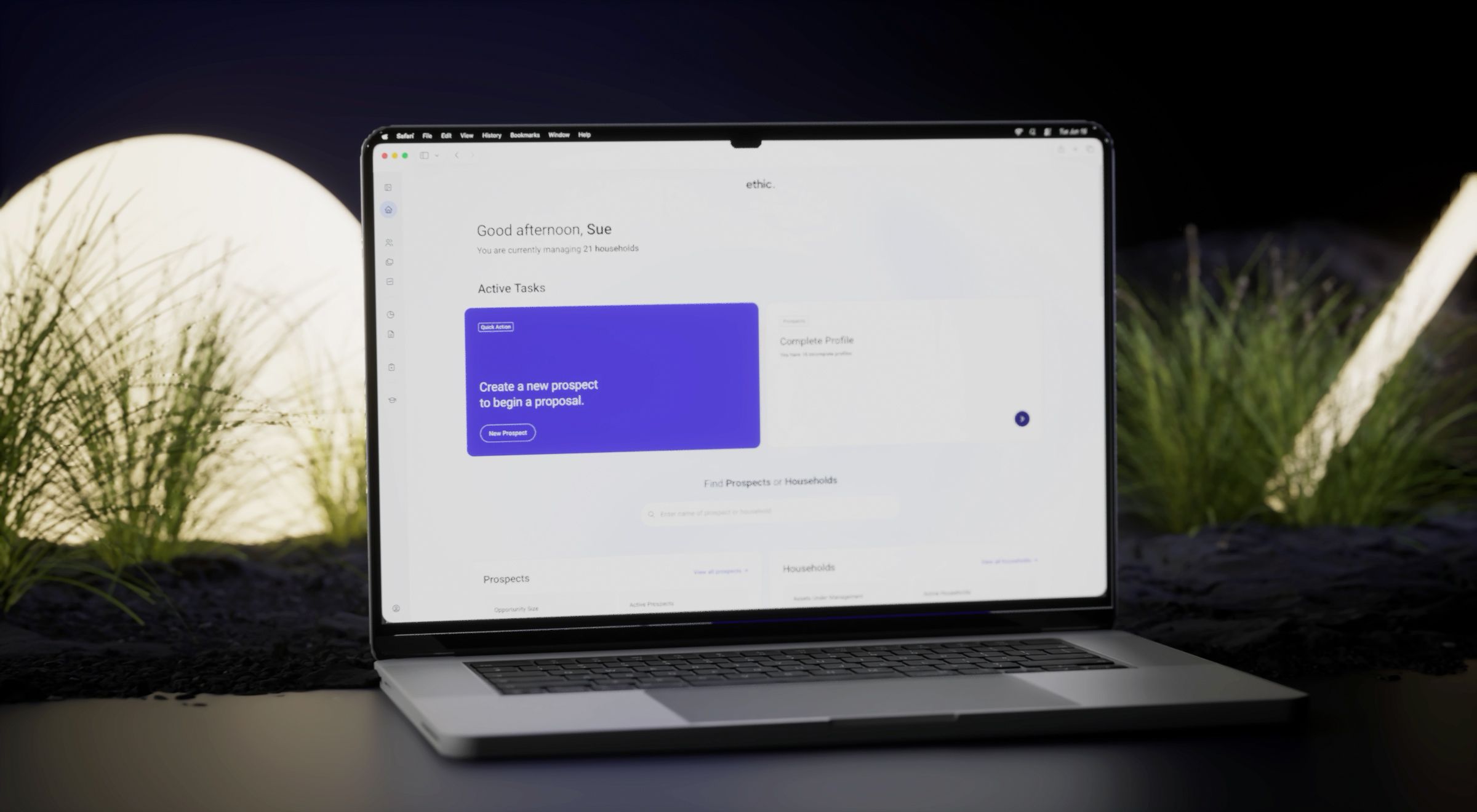
Its May 2026 platform rebuild makes the mundane work visible. Advisor feedback informed clearer prospect creation, simpler household pages and monthly-report searches by date or household. Those changes suggest where friction accumulated: finding information and navigating the work. Even a sophisticated investment engine needs a front end people can use.
Distribution matters, too. State Street Global Advisors led Ethic’s $64 million Series D in April 2025 and announced a partnership across customized accounts and model portfolios. The announcement disclosed revenue sharing tied to referrals and SPDR ETF net revenue. The arrangement connects product development with a larger distribution channel.
Owning something gives you something to do
Ethic competes with established direct-indexing providers including BlackRock Aperio and Parametric, which also offer personalization and tax management. Its case rests on the combination of research, advisor experience and portfolio delivery. By July 27, 2026, Ethic reported more than $10 billion under management and over 350 partner firms.
proposals voted on across 2,300 companies
35.8% opposed management · Company-reported activityOwnership also allows action beyond selecting holdings. Ethic’s September 2026 stewardship report records proxy votes across 2,300 companies and 27,767 proposals. Voting and engagement are concrete activities; they do not by themselves prove a company changed. The distinction matters. A portfolio can express a conviction. Whether that conviction changes the world requires another kind of evidence.