Before Eric Steinberger could write the sort of software he now wants AI to write, he had to learn to code. He was a teenager in Vienna, newly absorbed by the possibility of artificial intelligence. His mother had given him a book on the subject. In one interview he admitted, with useful candor, that he never read it. The idea alone had done its work. If a machine could learn, then learning how to build one seemed a reasonable way to spend a life.
That early certainty sounds tidy in retrospect. The work itself was anything but. Steinberger studied physics and computer science through free online material, then spent years on reinforcement learning, a field that trains systems through decisions and feedback. He gravitated toward poker, where an agent has to act without seeing every card. A player can know the rules perfectly and still have to reason through what is hidden. It is an oddly apt apprenticeship for a founder trying to build software that copes with incomplete instructions and a sprawling codebase.
His research took a turn that many students hope for and few arrange. He published Single Deep Counterfactual Regret Minimization, a paper that advanced work by Noam Brown, then a researcher at Facebook AI Research. Brown got in touch. Steinberger would later joke that his improvement was slight and had taken him years, while Brown might have arrived at it much faster. Still, a slight improvement was enough to start a serious collaboration. The young researcher found himself working with one of the people whose papers he had been reading.
A paper, a collaborator, and a limit
Steinberger went to Trinity College, Cambridge, to study computer science. At the same time, he worked part time at Facebook AI Research, where he and Brown continued investigating algorithms for games with hidden information. Their later paper, DREAM, addressed a difficult class of multi-agent problems without requiring a model of the game’s dynamics. Steinberger also maintained public code for poker reinforcement learning. Those repositories remain a glimpse of the practical side of his research: methods made concrete enough for another person to run.
Then a third commitment arrived. In 2019 he co-founded ClimateScience, an education nonprofit intended to make climate knowledge accessible. Its materials and volunteer network gave him a different kind of engineering problem, one involving people, learning, and coordination. He tried to keep university, FAIR research, and the nonprofit moving at once. After roughly three months, he left Cambridge. His explanation was unsentimental: two demanding things were possible for him then; three were not.
The nonprofit was a real departure from his laboratory path. ClimateScience organized volunteers and developed educational material for an international audience. Steinberger has described it as startup-like in its objectives and pace, while observing that a volunteer organization and a heavily funded AI company operate by very different rules. Today he is listed as a co-founder and trustee. Its team page offers a lighter footnote to the research résumé: hiking, rock music, and animated films are among his interests.
A poker AI paper draws Noam Brown into a research collaboration.
Facebook AI research and ClimateScience become the two major commitments.
Steinberger and Sebastian De Ro co-found Magic.
Magic announces LTM-2-mini and its 100 million token context window.
Magic reports a more efficient pretraining recipe and turns toward longer tasks.
The colleague in the codebase
By 2022, Steinberger had returned to the ambition that first pulled him into computing. He has said that advances in AI made the larger goal feel closer and gave him a more concrete research agenda. With Sebastian De Ro, he founded Magic. The company’s first public framing was disarmingly ordinary: what if AI felt like a colleague rather than a tool? A colleague can take a messy request, learn the local conventions, ask what matters, change the right files, and stay with a problem long enough to see whether the change works. That is a considerably harder assignment than predicting the next line.
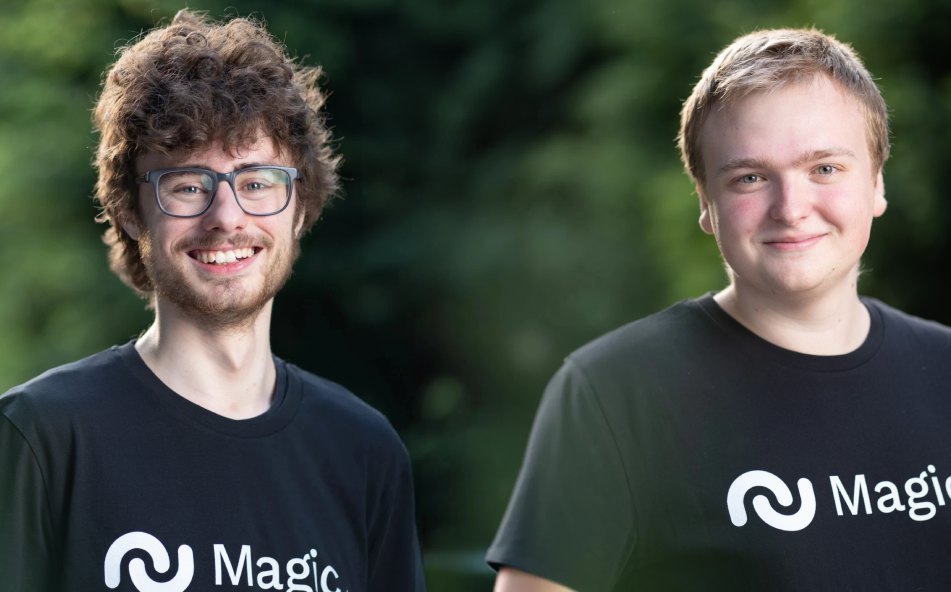
Magic’s 2023 Series A announcement put Steinberger’s broader motivations in print. He imagined advanced AI altering the relationship between work and human worth, and he described software engineering as a practical research route. A coding product would supply feedback from actual users, while the research team could train its own models and adjust the underlying algorithms. The company raised $5 million in seed funding and then $23 million in a Series A. Backers included CapitalG, Nat Friedman, Elad Gil, and Brown. The funding mattered because Magic’s proposed colleague required model research and substantial computing power, not just a polished interface.
The first visible technical milestone was LTM-1, introduced with a five million token context window in 2023. Context is the material a model can consider while it works: instructions, code, documentation, and prior steps. A much larger window could let an agent inspect more of a repository at once. The mere size of the window, however, says little about how well the agent will find and use the relevant parts. Magic’s later work focused on that distinction.
A big memory needs a hard exam
In August 2024, Magic announced LTM-2-mini, a model designed to reason over up to 100 million tokens. The company translated the scale into roughly 10 million lines of code, or 750 novels. These comparisons have the pleasing excess of a Victorian library catalog. Yet they point to a real engineering concern. A model asked to modify a mature product may need to understand distant functions, dependencies, old decisions, and instructions scattered across many files. Forgetting one link can undo the apparent brilliance of the rest.
Magic also challenged the way long context was commonly tested. A familiar benchmark hides one strange fact in a large document and asks the model to retrieve it. Steinberger’s team argued that an odd sentence can be too easy to spot, so success may exaggerate useful memory. Their alternative, HashHop, asks a model to follow chains of arbitrary relationships through a large context. The point is less theatrical than the 100 million token headline. It asks whether the system can navigate the material, not merely hold it.
The company was frank about one boundary. Its 2024 prototype could sometimes make reasonable changes to a real codebase, but it was much smaller than leading models and its code synthesis was not yet good enough for the end goal. Steinberger described the next problem as reliable work over long horizons. A useful agent must decide when to pause, inspect, plan, and test. He offered a concrete aspiration: spend time and computing power on a task and get a good pull request for an entire feature. That would be the moment a promising window becomes a working colleague.
Can a model carry a messy software task from an ambiguous request to a dependable pull request?
The quiet room and the machine room
There is a funny mismatch in Steinberger’s preferred working atmosphere. His LinkedIn bio says he enjoys important problems with a small team of good people in a quiet room. In the 2024 announcement, Magic described a team of 23 people working with 8,000 H100 GPUs and a partnership with Google Cloud to expand its computing capacity. One can imagine a quiet meeting room adjacent, conceptually at least, to a very loud data center. The small team is part of his self-description; the machines are part of what this kind of research now demands.
The company has kept publishing its technical account of the work. In September 2026 it reported a pretraining recipe it said was more than ten times as compute efficient as leading open-weight base models. Its post described failed scale-ups, unstable training, bug hunting, and a gradual accumulation of improvements across architecture, optimization, and data. Those claims are Magic’s own measurements, and a pretraining result is still some distance from an autonomous software engineer. The update nevertheless shows the current shape of the effort: less attention on the size of a single context window, more on building a strong base model and training it for extended tasks.
Steinberger’s story has an unusually clear through-line. The teenage poker project required prolonged attention to uncertainty. ClimateScience showed him how to organize people around a difficult mission and where his own limits lay. Magic combines the two lessons: a small group tackling an uncertain research agenda, with software engineering as the place where an abstract ambition has to meet a working test. He has revised his timelines in public, acknowledging that the goal proved harder than he first expected. That makes the unfinished part more interesting. The promised colleague is still ahead; the patient work of building it is already visible.