Eric Lam had a product, a theory about the future of marketing, and an awkward problem: people did not want to pay. In the early days of the business that became Aspire, even persuading a brand to spend a hundred dollars on an influencer could be difficult. The founders believed social media would change how companies reached customers. Belief, unfortunately, had yet to become a line item in anybody’s budget.
There is something useful about beginning Lam’s story there. Influencer marketing can look like a business built out of effortless popularity. His account begins with unanswered outreach and painstaking matchmaking. Before the software could make relationships easier to manage, somebody had to do the managing. The future arrived with quite a lot of correspondence.
A computer scientist takes the scenic route
Lam studied computer science at Brown University. His father was a computer science professor, which made his initial choice of finance a small family disappointment, as Lam later recalled. The route into technology would include investing, business school and mobile games. It was an education in how businesses worked before it became an education in how people discovered them.
His early employers included Berkshire Capital and The Carlyle Group. At Carlyle, his public career history places him in a venture and private equity associate role from 2007 to 2009. Harvard Business School followed, from 2009 to 2011. There was also a 2010 stint at Vostu, where he worked on launching a product in Brazil.
In 2011, he joined Pocket Gems. Over the next few years he moved into leading live product operations, overseeing a team of more than 60 people associated with the bulk of the company’s more than $80 million in 2013 annual revenue. Mobile games offered a particularly brisk education: build something, watch what people do, adjust. A product could exist on millions of phones and still have to earn its next moment of attention.
Pocket Gems’ annual revenue; Lam’s live-operations organization generated the vast majority. A company figure, not personal earnings.
The marketplace he learned to question
Revfluence, the business that would become AspireIQ and later Aspire, began in 2013. Lam’s fellow founders included Anand Kishore, Shuhan Bao and Suhaas Prasad. The initial territory was emerging quickly: brands wanted access to social audiences, and creators were becoming commercial partners. Finding the right people seemed a natural place to start.
By May 2017, Lam was publicly explaining why a marketplace alone was a troublesome business. His essay, prompted by the Fyre Festival fiasco, took aim at the incentives. A platform rewarded for transactions could celebrate activity while a brand remained unsure what it had bought. A vast list of creators also offered limited protection when competitors could approach the same people.
He included his own company in that criticism. Revfluence had operated as a marketplace before moving toward enterprise software in early 2016. That admission gives the essay its bite. The founder was describing a business model he had already tried, with the inconvenient detail that he had changed his mind.
The more durable opportunity lay in helping customers work with collaborators repeatedly. A good introduction has value. Remembering the agreement, keeping the work organized and making the next collaboration easier creates a different kind of business. Glamour gets the meeting; somebody still has to remember what everyone agreed to.
A photograph has more than one job
The 2018 change from Revfluence to AspireIQ made that broader ambition explicit. In Lam’s explanation, marketers needed communities capable of producing photographs and videos across many channels. A creator could contribute an audience and a body of usable work. Those two assets could have different lives.
Consider the practical difference. A sponsored post reaches people in a creator’s feed. With the appropriate agreement, the resulting photograph might also appear in an advertisement, on a product page or in an email. The relationship becomes part of the brand’s continuing creative process. The image has acquired a surprisingly busy diary.
Lam’s argument put pressure on the way companies organized marketing. Teams buying media and teams commissioning creative needed to think together. If every audience required a relevant message, a clever targeting system would eventually run into a less glamorous shortage: enough pictures and stories to put in front of those audiences.
In his 2017 writing about Stitch Fix, he approached the problem through experimentation. Segment an audience, make relevant creative, test variations, study the response, repeat. The difficult step was producing enough variety. His proposed answer drew on the photographers, bloggers and other creators already making work for their own communities.
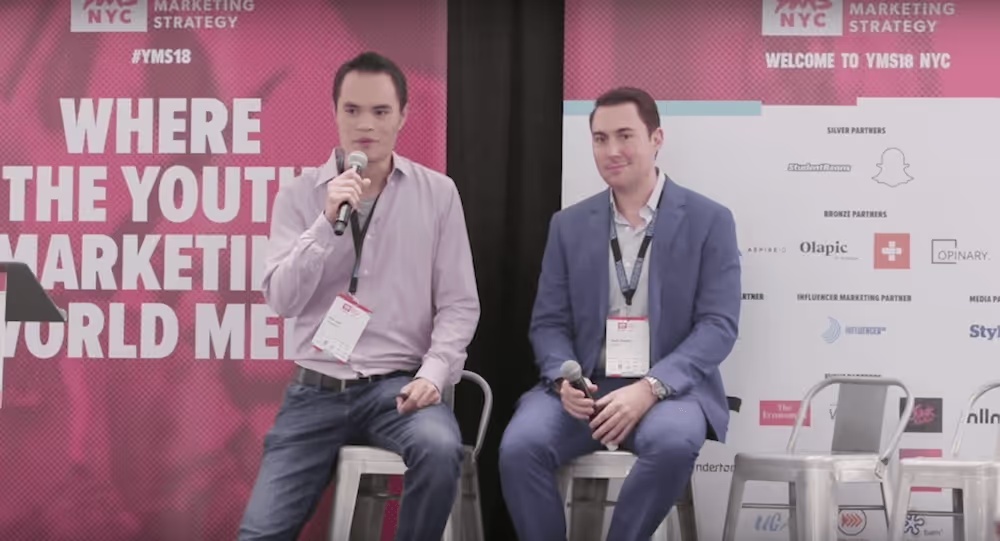
Onstage with marketing executive Zach Beatty, Lam returned to the tension between personalization and production. His questions moved from brand building to younger audiences, creative volume and the role of community. A performance marketer could target with precision, but somebody still needed to make the material that felt relevant.
He also brought his gaming experience into the conversation, recalling executives discussing celebrity television ads as a way to prepare audiences for direct-response marketing. Across both businesses, broad awareness and measurable action kept meeting. Lam seemed interested in the handoff: what happens between recognizing something and deciding it belongs in your life?
The arithmetic of staying useful
Alongside his writing about creators, Lam published advice about the less photogenic mechanics of software companies. A June 2017 essay examined customer retention and upselling. Its premise was uncomfortable: some businesses lose customers for reasons that even a diligent customer-success team cannot fix.
He distinguished products embedded deeply in daily operations from categories exposed to budget changes or customers going out of business. A marketing tool and a payroll system have different kinds of dependence built into them. Applying one ideal renewal target to both can obscure what the business actually needs to do.
Lam’s answer was to connect pricing to the value customers received and help successful customers expand their use. That makes the company responsible for understanding the customer’s work. A renewal reminder can request another year; a useful product has to give the buyer a reason to want it.
There is a shared concern running through these essays. Whether the relationship involves a creator or a software customer, the first transaction leaves an unfinished question. What would make the next one worthwhile? Lam repeatedly turns toward the systems that let a relationship earn its continuation.
Recognition for the backstage work
In October 2018, AspireIQ announced that Forrester had named it a Leader in its assessment of influencer marketing solutions. The company reported differentiated ratings in six criteria, including contracting and workflow, audience alignment, brand safety and product vision. The details fit the business Lam had been describing: the administrative machinery mattered alongside discovery.
The workplace had its own more cheerful machinery. In the 2019 Bay Area Best Places to Work listing, AspireIQ appeared at number 17 among small companies. Its listed practices included flexible hours, a dog-friendly office and an unlimited book-buying perk. As office benefits go, books have the advantage of occasionally surviving the next reorganization.
That detail sits comfortably beside Lam’s 2018 reading list: Elad Gil’s High Growth Handbook and Reid Hoffman’s Blitzscaling. He was running a growing company while reading about the difficulties of running a growing company. The appetite for scale came with an interest in the instructions.
“I try to carve out at least one hour per day”
Eric Lam, on making time to think, 2018
In its 2020 year-in-review, AspireIQ described another extension of the idea: Elevate, designed to help brands work with people valuable to them regardless of follower count. Customers, experts and existing advocates could belong in the same broader picture. It was a practical expansion of the company’s original premise. Someone who knows a product well may have something worth contributing before a marketer has counted their audience. The software needed to accommodate those relationships, too. For Lam, influence had become a question a brand could ask about its own community, rather than a number attached to a stranger’s profile.
An hour with nothing to tick off
Asked to describe his working style in one word, Lam chose “Thoughtful.” He also described protecting time to think, even as urgent work multiplied. The combination is more interesting than either answer alone. He valued moving decisions forward, while reserving space to decide which problems deserved the effort.
That practice offers a useful counterweight to the industry's taste for immediate response. A creator program can generate plenty of visible motion: messages sent, posts published, content approved. A software company can produce its own version of the same activity. It is possible to keep everybody occupied while leaving the larger question untouched.
By the November 2020 Up Next in Commerce conversation, Lam was identified as AspireIQ’s co-founder and president. His 2021 appearance on eCommerce Fastlane continued the theme of helping brands engage advocates and build ambassador programs. The definition of influence had room for people whose relevance came from their relationship with a brand.
His later public professional profile places him in product at YouTube. The setting has changed, but creators, audiences and the businesses around them remain close to the work. Aspire’s former CEO began by asking how products could be discovered. Along the way, he kept finding reasons to look beyond the first impression. An introduction is easy to admire. The second conversation is where the work gets interesting.
Keep the conversation going
Read Lam’s essays, hear him discuss the early business, or watch his conversation about creative strategy.