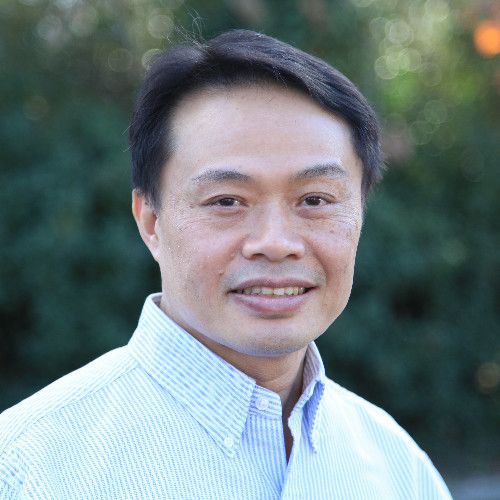
The most consequential object in Eric Chen's career may be the one people are trained not to see. It hangs above classrooms, shop floors and offices, blinking politely while everyone beneath it gets on with the day. The Wi-Fi access point is useful, necessary and visually forgettable. Chen looked at that ceiling fixture and saw spare ambition.
By 2011, he had spent roughly two decades managing software and research teams across the networking industry. His public career record begins at Fujitsu, continues through Cisco and Tahoe Networks, then moves to Nokia and ASUS. The route is less a tour of logos than an apprenticeship in how data travels, how networks are operated and how hardware becomes a platform. When Chen founded Relay2 in Milpitas, he brought those lessons to a deceptively plain question: if the access point is already closest to the user, why should it behave like a mere traffic cop?
Relay2's answer was to combine enterprise Wi-Fi, computing and storage inside what it calls a Service Point. Applications could run in the building where the data originated. A cloud system could still manage devices and software across many locations. The architecture divided the work by geography: central control where central control helps, local execution where distance becomes a cost.
01 / The apprenticeship
A career assembled in layers
Chen studied computer science twice: first for a bachelor's degree at National Taiwan University, then for a master's at Oregon State University. His professional path stayed close to the machinery of connectivity. He was a software development manager at Fujitsu from 1991 to 1994 and at Cisco from 1994 to 2001. He followed with senior software engineering work at Tahoe Networks, R&D management at Nokia and senior software R&D management at ASUS Computer International.
Software development manager at Fujitsu.
Software development manager at Cisco.
Senior software engineering manager at Tahoe Networks.
R&D management roles at Nokia and Nokia Networks.
Senior software R&D manager at ASUS Computer International.
Founded Relay2 in Milpitas, California.
The chronology matters because infrastructure ideas rarely spring from a blank whiteboard. They accumulate. A manager sees a deployment problem at one company, a bandwidth constraint at another, a software opportunity at a third. Eventually the irritations form a thesis. Chen's thesis gave the access point a larger job description.
A former colleague, Sotirios Makrygiannis, offered a glimpse of how Chen worked inside those earlier organizations. In a public recommendation, he described Chen as someone able to understand complex situations and give development teams clear directions and priorities. He also called him helpful, innovative and trust-inspiring. It is a small piece of testimony, but it matches the shape of Relay2's product: complexity arranged into an intelligible system.
02 / The ceiling computer
One box, three jobs
A conventional access point moves wireless traffic onto a wired network. Relay2 kept that function and added a small computer, dedicated storage and the ability to host containerized applications. The company wrapped the devices in cloud management and an application orchestrator so an operator could deploy and maintain software across many sites. It also developed an edge application store for prequalified and open-source apps.
The Relay2 division of labor
Policies + fleet view
Wi-Fi + compute + storage
Apps + content + data
The appeal appears first as subtraction. A separate server may be unnecessary for some applications. Frequently requested content can sit near the people requesting it. A local workload can avoid sending every byte over an expensive or unreliable wide-area link. Selected data can remain on premises. None of these benefits requires hostility toward the cloud. They require a more selective travel policy.
Relay2 combines WiFi, computer, storage and application directly in the WiFi AP as a service point.Eric Chen, in a 2023 European distribution announcement
That sentence is Chen's product philosophy compressed into one line. It is unusually concrete for a technology pitch. There is a box. It contains four capabilities. The consequence, he said in the same announcement, is a simpler and more cost-effective managed-services operation. Partners and systems integrators can use the platform to build their own services, which shifts the access point from purchased equipment toward programmable distribution.
The examples bring the abstraction down to floor level. In a classroom, digital lessons or video can be stored locally, reducing repeated trips through the internet connection when many students request the same material. In retail, analytics or other applications can run near the shop floor. In industrial and transportation settings, local processing can be useful where connectivity varies or data volumes are large. The common feature is proximity. The application runs near the event it cares about.
That proximity also changes the economics of experimentation. A managed service provider can test a local application on infrastructure that is already carrying Wi-Fi, then coordinate deployment through the same cloud-managed system. The access point becomes a small piece of real estate for software. Relay2's application-store concept follows naturally: if a fleet can host software, operators need a disciplined way to choose, distribute and maintain it. The unglamorous details - qualification, orchestration and remote management - are what turn an inventive appliance into something a business can operate across many locations.
03 / The cost of arriving early
A category catches up slowly
Relay2 was founded before "edge computing" became a dependable label for conference programs and corporate road maps. That gave Chen a useful idea and an educational burden. Customers already understood Wi-Fi. They understood servers. They understood the cloud. Relay2 had to explain why capabilities normally separated across those categories should share a ceiling mount.
The company kept turning the argument into products. Its RA200 service-ready access points, introduced in 2016, were designed for delivering applications over Wi-Fi at the network edge. Relay2 describes Chen as the leader of product development and technology solutions, and credits him with six US patents. Public patent records assigned to Relay2 describe techniques around containerized applications on wireless access points, airtime allocation and distributed load balancing. The vocabulary became more current; the architectural concern remained steady.
Funding and ownership added another plotline. Relay2 raised venture capital, with the supplied company record placing total funding at $13.5 million and the latest round in 2015. Japanese telecommunications company T-Gaia began a capital and business alliance with Relay2 in 2019. It later increased its investment and made Relay2 a consolidated subsidiary in 2022. In May 2024, T-Gaia disclosed that it had sold its entire 51.32 percent voting stake to Relay2 Investment LLC. The filing still identified Chen as CEO.
Corporate structures change more quickly than a founder's central question. Relay2 continued pursuing distribution and application partnerships across regions. In 2021, Chen described a deal with sysob as a way to strengthen the company's EMEA presence. A 2023 agreement with V-Valley extended its European distribution. He also contributed technical input, alongside Daniel Kwong, to a report examining the future of edge AI with Wi-Fi.
04 / The founder in the architecture
Quiet biography, legible ambition
Chen maintains a limited public profile. The available record concentrates on degrees, employers, patents, partnerships and products. Yet the architecture reveals a recognizable operating instinct: put capability where it removes friction, then preserve a central way to control it. The impulse is neither maximalist nor decorative. It is closer to careful rearrangement.
There is also a useful lesson in the object Chen chose. Founders are often advised to search for entirely new behavior. Relay2 began with behavior already happening everywhere: people connecting to Wi-Fi through access points mounted in useful locations. Chen's move was to ask whether that installed object could take on more responsibility without asking customers to populate every site with more appliances.
His career gives the question weight. The path from Fujitsu to Cisco, Tahoe Networks, Nokia and ASUS placed him on several sides of networking software and management before he became a founder. Relay2 did not emerge from a weekend fascination with Wi-Fi. It arrived after years of seeing how network products are built, deployed and coordinated by teams.
The edge is easiest to understand as an address: the place where the user, the data and the useful work can meet.A reading of Relay2's product architecture
That last line is an observation, not one of Chen's public quotes. His own language remains more mechanical: Wi-Fi, computer, storage and application, combined directly in the access point. The distinction suits him. Some founders sell a future by painting the horizon. Chen has spent his public career describing what should go inside the box.
The box, meanwhile, continues to hang above the room. It has power. It has a network. It sits close to the work. After decades of cloud expansion, the practical argument for doing selected tasks nearby has become easier to hear. Eric Chen was making it when the ceiling still looked empty.