An early North Spore grow kit sold on Amazon for about $25. Eliah Thanhauser and his partners took it to a FedEx store, where shipping cost $30. They had sold a mushroom kit and purchased a lesson. Before counting the cost of making the thing, they were already five dollars behind. A business can announce its arrival with a ribbon cutting. This one also had a receipt.
Thanhauser still tells that story. It is a useful entrance to a career that has involved growing food, putting up a production facility, and discovering how much work sits between an interesting organism and a customer’s front door. North Spore began in 2014 with three friends. Over the following decade, it changed what it sold, where it worked, and whom it helped. The friendship remained inside the machinery.
−$5 Before making the kit. Before overhead. First, a lesson.
Before the buckets, the woods
Thanhauser grew up in Monroe, Maine, and was looking for mushrooms in the woods by high school. At College of the Atlantic in Bar Harbor, he met Matt McInnis during his freshman year. He remembered playing guitar with him. Jon Carver entered his circle the following year. It is an appealingly ordinary beginning for a partnership: people finding one another before anyone has a job title to put underneath a name.
All three graduated in 2009. They then accumulated different kinds of experience. Thanhauser worked on organic farms and boats. McInnis worked in photography and restaurants. Carver pursued graduate study in mushroom biology. By the time they came back together, their common interest had acquired a useful division of labor. They could bring agricultural practice, visual communication, and laboratory knowledge to the same problem.
Thanhauser’s farming background matters here. Louis Giller, who later worked with the company, described his interests as including building things and managing greenhouses, as well as business and farming. A greenhouse makes a rather stern management tutor. The work has physical consequences, and enthusiasm cannot repair a process on its own. That experience gave Thanhauser a practical place to stand when the friends decided to make a company.
A second career for a pickle bucket
The early operation grew oyster mushrooms near the Portland-Westbrook boundary. Used food buckets became growing containers. They came from local businesses, including Amato’s and Maine Mead Works, after earlier careers holding pickles, tomato sauce, or honey. Cleaned and reused, the buckets offered an alternative to disposable growing bags. The founders sometimes made the rounds of Amato’s locations asking whether there were any to spare.
By February 2015, North Spore was producing roughly 100 pounds a week and selling to about 15 restaurants. Its winter community-supported agriculture offering put mushrooms into subscribers’ kitchens. There was demand, and there was still plenty to work out. A second room would give the crop more space. At home, Thanhauser often ate mushrooms with pasta. A founder’s product research can, on occasion, be dinner.
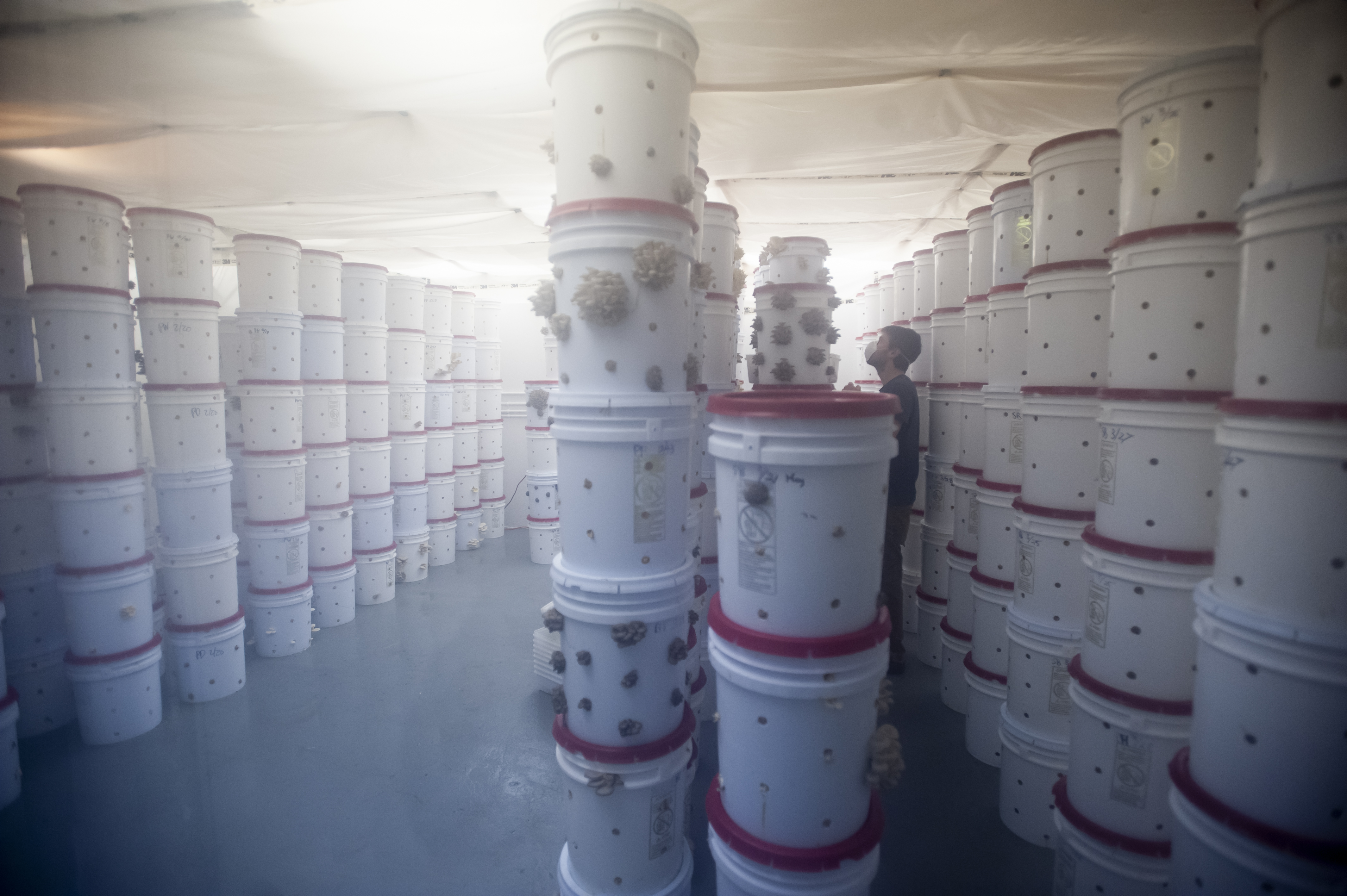
His stated ambition was broader than a fascination with a particular crop. He wanted useful work in the community, carried out sustainably. That early explanation gives the later business a human scale. The company would become more complicated, but the question he asked of the work was already there.
“I want to be doing a positive thing for the community and doing it sustainably.”
Eliah Thanhauser, 2015
The farm with a laboratory attached
North Spore made its own spawn from the beginning. Spawn is the material growers use to establish a mushroom crop, serving a role comparable to seed. That choice brought laboratory work into the business while it was still a small farm. Carver’s scientific training was a useful complement to Thanhauser’s agricultural experience. It also opened a second market: other people who wanted to grow mushrooms needed supplies.
The distinction between selling a harvest and supplying another grower would gradually reshape the company. A fresh mushroom goes to a restaurant or a household. Growing supplies go to someone preparing a harvest of their own. The transaction carries an expectation of knowledge along with the material. How should it be used? What equipment belongs with it? What does a beginner need to understand before starting?
By 2015, North Spore had added grow kits, spawn, and equipment for home cultivation. The business began serving a wider group without requiring every customer to become a commercial farmer. A kitchen experiment and a farm operation have different needs. Making room for both gave the founders a business to develop beyond their own fresh crop.
- 01 Cultures
- 02 Spawn
- 03 Supplies
- 04 Growers
North Spore produces cultures and spawn in-house, then supplies customers growing mushrooms themselves.
A pitch with machinery in it
Growth required more than finding buyers. In 2018, North Spore returned to Gorham Savings Bank’s LaunchPad competition after being a finalist the previous year. This time it won the $50,000 prize. The judges responded to a plan to increase production capacity and efficiency through equipment. There was an autoclave and an autobagger in the company’s future. These are pleasingly concrete objects to find in a pitch.
The bank’s account says the grant purchased those machines. North Spore also won Greenlight Maine that year. Awards supplied attention and money, but the proposed use was the telling detail. The partners wanted to make the operation work better. A production business can collect admirers faster than it can process an order. Equipment helps close the gap.
Support also came through people who knew how growing companies worked. North Spore entered Maine Center for Entrepreneurs’ Cultivator program in 2018 and CEI’s Tastemakers program in 2019. Thanhauser later credited those programs with getting useful business resources to the company at the right time. The founders had learned their respective crafts. Running an expanding organization gave them another subject to study.
The crop moves to the customer
The fresh-mushroom business ran into a sharp contraction in 2020. Restaurant orders disappeared, and North Spore accelerated its move toward cultivation supplies and online sales. Equipment and instruction already had a place in the company. Now they would occupy far more of it. The transition demanded production capacity for a different kind of customer.
Maine Technology Institute supported the physical changes. Earlier seed funding had helped the company acquire hardwood-pellet processing equipment. Later support went toward laboratory improvements, an autoclave, and grain-processing machinery. The change in business model had pipes, filters, and processing equipment attached. It took investment in the operation to make the new direction practical.
Thanhauser oversaw construction efforts for the Portland production and fulfillment facility. At 25,000 square feet, it represented a different scale of responsibility from the early growing rooms. A building can be a wonderfully persuasive symbol of growth. It also has to function on a Tuesday, when materials need processing and orders need packing.
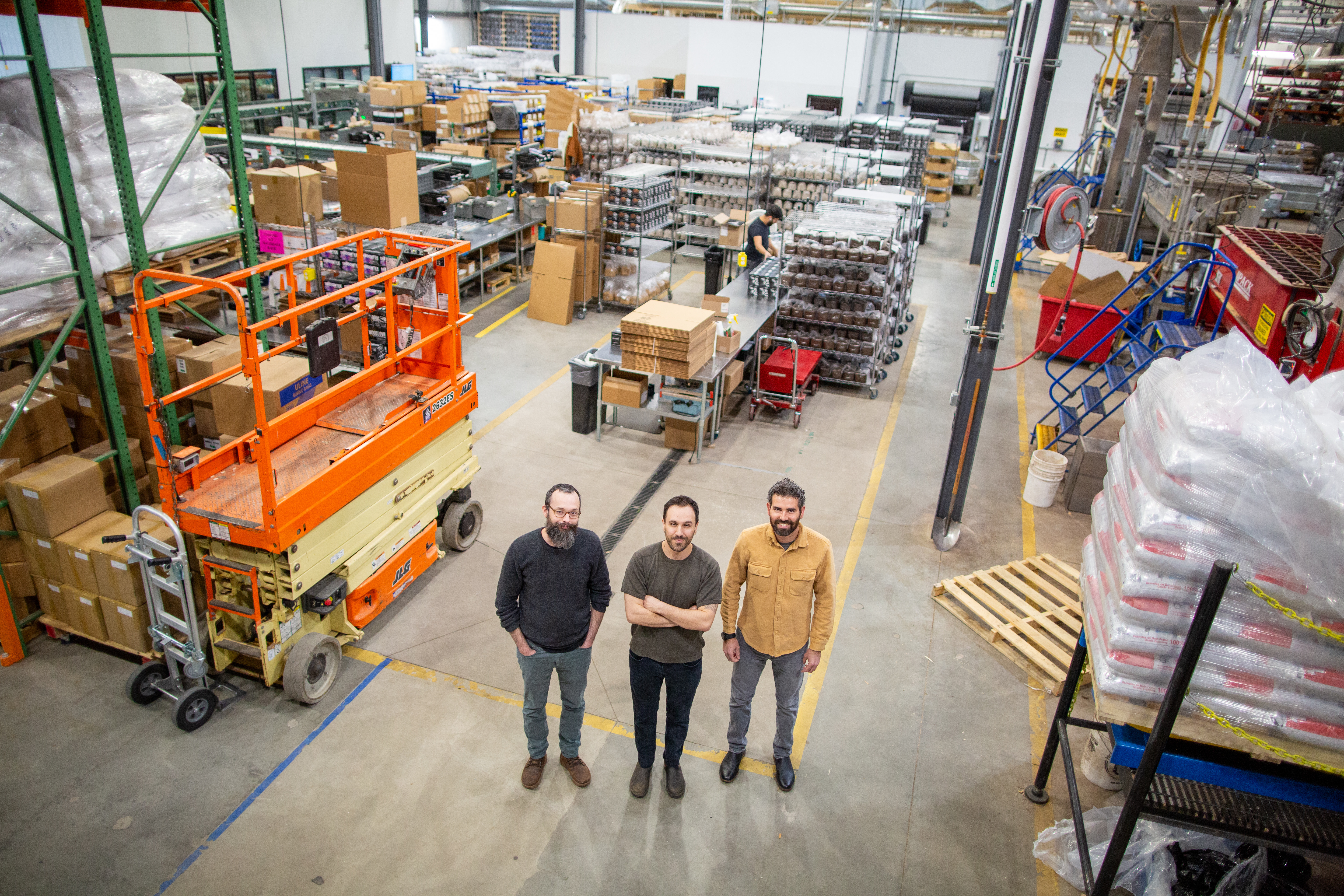
The company received Maine’s SBA Small Business Manufacturer award in 2025. The award account described a facility accommodating 76 employees and both production and shipping. It credited an SBA 504 loan with helping the expansion. The numbers belong to that moment in the company’s history. Their significance for Thanhauser is tangible: a project begun with two friends had become a workplace for dozens of people.
A room full of people who want to learn
Teaching became a substantial part of North Spore’s public life. Videos and written guidance helped customers understand cultivation. The company’s research partnership program, led by Carver, offered materials to people pursuing mushroom-related questions and shared their discoveries with a wider community. It was a way for the original partnership’s different interests to keep producing work beyond the founders themselves.
That community also gathered in person. In October 2024, MycoWizards released a two-hour conversation with Thanhauser recorded at North Spore’s Mycology Outside event at the Ecology School in southern Maine. Carver and McInnis were in the audience and contributed comments. The setting suited the subject: a discussion about an industry taking place among people who were participating in it.
The episode’s host described Thanhauser as curious and kind. Those are observations from someone who had sat with him, rather than personality scores assigned from a distance. Earlier that summer, Thanhauser had returned to his college for a public conversation with trustee Tony Mazlish about North Spore. His working life had become something he could bring back to the place where the partnership began.
“We wanted to build a community like the one we had all found at COA, to continue learning with and from each other.”
Eliah Thanhauser, College of the Atlantic alumni feature
The next job inside the same company
The leadership arrangement has since changed. Benjamin Chesler announced joining North Spore as CEO in 2025, after working with the founders as an adviser. Thanhauser’s current public profile identifies him as co-founder and president. A business started among friends can acquire new responsibilities and new people without losing the people who started it.
At a June 2025 Maine Accelerates Growth presentation, the company reported $16.5 million in revenue for 2024. The meeting notes described Thanhauser’s move toward operations and an ambition to expand mushroom supplies into garden centers and hardware stores. These were plans made at that time. They suggest a next chapter in which customers encounter the company alongside familiar gardening purchases.
What connects that possibility to the beginning is another person’s opportunity to grow something. Thanhauser came to the work through farms, woods, and friends with different skills. He helped build the place where those skills could become an operation. The first shipping receipt had been unhelpful to the margin. It was quite helpful to the education.
Keep following the conversation
Explore the work, hear Thanhauser in conversation, or take a closer look at the company’s beginnings.
- North Spore’s website and Thanhauser on LinkedIn
- Honest Ecommerce: the February 2026 interview
- MycoWizards: Thanhauser at Mycology Outside
- The College of the Atlantic alumni conversation
- Matt McInnis’s account of North Spore’s beginnings
- Watch North Spore’s bucket-growing video on YouTube
- The 2025 Maine manufacturing award
- North Spore’s company accounts: Instagram, Facebook, TikTok, and YouTube