Consider the missed pill. In most accounts of health, it belongs in the failure column: another day when intention lost to breakfast, a bus, a busy morning. In Elfie, reporting that missed pill can earn the same reward as reporting a taken one. The company has built a health business around a deceptively interesting distinction. A person can fail to follow a plan and still succeed at telling the truth.
- The offer: a free app for recording health, medication and everyday habits, with coins and rewards attached.
- The business: pharma companies, insurers, employers and researchers pay for programs and services.
- The question: can a reason to return today help people manage a condition that lasts for years?
That is a useful place to begin with Elfie. The company occupies the space between a consultation and the next consultation, where the patient has a treatment plan but also a life. Its wager is that an ordinary daily task becomes easier to repeat when it produces something more immediate than the promise of future health.
The reward is for the record
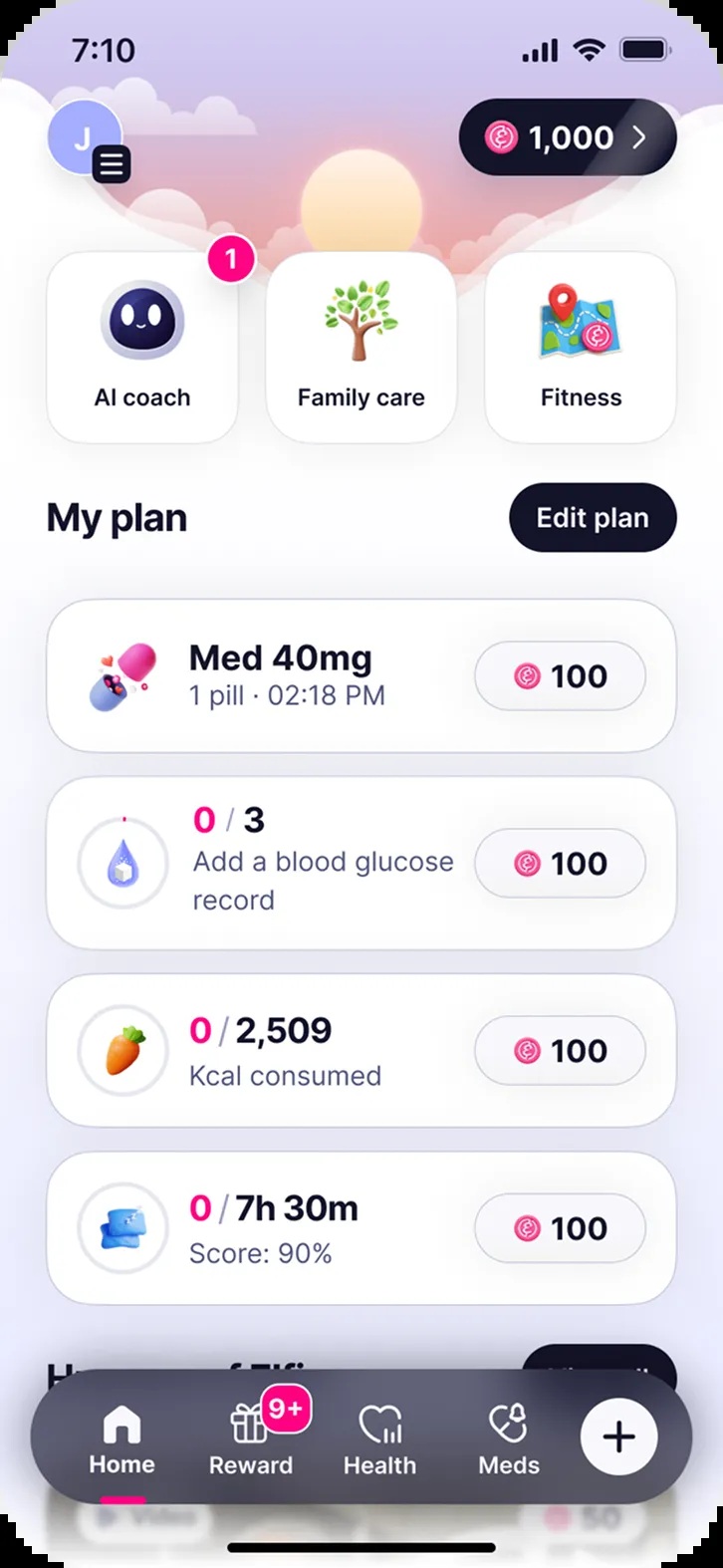
Users complete a health profile and receive a monitoring plan. They can record readings, log medication, walk, read educational material and collect virtual coins. Those coins lead to rewards, discounts or charity goals. The currency stays inside the app; it cannot be exchanged for cash or traded elsewhere. Rewards and features depend on the market.
The crucial detail lies in the rules. Normal and elevated readings receive equal rewards. So do reports of medication taken and medication skipped. An app that paid extra for good numbers would invite people to manufacture good numbers. Elfie removes that particular temptation. The design lesson travels well beyond healthcare: when you need accurate information, avoid making accuracy compete with the prize.
“We are seriously fun.”Elfie’s published gamification rules
There are limits to the merriment. Elfie’s ethics page says it does not reward medication purchases or excessive digital use, and does not pay doctors to recommend the app. The coins are an invitation to participate. Turning them into a reason to buy more medicine would change the bargain entirely.
Before the code, a way into the clinic
Founded in 2020 by Ofir Ejnes and Jean-François Legourd, Elfie did something worth stealing from its early calendar. Its first recruit, in February 2021, was a lead UX designer. Engineering began in May. The company says it waited until it had confirmed client traction and secured a market-access advantage.
By September, a private version was ready. In October, the app entered Vietnam through public and private hospitals, supported by a pharmaceutical partnership. Distribution was part of the original construction. A beautifully designed reminder has limited usefulness if the people who need it never encounter it.
That sequence also explains Elfie’s mix of expertise. Software, patient experience and commercial access sit beside medical oversight. Ejnes brings a software-development background; Legourd’s earlier roles include Samsung and Singtel. Dr. Jean-Jacques Mourad reviews clinical protocols and medical guidance. The company’s published values emphasize ownership and speaking up, sensible aspirations for a product whose cheerful interface sits on consequential information.


Free on one side, paid on the other
Elfie’s users and customers are different groups. The consumer app is free. Its paying customers include life-science companies buying patient engagement and anonymized real-world insights, employers and insurers buying health services, and research organizations buying recruitment and engagement support. Keeping a person involved is useful to several institutions at once.
Servier supplies a concrete example. Its FY2023-2024 report confirms an extension of the Elfie partnership for a further ten years, following deployments in Vietnam, Turkey, Egypt and Brazil. A subsequent sustainability case also describes an ongoing trial with 866 enrolled patients. This is a business relationship built around the long, repetitive business of chronic care.
In June 2025, Elfie announced a $12 million Series A led by White Star Capital, with LifeX Ventures and existing investors participating. The funding was intended to expand partnerships, the US team and research capabilities. It is capital raised, rather than a disclosed bill for building the app. Enterprise pricing varies by arrangement; insurer offers include per-member, engagement-based and outcome-based models.
ElfieCare gives healthcare professionals a free way to review what patients have recorded. ElfieWorks serves employers and insurers. ElfieResearch supports decentralized and hybrid studies, while ElfiePSP handles patient programs. These are different uses of the same underlying asset: people who are willing to keep showing up.
A million people, and a harder question
The company’s timeline reports reaching one million users in August 2025. Scale makes the idea interesting. Evidence makes it worth examining. A January 2026 journal-supplement abstract analyzed 22,901 users with uncontrolled hypertension in Brazil, Vietnam and Turkey, using pooled, self-reported data over twelve months.
22,901 users · 3 countries · observational analysis
The abstract reports improved blood-pressure control and medication-adherence trends. It was funded by Servier Affaires Médicales. An observational analysis cannot establish that Elfie caused those changes: treatment, continued participation and other differences may matter. That qualification belongs beside the result, rather than buried beneath the enthusiasm.
The habit is the product
Elfie fits between disease-specific monitoring tools, medication reminder apps and general wellness products. Its distinction is the combination: multiple conditions, connected health data, rewards and free consumer access. Users can import lab results, connect devices and manage family profiles. Convenience matters when one person has several conditions, or one caregiver is keeping track of several people.
The bargain still requires a usable phone, reliable measurements and a willingness to return. A discount cannot supply a blood-pressure cuff or replace clinical care. Elfie describes itself as a companion, not a medical device. Its most portable idea is smaller than its ambition: make the next honest action easy and worthwhile. Even an imperfect day can leave a useful record.