The compressed version of a pharmaceutical career fits on one slide: education, promotions, launches, boards. Eiry Roberts's version looks tidy from that distance. She qualified in medicine at the University of London in 1987, spent 26 years at Eli Lilly, became chief medical officer of Neurocrine Biosciences in 2018, and moved into strategic advising and public-company governance. But the useful story sits between those milestones. It is about learning to see the full chain of work - from an early scientific signal to the committee room where evidence is challenged, the team where a plan is built, and the boardroom where capital and patience must be allocated.
Roberts began with the individual scale of medicine. Her postgraduate clinical training at St. Bartholomew's Hospital and the Royal London Hospital covered clinical pharmacology and cardiology. Clinical pharmacology is a good school for intellectual humility: the molecule may be elegant, the theory persuasive, and the result still dependent on how a human body responds. Later, as her remit expanded, that habit of joining scientific detail to practical consequence would become her operating language.
01 / The apprenticeshipLearning the whole machine
Twenty-six years inside one large pharmaceutical company can be mistaken for one long job. Roberts's tenure at Lilly was closer to a sequence of apprenticeships. She worked in clinical pharmacology, led product development, took responsibility for research and development in the BioMedicines unit, and finished as a vice president in R&D. Each move widened the lens. A specialist asks whether the evidence is sound. A development leader must also ask whether the plan is executable. A portfolio leader has to decide which sound, executable plan deserves scarce attention now.
At Lilly, Roberts chaired the Medical Review Committee, which reviewed and approved integrated clinical plans across the company's portfolio. She also served on its Corporate Portfolio Management Committee and Lilly Ventures Steering Committee. These are not glamorous vantage points, but they are revealing ones. Committees see optimism arrive in polished decks. Their job is to test it without crushing the energy behind it. They must separate a promising result from a durable case and a fascinating program from the right program for the company.
The Roberts operating ladder
The record also shows Roberts working across alliances, business partnerships and venture collaborations. That matters because modern drug development is an exercise in handoffs. Discovery passes to development. A partner may supply a compound or a capability. Regulators interrogate the evidence. Commercial teams inherit years of assumptions. Every handoff creates a chance for context to leak. An executive who has occupied several positions along the chain can notice what each group forgets to tell the next.
02 / The builderTurning memory into capability
When Roberts joined Neurocrine in January 2018, she brought the memory of a much larger organization into a San Diego biotech with a newly commercial portfolio and ambitious development plans. The tempting move would have been to import the large-company apparatus wholesale. Her public record points to something more selective: building the clinical team and broadening the internal capabilities needed for Neurocrine's own stage of growth.
Capabilities are easy to praise and difficult to photograph. They live in review standards, hiring choices, operating cadence and the quality of questions asked before a program reaches a formal gate. They become visible only later, when several programs move at once without the organization losing its grip. In announcing Roberts's succession in 2025, Neurocrine highlighted both concrete program progress and the clinical development organization she had built. One is the milestone. The other is the machinery that can produce another.
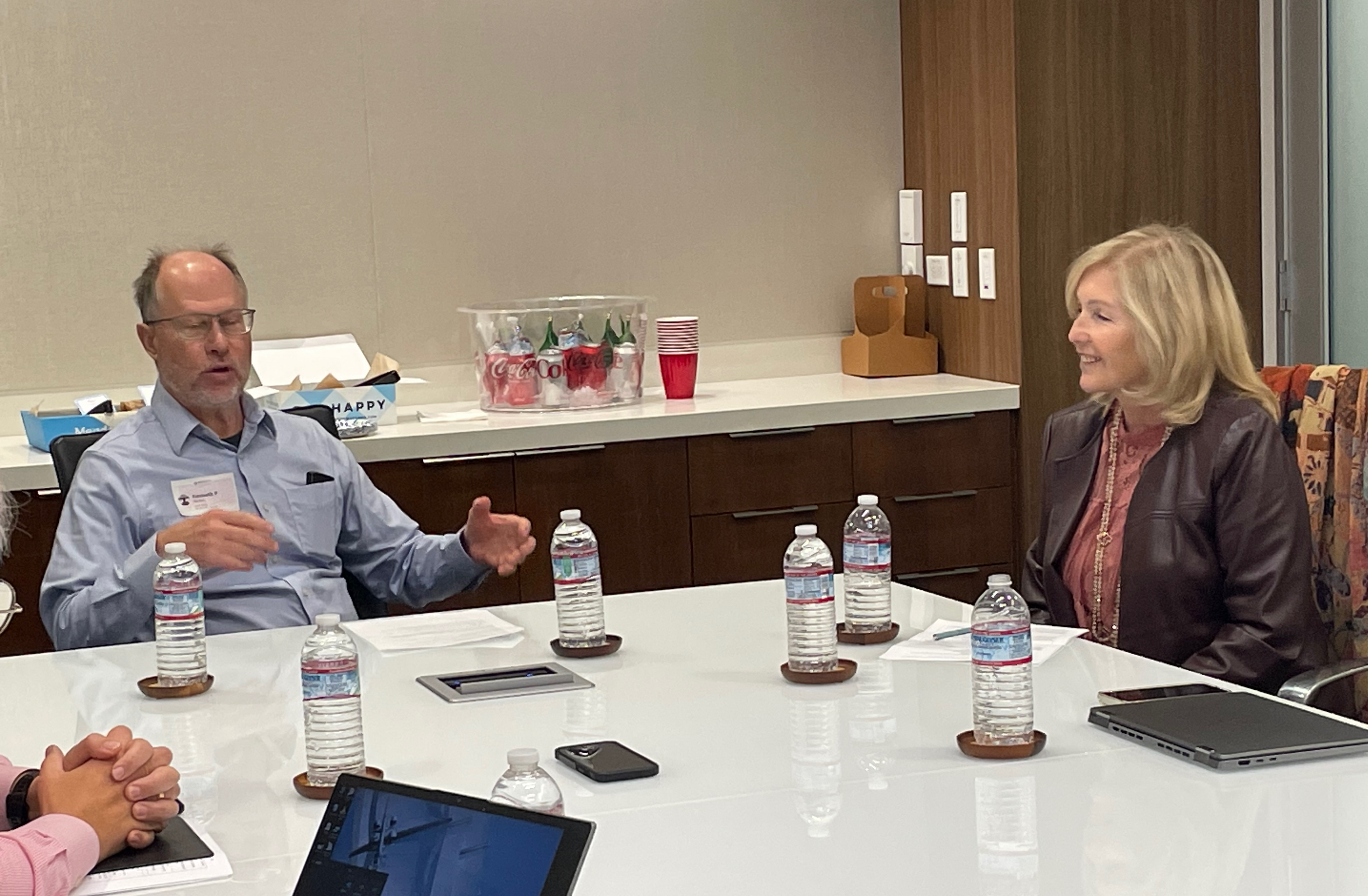
Her public appearances share a similar rhythm. On investor calls, Roberts tended to define what a study could answer, then name what remained unknowable until the data arrived. In one 2023 discussion of an early program, she resisted predicting monitoring requirements before seeing the clinical profile. It was a small exchange, but a useful tell. Good scientific communication does not remove uncertainty with confident language. It gives uncertainty a boundary.
That boundary matters in an industry where every audience wants a cleaner answer. Investors want a date. Teams want a green light. Partners want conviction. Leaders have to provide enough clarity for action without pretending the world is more settled than it is. Roberts's career across review committees, development programs and public calls made that translation a recurring part of the job.
A widening field of view
03 / The handoffSuccession without amnesia
Roberts left the CMO role on June 2, 2025, when Sanjay Keswani succeeded her. The transition was designed as a relay, not an exit. She became strategic adviser to Neurocrine's CEO, initially through the end of 2025. That November, the company extended the arrangement through December 31, 2026.
The extension says something about the value of operating memory. A pipeline contains decisions whose reasons may be years old. A senior team carries knowledge that never fits completely into minutes or databases: why one endpoint was chosen, where a partner relationship became fragile, which capability was hard to build, and which apparent shortcut has already been tried. Keeping a former operating leader close can preserve that context while the successor changes the system.
The arrangement also offers a practical model for executive succession. A clean organizational chart may demand a single owner. A healthy transition can still make room for continuity. The former leader does not need to hover over daily choices to be useful. She can become a callable archive, a pattern-matcher and a sparring partner for the decisions whose consequences travel furthest.
04 / The boardroomQuestions with longer time horizons
Roberts had already started building a governance portfolio before leaving the CMO seat. She joined the board of Amicus Therapeutics in June 2021. In May 2026, Bausch Health shareholders elected her as a new director, and the company made her chair of its Science and Technology Committee. The progression is coherent. The scientist learned the development system. The operator built within it. The director now evaluates how other organizations use it.
Board work changes the altitude and the clock. An operating executive is responsible for the next review, the next hiring decision, the next result. A director must consider whether the company is building a durable capacity to make good decisions across many cycles. Roberts brings a useful dual awareness to that room. She knows how a portfolio appears from above, and she knows what it feels like to carry one through the machinery below.
Her community work adds another dimension. Roberts has served on nonprofit boards for the Indianapolis Children's Choir and St. Richard's Episcopal School, and she has been an adjunct professor of medicine in clinical pharmacology at Indiana University. Those roles sit outside the usual public-company biography, yet they fit the pattern: institutions, learning, and stewardship over a longer horizon than any single project.
05 / What travelsA playbook for technical leaders
There is a stealable idea in Roberts's path for anyone moving from technical expertise into leadership: do not rush away from detail. Learn how the details connect. Her authority did not come from trading science for management. It came from adding layers - regulatory logic, portfolio tradeoffs, team design, partnership mechanics and public accountability - without discarding the foundation.
A second idea is to build competence that survives your title. Neurocrine did not describe Roberts's contribution only in terms of programs. It emphasized the team and the internal capabilities. That is a demanding standard for leadership because it shifts the proof beyond the leader's tenure. The question becomes whether the organization can continue to make sound choices after the person who shaped the system changes seats.
Roberts's next chapter is still being written across three institutions: advising at Neurocrine, directing at Amicus, and chairing science and technology oversight at Bausch Health. The common currency is judgment, accumulated slowly and now deployed at a wider angle. Her career is a reminder that the distance from lab bench to boardroom is not measured in promotions. It is measured in how many parts of the system a leader has learned to hold in view at once.