The most expensive part of a cheap hire is often everything that happens next. Someone has to issue the laptop, arrange payroll, explain the CRM, review the work, chase a missed shift and decide whether a wobbly first week is a training problem or a hiring problem. eFlexervices has built its pitch around this unglamorous truth. The company does not simply introduce U.S. businesses to Philippine talent. It volunteers to own the plumbing.
That sounds like a small semantic distinction until a manager has spent Tuesday morning debugging an overseas contractor's access to Zendesk. eFlex recruits, screens and shortlists candidates; the client interviews the finalists and makes the choice. After that, the specialist reports directly to the client's managers, while eFlex remains responsible for local HR, payroll, equipment, IT support, wellness and performance management. In its neatest phrase: “You lead the work. We handle the engine.”
The engine now supports a wide catalog of work: customer service, sales operations, accounting, collections, recruiting, executive assistance, software development, help desk, QA, security, data analysis, creative production, project management and freight coordination. The breadth can look like a diner menu. The underlying pattern is tighter. These are jobs with repeatable workflows, visible outputs and software tools that let a remote specialist sit inside a client's operating rhythm.
A family business with a two-sided promise
eFlexervices dates itself to 2001. CEO Rob Astudillo has described the beginning more personally: his parents started the journey, and he now works alongside his sister, Krystel Moore, the company's marketing and growth executive. The original idea joined two ambitions that still sit at opposite ends of the service - help business leaders scale while creating professional opportunity for people in the Philippines.
Astudillo served as company president from 2008 and moved into the CEO role in 2014. His background included web development and a hotel-marketing venture, which helps explain eFlex's early technical complexion. Today the company lists San Francisco as headquarters, maintains a Burlingame address and has a deep operating identity in Baguio. Public employee counts put the organization at roughly 170 people.
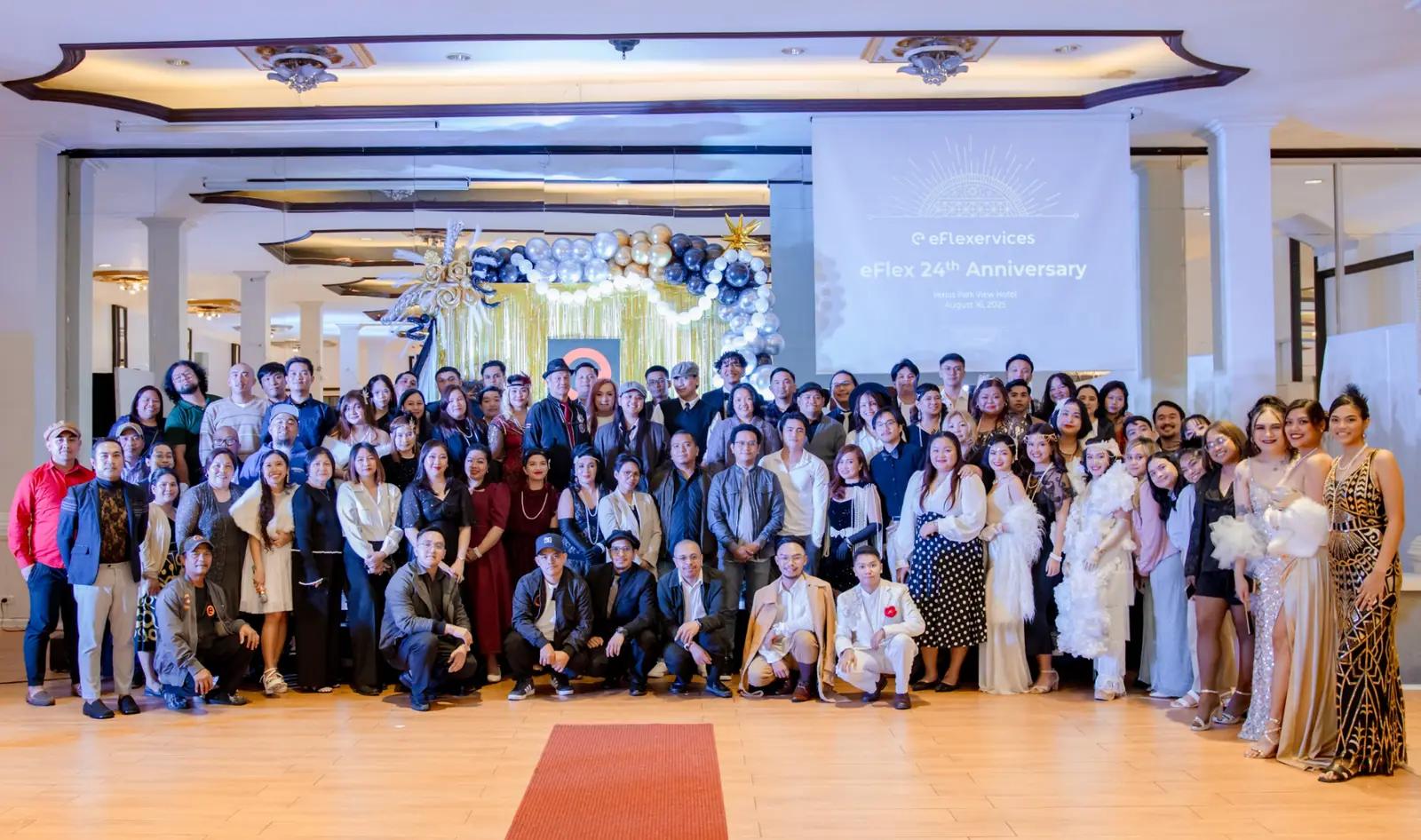
The culture pitch is conspicuously social for a remote-work company. eFlex advertises coaching, clear promotion paths, HMO coverage, paid leave and learning programs, with benefits varying by role. Its 2026 activity list ranged from a vision-board party to bowling, Mobile Legends esports and a mental-health reset. This is not incidental decoration. Retention is one of the things clients are buying, so an employee who feels attached to a Philippine team is less likely to vanish from an American client's workflow.
“The process is simple. The support is not.”eFlexervices on the work behind each placement
The product is the part staffing firms leave behind
The customer journey is deliberately plain. First, the client describes the role, schedule, tools and definition of good performance. eFlex recruits and vets. The client meets the best matches. Then the new hire starts reporting into the client's team while eFlex manages the local employment apparatus. Daily alignment, weekly performance pulses and monthly business reviews are meant to stop the relationship from becoming a handoff followed by silence.
That is the company's competitive wedge. A freelancer can be flexible but leaves management to the buyer. A staffing agency may find people but often stops short of hardware and daily support. Building a captive offshore office offers control, but comes with legal, facilities and management overhead. eFlex positions itself between those options: dedicated people under direct client direction, wrapped in a managed local structure.
The service comes in three rough sizes. A pilot starts with one dedicated specialist, a 30-day onboarding sprint, weekly check-ins and no required long-term commitment. The growth plan covers two to ten placements with biweekly reviews. Enterprise deployments begin at ten seats, add executive oversight and support multiple functions. The site says it can scale beyond 50 seats. Most prices are custom, which is sensible for a catalog ranging from chat agents to security engineers, though it makes casual comparison difficult.
The price card is vivid. The caveat matters.
Accounting is the rare corner where eFlex publishes dollar figures. It lists an offshore bookkeeper at roughly $1,400 to $2,000 a month, an accounts-receivable or accounts-payable specialist at $1,800 to $2,400, and a financial reporting analyst at $2,500 to $3,500. An accountant or CPA begins around $3,000 monthly. The company compares those all-in rates with U.S. salary, benefits and overhead, claiming typical savings of 40 to 60 percent.
Published monthly ranges, midpoint shown
Midpoints calculated from eFlex's public ranges. Role, experience and scope change the final rate; most services require a custom proposal.
The useful reading is not that every company will save 60 percent. A U.S. salary comparison is not a controlled experiment, and wage arbitrage alone can hide the cost of documentation, time-zone overlap and internal supervision. The stronger claim is operational: one fee covers the specialist and much of the machinery around that person. A buyer should compare the fully loaded alternatives, then insist on service levels that turn the spreadsheet savings into real capacity.
What failed first? The old support shape.
eFlex's best evidence is not a customer logo but a broken Monday. In one company case study, a data-and-business-intelligence associate named Jerald inherited a reporting routine built from 38 files pulled from CRM, product-analytics and sales systems. The reports consumed hours and arrived stale. He created automated pipelines, consistent transformation rules and a dashboard that produced a single report before 8 a.m. The company says three product decisions in the next quarter drew directly on that infrastructure.

Another case study describes a small, two-person technical desk overwhelmed by bugs, feature requests and enterprise escalations before an eFlex specialist helped turn support into a round-the-clock operation. A customer-support lead named Jefferson is credited with building 24/5 coverage across three continents, logging every escalation and feeding repeated issues back to product. In both stories, the first failure was not “we need offshore labor.” It was a process whose volume had outrun its shape.
What changes a skeptical buyer's mind is similarly concrete. One anonymous SaaS client, identified as a director of revenue operations, said a previous offshore provider had gone badly. The difference this time was that the eFlex team lead understood the client's CRM within two weeks and went on to run HubSpot operations independently. Another client began with one QA analyst and grew to a six-person QA and compliance team over 18 months. Trust arrived after a narrow test, not before it.
The best outsourcing pitch is not a promise of scale. It is a small piece of work that earns the right to scale.YesPress analysis
The playbook worth stealing: make the work legible
A reader does not need a Philippine operation to borrow the useful parts. eFlex's sequence is a compact management recipe: define a role in terms of outcomes, specify tools and working hours, let the manager choose among vetted candidates, train against the client's real workflow, and install a cadence for daily priorities, weekly blockers and monthly trends. Start with one bounded role. Scale only when the evidence says to.
Five moves an operator can copy on Monday
- Choose repeatable work with a visible queue or deliverable.
- Write down the tools, hours and definition of “done.”
- Give the worker direct access to the manager who owns the outcome.
- Review blockers weekly and operating trends monthly.
- Add headcount only after the first role produces clean evidence.
Security belongs in that operating recipe. In May 2026, eFlex announced that Johanson Group LLP had completed a SOC 2 Type II audit covering January 5 through April 5, with no exceptions noted in the tested controls. The review covered access, incident response, change management, data protection and internal procedures. That matters when an outsourced accountant, support agent or engineer will enter systems where “friendly and capable” is not an adequate security policy.
Good fit
A growing company has documented, repeatable work; can name an internal owner; needs dedicated capacity; and is willing to share tools, context and feedback.
Proceed carefully
The role depends on constant physical presence, local licensing, tacit knowledge nobody can document, irregular scraps of work, or data that cannot leave a tightly controlled environment.
There are conditions under which the model will disappoint. An unclear job remains unclear across an ocean. A founder who delegates tasks but withholds context creates a human API with terrible documentation. A workload too small or erratic for a dedicated seat may fit a freelancer better. A regulated function can require legal review beyond a provider's security certificate. And teams that cannot create meaningful working-hour overlap should expect slower decisions, however polished the dashboards.
The wide service catalog also asks buyers to check depth role by role. A provider capable of hiring both a bookkeeper and a QA engineer is convenient, but convenience is not proof of expertise. Interview the actual specialist. Inspect a work sample. Verify the promised software proficiency and ask who coaches the function after launch. The company says its indexed pool exceeds 34,000 professionals; the relevant number is how many are excellent at the one job in front of you.
Where eFlex fits: between a marketplace and your own office
In the crowded outsourcing market, eFlexervices is neither the giant contact-center campus nor the click-and-hire freelance bazaar. It is a mid-sized, family-rooted operator selling dedicated specialists with a management wrapper. That puts it alongside boutique BPOs and managed offshore staffing firms, competing with providers such as Peak Support and Helpware, larger names such as TaskUs and Teleperformance, and the increasingly viable choice to hire internationally through an employer-of-record platform.
Its most credible distinction is not the adjective “AI-enabled,” now nearly compulsory on service websites. It is the insistence that humans remain responsible for outputs while automation handles pieces such as data entry, CRM hygiene and reporting. That is modest, which is why it lands. Businesses are not shopping for a robot that improvises with their customers or books. They are shopping for more capacity without importing a second management crisis.
eFlex's wager is that the provider willing to do the boring work wins the long relationship. Recruiting gets the applause; payroll, access logs, coaching notes and equipment tickets keep the promise. Twenty-five years after the Astudillo family began the company, the offer has broadened dramatically. The core sale remains almost stubbornly practical: hand us a well-defined seat, keep control of the work, and let us make sure someone good can keep sitting in it.