After buying his first computer and a modem with his university allowance, Edwin Bruno had ten dollars left. He spent it on business cards. The purchase had a certain practicality: a computer could help him build a website, but somebody still had to know whom to call. Long before Smart Lab, corporate partnerships or accelerator programmes, there was the small matter of introducing himself.
His first customers had bought something rather different. At thirteen, Bruno sold cassettes; at seventeen, he moved to CDs. Then came websites for businesses. Across those changes in format, the transaction kept a familiar shape: find something people want, work out how to deliver it, persuade them to pay. The technology changed more quickly than the question.
Today, in Dar es Salaam, Bruno is the founder behind Smart Lab and the founder and chief executive of Smart Africa Group. His work brings students, startups and established companies into contact. Looking back through his career, an introduction begins to seem less like a courtesy than a piece of business infrastructure. A useful meeting can change what a person is able to attempt.
The student who sent an invoice
While studying computer science and engineering at St. Joseph’s, Bruno approached practical training as an opportunity to sell his skills. He described showing a company what he could improve, what it could save and where technology might help it compete. The pitch earned him the ability to charge as a consultant while still a student. Work experience had acquired a price list.
He later took his idea to the Dar Teknohama Business Incubator, associated with Tanzania’s Commission for Science and Technology. Friends joined him; the venture received office space. He remembered the earlier arrangement in a compact sentence: “My office was my university.” Smart Codes, founded in 2010, grew from those beginnings.
The incubator connection matters because Bruno eventually came to organise support for other entrepreneurs. He and his team were early DTBi beneficiaries, gaining experience of incubation and acceleration through DTBi and Buni Hub. The route from receiving help to arranging it for somebody else is unusually visible here. The office was useful; knowing how such an office could work for another founder became useful too.
“My office was my university.”
Edwin Bruno
A newspaper finds another way home
M-Paper gave Bruno’s technology business a recognisable product: newspapers and books delivered to a reader’s phone. It took a familiar purchase and changed the journey between publisher and reader. By 2015, the app had won an AppsAfrica educational innovation award. Bruno also received the Young Achiever of the Year award at the Tanzania Leadership Awards that year; Forbes Africa included him in its 2016 30 Under 30 selection.
His response to that recognition put the emphasis on his colleagues. “It is really for the whole team,” he said. Awards tend to arrive with one name printed in large type. Bruno was pointing towards the people doing the work behind it.
The way the app came together deserves as much attention as its awards. At his 2016 Startup Grind Dar es Salaam appearance, he discussed seeking publishers’ participation before proceeding with the app’s design. The order is revealing. Before investing heavily in the product, he worked on the relationships that would make the product possible. A digital newsstand with no newspapers would have been a beautifully organised vacancy.
He also advised founders to seek paying clients rather than wait for an investor or pitching competition. In his own account of financing Smart Codes, Bruno described reinvesting client revenue. The customer helped pay for what came next.
- MusicCassettes, then CDs
- MediaNewspapers on phones
- Market accessFounders meet corporate partners
An introduction becomes a programme
Smart Lab addressed a particular gap: university technology entrepreneurs needed a way to work with established companies. Bruno committed his own money to getting the idea started. The proposed relationship had something for both sides. Young builders brought ideas and technical ability; companies brought business problems, resources and potential routes to market.
That arrangement became more practical through programmes. In August 2020, Smart Lab announced university outreach with the Human Development Innovation Fund, designed to accommodate more than 400 students. The institutions named included the University of Dar es Salaam, St. Joseph University, Dar es Salaam Institute of Technology and the Institute of Finance and Management.
The activities included soft skills training, human-centred design workshops, corporate hackathons and a career fair. It was a plan to give students a business problem to wrestle with, and employers a chance to see how they wrestled. Four hundred was a programme target, rather than a claim that four hundred careers had already been transformed.
Bruno also confronted the employer’s side of the same difficulty. Smart Lab Talent, launched in May 2020, offered recruitment and outsourcing for engineering and technology teams. A company can want to modernise and still struggle to find the developer who will do the work. Connecting a person to a job is another version of connecting a product to a customer.
Smart Lab’s August 2020 university outreach plan, across four named institutions. A programme target, not a completion count.
The useful business of spare capacity
Bruno has given a concrete explanation of how an agency could support startups: skilled employees were not occupied by client projects every hour. Their available time could help develop another business. In a 2021 interview, he described contributing expertise to ventures, sometimes in exchange for equity. An unused hour on the agency’s schedule could become an investment elsewhere.
The same thinking connected product development with strategy, production and marketing. A startup might need help deciding whether a market existed, building its product and then explaining that product to customers. Bruno wanted those capabilities within reach of one another. It is an operating idea with consequences for the diary as much as the organisation chart.
The Vodacom Digital Accelerator gave that approach a corporate partner. Smart Lab worked with Vodacom to help startups develop and reach customers. Bruno’s explanation centred on access to an existing network and the trust associated with an established brand. Distribution is a less glamorous word than disruption, but a founder trying to make a sale may prefer it.
His own writing about apps is similarly attentive to the work after launch. In a 2017 column, he discussed acquiring users, keeping them and releasing improved versions. The download was a beginning. Getting someone to return, and giving that person a reason to stay, required further work. It is a useful corrective to the idea that the most consequential moment in a software business is the day somebody presses publish.
He would like a better-looking office building
For someone occupied with digital products, Bruno has opinions about the physical world. In a LinkedIn post, he urged architects and property owners in Tanzania, particularly Dar es Salaam, to build more inspiring workplaces. He acknowledged budgets, then pressed the point anyway. People, he argued, should have buildings that make them want to get up and go to work.
The complaint is wonderfully specific. Many executives can produce a statement about innovation on demand; fewer interrupt the conversation to object to the shape of the office. It gives a glimpse of the environments Bruno wants around the work, beyond the software running inside them.
His curiosity also has a public outlet in Executive Echo, a podcast about leadership, innovation and technology. In a late-2024 conversation with Stanbic Bank Tanzania’s Fredrick Max, he explored how banks, telecoms and startups serve smaller businesses. His accompanying questions included whether large companies pursue partnerships for shared growth or learn from a smaller partner and then dispense with it.
That is a pointed question for someone whose business depends on introductions. Getting two parties to meet does not settle whether the arrangement will be fair. Bruno’s podcast leaves room for the awkward part of collaboration: what happens after everyone has agreed that collaboration is a good idea.
Dar es Salaam, with a longer address book
In February 2023, Bruno joined a digital creative economy panel at Africa Tech Summit Nairobi, alongside Chimano of Sauti Sol and ONErpm’s Bilha Ngaruiya, moderated by Hustle Sasa’s Peng Chen. The company-building conversation had room for musicians, distribution and the economics of creative work. His interests extend beyond the software team to the person trying to make a living from what that software distributes.
By May 2025, Smart Africa Group’s activities spanned five businesses, including Smart Codes, Smart Lab, Smart Nology, Smart Studio and Smart Foundry. Its work connected marketing, technology, production and venture building, with a presence extending into neighbouring East African markets.
Bruno described the intended destination as the support he wished had existed when he started. He wanted other founders to encounter fewer of the obstacles he had met. That ambition supplies a useful measure for the group: the businesses it helps launch and the entrepreneurs it helps move forward. An expanding list of subsidiaries is easier to count; somebody else’s first viable customer may be more consequential.
The next introduction crosses a border
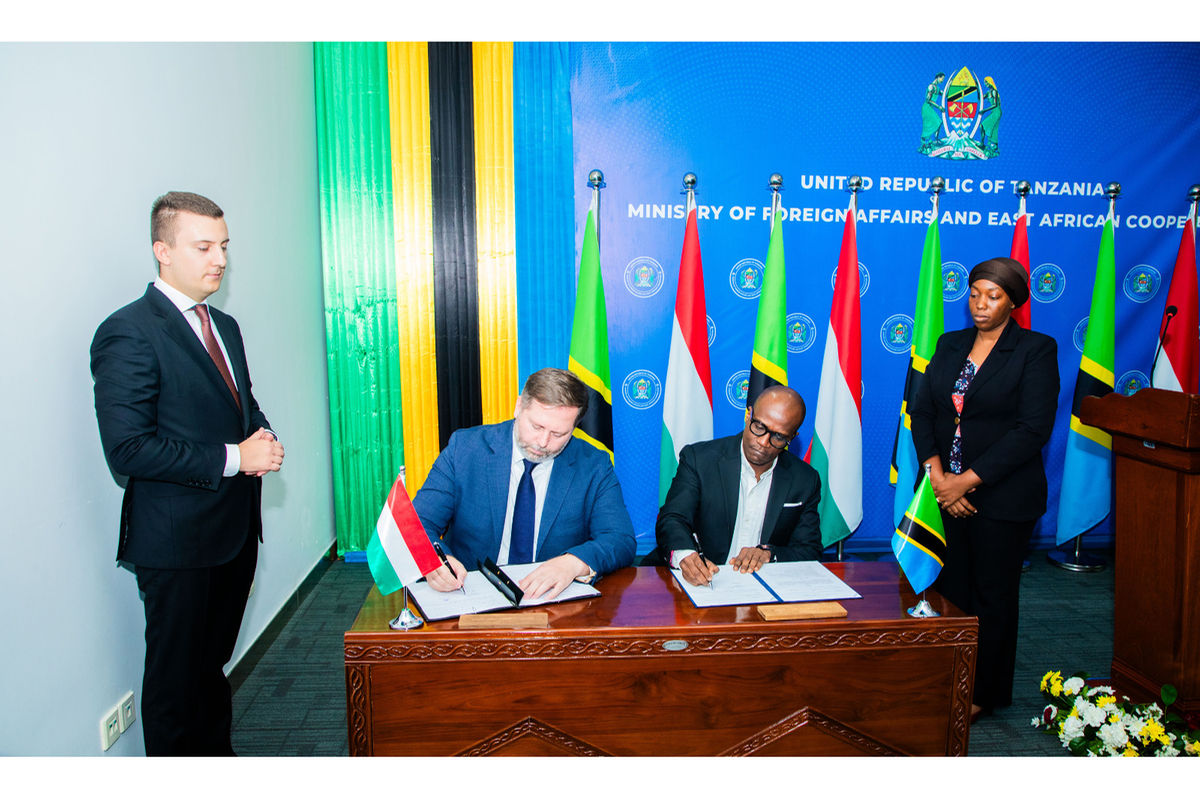
In September 2025, Bruno signed an agreement with MeOut Group’s president, Attila Sándor, connecting SmartLab with the Budapest-based organisation. The plans included Living Labs in Tanzania for testing AI applications in agriculture, climate resilience and digital inclusion, alongside training for young people, women and smaller enterprises. The agreement set out work to be done, rather than finished results.
The photograph is suitably official: documents, national flags, two men signing at a table. The task behind the ceremony is familiar from much earlier in Bruno’s career. Bring people with different resources into a relationship, then give them a practical reason to keep working together.
In January 2026, he was publicly recruiting a programmes and projects coordinator for Smart Lab. Even an ambition that reaches across borders needs somebody to manage the programme. His career has repeatedly returned to that distance between an idea and the arrangement that lets it happen. Once, a student spent his last ten dollars making himself reachable. Now, much of his work is about helping the next introduction lead somewhere.
Keep the conversation going
Explore Smart Africa Group and Smart Lab. Follow Edwin on LinkedIn, X and Instagram.
Watch Executive Echo on YouTube or the Africa Tech Summit creative economy panel. Read his column on building mobile apps, the 2023 career interview, the 2025 conversation about SAG, and the SmartLab–MeOut agreement report.