A billboard is a wonderfully impolite object. It interrupts the horizon, borrows eight seconds from a driver and makes a business proposition at sixty miles an hour. The work behind it is less theatrical. There are permits, steel, land rights, maintenance calls, local advertisers, traffic counts and an expensive piece of technology expected to survive the weather. Edward Lastes built his career in that backstage world, where a sign is not scenery. It is an operating asset with a hometown.
Lastes is the CEO of Fusion Media Group, the Massachusetts company formed in 2006 to work with independent outdoor-advertising operators. His public résumé calls him a C-suite executive and transaction professional. The more revealing description sits inside Fusion's original design: buy a majority interest, give an owner some liquidity or growth capital, bring the advantages of a larger organization, and keep the local management team running the business.
That last clause carried the idea. A conventional acquisition can treat local knowledge as something to be folded into a central office. Fusion treated it as part of what had been purchased. The people who knew which locations mattered, which advertisers paid, which municipalities required patience and which repairs could not wait were meant to remain at the controls. Capital would enter. Memory would stay.
The useful thing not to replace
The plan took about a year to develop. Lastes worked with Lars Swanson and Key Venture Partners on the proposition, drawing on a founding team that described more than thirty combined years financing and operating media companies and experience from more than sixty billboard acquisitions. In early 2008, Fusion announced a $7.5 million Series A commitment from the Waltham, Massachusetts investment firm. At the same closing, it made its first operating move by acquiring the assets of Genesis Media Advertising in Tyler, Texas.
The geography is instructive. Headquarters sat in Wenham, north of Boston. The first affiliate operated in East Texas. Fusion was national in ambition but deliberately local in execution. Its holding-company structure was supposed to provide purchasing power, capital and shared capabilities without pretending that a distant executive could learn every roadside market from a spreadsheet.
Lastes did not arrive at the arrangement as a media celebrity looking for a new category. An earlier corporate record places him in the finance seat as CFO and a director of Invincible Technologies Corporation, a Massachusetts technology company. His education record names Saint Michael's College, though it does not publish a degree or years. The visible arc is therefore functional rather than ornamental: finance, governance, transactions, then the construction of an operating company. Fusion needed someone who could see a local sign business as both a collection of physical assets and a set of human relationships. The CFO vocabulary covered the first half. The affiliation model addressed the second.
Calling oneself a transaction professional can sound like a preference for the moment of the deal. Fusion's structure pointed beyond that moment. Partial liquidity allowed an owner to take some value off the table without necessarily leaving. Low leverage was part of the proposition. Remaining equity left room for future upside. Local managers continued adding value after the lawyers closed their folders. This was not a purchase followed by a farewell; it was designed as a continuing arrangement between people whose incentives still had to make sense on Monday morning.
There is an old corporate temptation to mistake ownership for omniscience. Lastes's model resisted it. The parent company could supply money and leverage. The operator supplied context. Neither was ornamental. The transaction worked only if both sides understood the limits of what they knew.
The market backdrop helped explain the timing. Outdoor advertising was an old medium being altered by new display technology and better audience measurement. It also had a quality that television, radio and print could not easily imitate: a roadside board cannot be skipped, muted or placed under a pile of mail. Fusion saw a fragmented field of hundreds of independent operators and a chance to organize some of them without sanding away the entrepreneurial culture that made their assets productive. It was consolidation with an asterisk, and the asterisk was the local operator.
“The bottom line is that as a smaller company, we can't afford to make bad decisions.”Edward Lastes, on choosing a digital-display partner
A bright board and a sober calculation
In 2009, that philosophy met a very literal test. Connect Outdoor Media, a Fusion affiliate serving East Texas and Shreveport, converted a static billboard along U.S. Highway 259 north of Kilgore into its first digital display. More than 21,000 vehicles passed the location each day. The local operator projected that the new board would generate at least twelve times the revenue of the static sign it replaced.
The appeal was not mysterious. One printed face offers one message until somebody climbs up and changes it. A digital face can rotate campaigns and sell different moments of the day. Breakfast can belong to a cafe; the evening commute can belong to a car dealer. The pole remains planted while the inventory becomes elastic.
One location, a different revenue clock
The affiliate operator's 2009 projection for the converted Kilgore site, not a reported realized result.
Lastes's explanation of the supplier choice was conspicuously unromantic. He emphasized the manufacturer's financial stability, service network, relationships with large outdoor advertisers, customer base and staying power. A small company could not afford a glamorous machine attached to a fragile support system. The complete package mattered because the consequences of failure would not be theoretical. They would be standing beside the highway, blank.
That is a finance executive's view of innovation. It asks not only what the new thing can earn, but who will answer the phone when it stops earning. The digital sign offered speed and flexibility. The decision behind it demanded patience and a broad reading of risk.
The other kind of operating system
Seasons, councils and the habit of returning
A transaction record can make a person appear to live entirely among term sheets. Lastes's volunteer history offers a less air-conditioned picture. He coached and served on the board of Masconomet Youth Football from 2011 to 2015. He later spent two years as president of the Masconomet High School Football Boosters. Since 2023, he has served on Macalester College's Parent & Family Council. His parish affiliation with St. Rose of Lima reaches back to 1998.
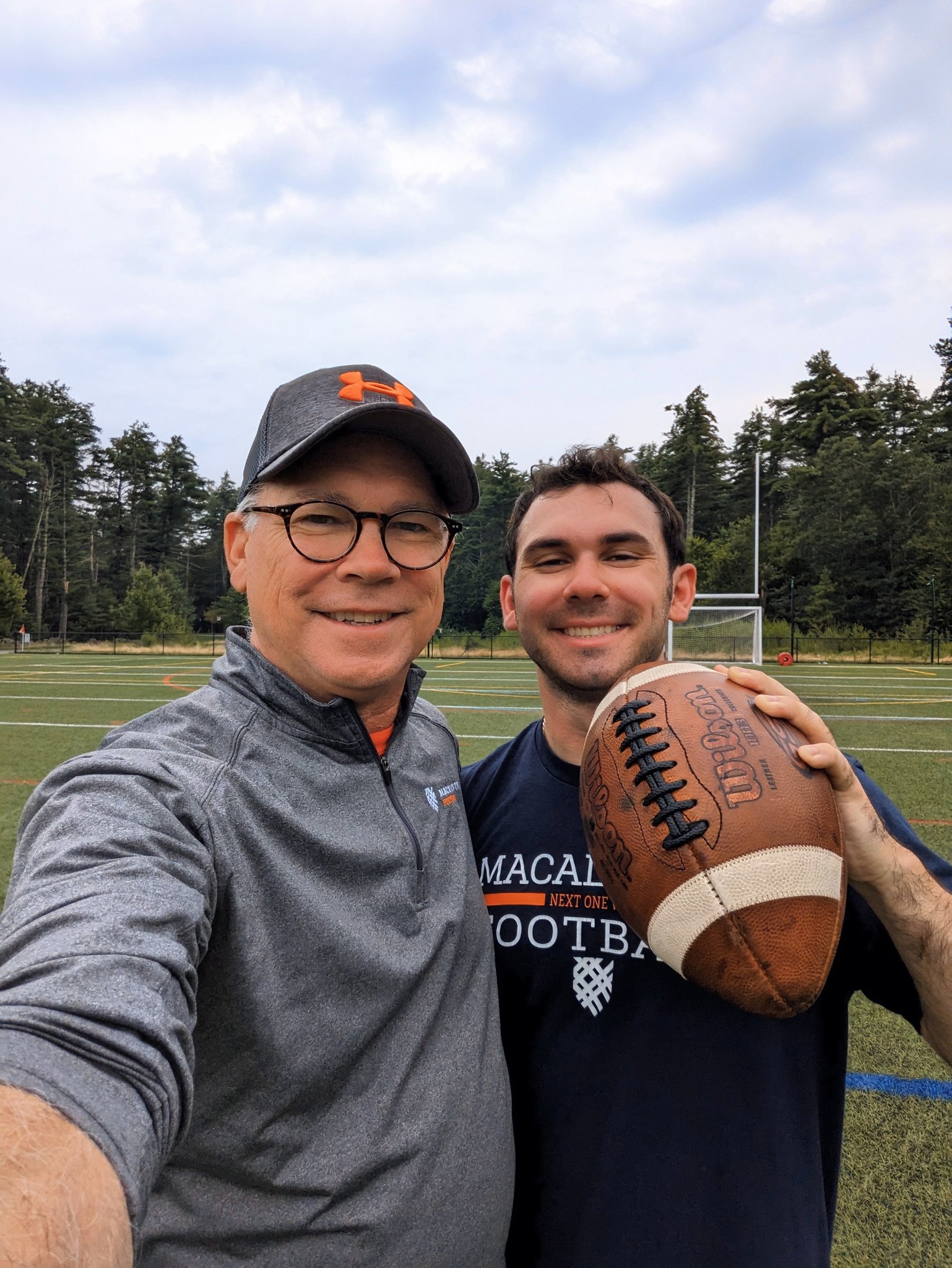
In August 2023, Lastes posted a photograph from a football field. He stood beside his son Marshall, who held a ball and wore a Macalester football shirt. The caption marked their last preseason workout before Marshall's senior season. It is a modest image, and precisely for that reason it says more than a staged executive portrait. Years of coaching and booster work narrow into one final workout between father and son.
The connection to his business career should not be strained into a parable. Football is football, and an acquisition is paperwork with better shoes. Yet both records reward the same unflashy behavior: show up repeatedly, respect the people nearest the action and build a structure that allows them to perform. A booster club, a parent council and a small-market billboard company all depend on work whose importance is larger than its glamour.
A public profile with the volume turned down
Lastes does not maintain the sort of public persona that requires a content calendar. His social accounts are sparse. His website currently offers a simple promise that a new version is coming and says the company looks forward to creating value with traditional and digital out-of-home media. His occasional posts include family football, congratulations to professional contacts and, once, a package of whoopie pies assembled with the frosted sides facing outward. The complaint was eight words and a long row of periods. Even the pastry received a due-diligence review.
The quieter profile makes the available decisions carry more weight. In 2008, Lastes described Fusion's ambition as building a meaningful company in out-of-home media with an investor who understood an unusual model. In 2009, he explained that a smaller company had little room for a poor technology choice. In 2016, a Massachusetts business record listed him as manager of Fusion Media Holdings II. The sequence is not dramatic, but it is consistent: structure the capital, preserve operating knowledge, choose infrastructure carefully and keep the platform alive.
The roadside medium itself has a sly lesson for anyone inclined to confuse loudness with endurance. A billboard wins attention by being enormous, but it earns its keep through ordinary repetition. Drivers pass. Advertisers rotate. Crews maintain the structure. Someone renews the lease and checks the display. Lastes's career has largely occupied that second category of visibility: less concerned with being seen than with keeping the thing that is seen in working order.
Fusion Media Group's original proposition remains the clearest expression of his work. Growth did not require pushing the local entrepreneur off the stage. Technology did not excuse careless vendor selection. Scale did not eliminate place. From a Massachusetts office to a Texas highway, the company tried to connect those truths. The billboard got brighter. The operator stayed in the picture.