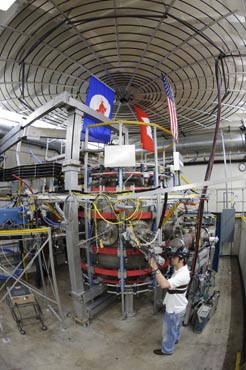
In an old laboratory photograph, Edward Hinson stands beside the Pegasus Toroidal Experiment, attending to a machine that takes up considerably more room than he does. Metalwork, cables and access platforms crowd the frame. It is an excellent antidote to the weightlessness of a startup pitch. Long before Hinson began talking about fusion power in orbit, there was equipment to maintain on Earth.
The photograph dates from 2010, when he was a graduate student at the University of Wisconsin–Madison. Today he is co-founder and CEO of Zephyr Fusion, which is developing a compact fusion power source for space. The proposed destination has changed. The underlying concern has stayed remarkably consistent: how to give a fusion plasma the conditions it needs without letting the surrounding engineering defeat the purpose.
His career can be followed through several versions of that problem. Materials exposed to plasma. Particles that need to leave it. Instruments that reveal where those particles go. Now, with co-founder Galen Burke, he is considering an environment where the vacuum surrounding the experiment comes with the address.
A research career starts against the wall
Hinson graduated from Middlebury College in 2006, having double-majored in mathematics and physics. A Fulbright U.S. Student Award took him to the Max Planck Institute for Plasma Physics near Munich for the 2006–2007 academic year.
His research concerned plasma-induced erosion of materials being considered for shielding inside ITER, the international experimental fusion project. That is a wonderfully literal introduction to the subject. Before asking what fusion might do for the world, a researcher has to consider what the plasma might do to the walls.
At the time, Hinson said fusion was the field he wanted to pursue professionally. He was already doing experimental work abroad, applying his undergraduate training to a specific reactor problem. His later career would keep returning to the boundary between a plasma’s useful behavior and the complications that come with containing it.
The friendship inside the experiment
At Wisconsin, Hinson worked on Pegasus, a spherical tokamak. Its nearly spherical shape distinguished it from the more elongated doughnut many people associate with magnetic fusion devices. The experiment served as a testbed for research relevant to larger machines.
Graduate school also supplied a future business partner. Hinson and Burke began their friendship and collaboration in 2010 while operating a spherical tokamak together. Fifteen years later, they would found Zephyr Fusion.
That interval gives their partnership a different texture from the usual introduction between prospective co-founders. They had already shared technical work before they shared a company. Their eventual division of responsibilities pairs Hinson’s leadership of company strategy with Burke’s direction of technical development.
Hinson earned his PhD in Nuclear Engineering and Engineering Physics at Wisconsin. His professional history includes research at Oak Ridge National Laboratory; Burke’s includes Lawrence Livermore National Laboratory. By the time they started Zephyr, each had spent years working within the practical demands of experimental plasma physics. Their partnership had a substantial laboratory history before it acquired a business plan.
The particles that have to leave
One particularly revealing episode in Hinson’s research concerns helium exhaust at DIII-D, the fusion research facility in San Diego. He led the author list on a 2020 paper examining how resonant magnetic perturbations affected the removal of helium from the plasma.
The technique modifies the magnetic field to suppress instabilities at the plasma’s edge. Those instabilities can expose internal surfaces to damaging bursts. The researchers found an additional benefit: the applied perturbations helped expel helium, the waste product of deuterium-tritium fusion.
The engineering tradeoff mattered. The same intervention could also reduce the confinement of heat, which the fusion process needs. A useful result therefore required more than getting helium out faster. The relationship between helium removal and energy loss had to improve. The work showed an improvement in that relationship.
This is the less photogenic side of an energy ambition: deciding what should remain inside a system, what should escape, and how much one can lose while encouraging the other. Hinson’s research dealt directly with that accounting.
His December 2020 seminar at Wisconsin followed the result across the experiment, discussing measurements in the core, edge and pumping region. It described reductions in effective helium confinement time and in its ratio to energy confinement time under the conditions studied. The finding belonged to a particular experiment, with a particular comparison. Keeping those boundaries visible is part of understanding what the achievement meant.
There was hands-on diagnostic work behind the broader research program, too. In spring 2017, Hinson installed pressure gauges in DIII-D’s lower pump ducts. They measured impurity partial pressures in the pumping plenum and were used in experiments involving nitrogen, argon, neon and helium.
A gauge in a duct is unlikely to become the centerpiece of a venture presentation. Yet it belongs in this story. If a researcher wants to understand exhaust, the particles’ destination must become measurable. The useful scientific question travels all the way from the plasma to the instruments that observe it.
Changing the surroundings
Zephyr Fusion, founded in 2025 and part of Y Combinator’s Fall 2025 batch, takes Hinson into a different kind of engineering argument. The company is pursuing megawatt-class power sources designed for orbit, where it hopes to supply activities that demand much more electricity than conventional small satellites use.
The proposal centers on a magnetic dipole. The founders describe plasma occupying a large region around a coil, extending into the surrounding vacuum. They argue that this arrangement could loosen the connection between plasma volume and the amount of enclosing hardware a terrestrial experiment requires.
That is the geographical twist in Hinson’s career. Space is usually introduced as a list of additional difficulties. Zephyr’s premise is that one of its characteristics, the available vacuum, could become a design advantage for this particular approach to fusion.
The argument remains a proposal for a power system under development. A favorable environment does not itself deliver electricity. The attraction is in the possibility of choosing surroundings that change the engineering burden, then building a machine that can exploit them.
A business measured in watts
Hinson’s own description of the problem is succinct: “the space economy is power-limited.” It is an infrastructure argument. The proposed customers need electricity to do something else: process materials, operate computing systems, propel spacecraft or support larger orbital facilities.
Thinking in those terms makes the commercial ambition more concrete. A manufacturer needs a workable production process. A computing operator needs usable capacity. A propulsion system needs enough power for its mission. Zephyr aims to become one of the suppliers behind those activities.
The founders point to improvements in high-temperature superconductors and falling launch costs as reasons to attempt the design now. Better magnets and less expensive transport would change different parts of the same engineering calculation. Their thesis depends on both the physics of confinement and the economics of getting the hardware into orbit.
“the space economy is power-limited.”
Edward Hinson, announcing Zephyr’s YC participation
Megawatt-class is the target, rather than an achieved output presented here. The distinction is central to reading Hinson’s story fairly. His earlier research has published results. His company has a proposed architecture and a market it wants to serve. Both belong in the profile, with their different stages of development intact.
The long preparation for a new address
Hinson’s public role now includes explaining that proposition beyond the laboratory. In March 2026, Alumni Ventures listed him for a conversation about fusion energy and space infrastructure alongside LeoLabs CEO Tony Frazier and investor Matt Caspari. The pairing placed energy generation beside the work of understanding and operating in orbit.
Wisconsin’s calendar also lists him, affiliated with Zephyr Fusion, for a plasma physics seminar on October 26, 2026. It is a scheduled return to a scientific setting that figures throughout his career, this time with a company attached to his name.
The early photograph remains a useful place to leave him: beside a machine, dealing with the physical details. The career that followed includes a doctorate, national-laboratory research, a published exhaust study and a collaboration sustained across fifteen years before a startup appeared.
Now the proposition is to take an energy system into orbit and make productive use of the emptiness around it. For a physicist whose early work concerned the punishment plasma inflicts on reactor materials, the appeal is easy to follow. The surroundings have become part of the experiment.