The most consequential screen in a school is rarely the one on the classroom wall. It is the quiet administrative screen where someone records an absence, changes an address, checks an immunization, builds a schedule or confirms that a student is on track to graduate. Get those facts wrong and the error travels: into a report card, a parent notification, a state filing, perhaps even a district's funding. Edupoint Educational Systems has spent more than two decades trying to make those facts travel correctly.
The Mesa, Arizona company builds Synergy Education Platform, a set of K-12 applications joined to one student record. Its customers are districts, regional agencies and state education departments; its daily users include registrars, principals, teachers, counselors, special education teams, parents and students. Edupoint says the platform now reaches more than 5.5 million students in over 7,500 schools. In the sleepy world of education infrastructure, that is a very busy piece of plumbing.
The product is a shared memory
Synergy begins with the student information system, or SIS: enrollment, demographics, attendance, scheduling, grades, health, discipline, transcripts and state reporting. Around that core sit TeacherVUE gradebook, ParentVUE and StudentVUE portals, online registration, lottery and athletics workflows, learning management, assessment, multi-tiered support, early warning, special education, 504 plans and analytics. Edupoint also sells implementation, cloud hosting, training, consulting and support.
The distinction is architectural, not alphabetical. Instead of acquiring a sack of applications and teaching them to swap files, Edupoint says its modules are built on one data model. An address corrected in the SIS can appear where it is needed. An interventionist can see current grades. A special education team can pull student details into compliant documents without typing them again. A parent can open the same family-facing portal for attendance, assignments and registration.
One record, many jobs
enrollment · attendance · schedules
gradebook · LMS · assessment
MTSS · early warning · IEP · 504
ParentVUE · StudentVUE · registration
state reports · workflows · permissions
dashboards · queries · analytics
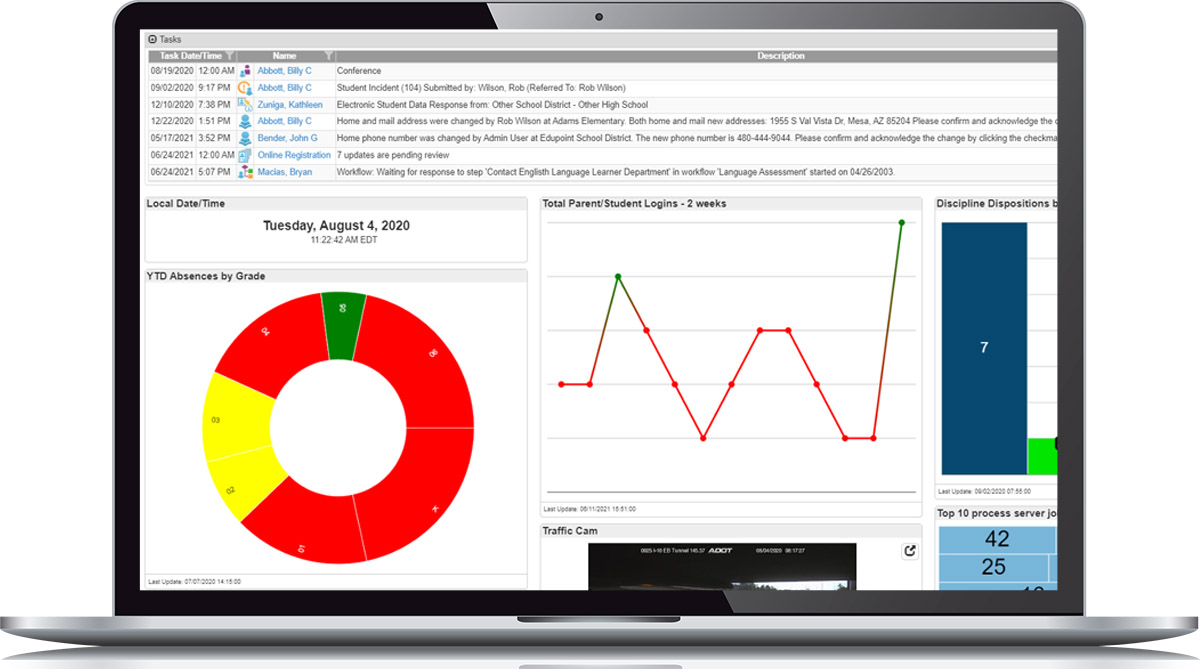
This is Edupoint's answer to a familiar enterprise-software nuisance: the swivel chair. A person looks at one system, turns to another, copies a number, exports a spreadsheet, sends a file overnight, then wonders which version is true. Synergy's promise is that the person can stay put. The company reinforces it with role-based dashboards, hundreds of reports, configurable fields and workflows, APIs, mobile apps and a development toolkit that districts can license for custom work.
How districts decide to buy
Edupoint does not sell to an impulsive founder with a credit card. A district SIS purchase can involve teachers, secretaries, schedulers, parents, students, technology staff and the school board. Prince George's County Public Schools, a Maryland district serving more than 128,000 students, put more than 60 stakeholders through a demo day before deeper evaluations of scheduling, reporting and data analysis. Synergy emerged as the favorite. Indian Prairie in Illinois ran a three-month search and collected nearly 60,000 evaluation points.
What changed buyers' minds was not one dazzling feature. It was the reduction of institutional anxiety: familiar references from nearby districts, reliable state reporting, mobile access, configurable workflows and one vendor to call. Highline Public Schools in Washington spoke to peer districts after its existing system was discontinued. Their reports that Synergy worked well, combined with Edupoint's state-reporting record, pushed the selection over the line.
“Synergy consistently ranked very high on customer service and product support based on feedback from our colleagues in benchmarked districts.”Andrew Zuckerman · Prince George's County Public Schools
That customer-reference engine is part of the business. Founder Bob Weathers started as an IT director for a large K-12 district before building student systems. Edupoint's published principles - “Do the Right Thing,” “Customer First Always” and “Partners for Life” - sound folksy until one remembers that a district may depend on the same vendor through several superintendents, new state rules and millions of attendance marks. The company runs training, support, consulting and an annual user conference because the software is never really finished.
What it costs
There is no useful sticker price. A district buys a particular mix of enrollment capacity, modules, hosting, migration and service. Public paperwork supplies the range. Poudre School District's 2025-26 amendment listed $242,120 for SIS and state-reporting maintenance, family portals, gradebook, an ST tool, online registration and assessment. A 2024 Beaverton renewal was $345,585. Montgomery County Public Schools approved roughly $2.24 million for a year after removing LMS from its bundle. Hillsborough County bought Synergy in 2019 for $8.5 million and expected more than $300,000 in annual savings after implementation.
The business model is therefore classic vertical enterprise software: licenses or subscriptions, annual maintenance, additional modules, cloud hosting, implementation, professional services and training. The company can land with the core SIS, then expand into registration, analytics, assessment or special services. Integrations with Google Classroom, ParentSquare, MySchoolBucks and education data standards make Synergy the system of record while allowing districts to keep specialist tools.
What failed first
Hillsborough County, Florida, offers the necessary cold shower. The district purchased Synergy in 2019 to replace a homegrown system more than 30 years old. The pandemic delayed the work. Superintendents changed. Formal project management was weak. When the system launched for the 2024-25 school year, teachers and staff reported inadequate training, technical problems and difficulty performing essential work. Consultants said Edupoint had not delivered everything in its agreements. District leaders considered alternatives while trying to stabilize the system.
What failed first was not a database in isolation. It was the implementation system around it: governance, continuity, testing, training and shared accountability between customer and vendor. The old software contained decades of local habits. Replacing it meant translating those habits, deciding which should survive and teaching thousands of people a new grammar before the first day of school.
One database can remove duplicate entry. It cannot remove organizational turnover, unclear ownership or the need to train the person taking attendance at 8:05 a.m.
This also explains why the model does not work everywhere. A district without a strong executive sponsor, empowered project manager, clean data, realistic migration window and protected training time can turn platform breadth into a liability. Heavy local customization may make a standard product feel restrictive. A small school with simple needs may be better served by a lighter system. A district unwilling to retire redundant tools will pay for unification while preserving the silos.
What builders can copy
Edupoint's most portable lesson is not “make an all-in-one.” It is to choose a painful source of truth and expand outward without losing it. Attendance and enrollment are not glamorous, but they are authoritative. Once the shared record is trusted, adjacent workflows become easier to sell. The second lesson is to treat support as product. In regulated verticals, expertise in state reporting, privacy, accessibility and special education is not customer success decoration. It is part of what the customer bought.
Anchor every module to the same live record before adding surface area.
Deep vertical focus turns tedious rules and edge cases into accumulated advantage.
Give cautious buyers references from organizations that resemble their own.
Migration, training and governance belong in the product plan and the budget.
Edupoint now competes with PowerSchool, Infinite Campus, Skyward, Focus and the stubborn remains of district-built systems. Its difference is the breadth of natively connected K-12 workflows and a company identity confined to that market. The constraint has teeth: every new state and module brings compliance work, support load and implementation risk. It also gives the company a plausible answer when a district asks whether the vendor understands the peculiar machinery of public education.
Recent momentum includes a statewide selection in New Mexico, renewed approved-vendor status in Tennessee, a ParentSquare integration partnership and 2025 and 2026 product awards. Edupoint was also named one of Arizona's top workplaces for the eighth time in 2026. The trophies are nice. The harder measure arrives every August, when schedules load, parents log in, teachers take attendance and nobody wants to think about the student information system at all. Infrastructure wins when it becomes boring again.
There is one more condition hiding inside that success: patience. Maine's education department once estimated that moving to Synergy would take 18 months to two years. That is a more honest product description than any feature grid. A district is not uploading a contacts list; it is relocating its institutional memory while classes continue. The practical playbook is plain: inventory every local workflow, clean the data before migration, name a decision-maker, rehearse with real users, phase optional modules and keep the old system available long enough to reconcile critical records. None of this is novel. That is why teams skip it. Edupoint works best when buyer and vendor treat go-live as the midpoint of a long operating relationship, not the finish line of a software purchase.