Imagine a contractor who has priced a hundred buildings. Somewhere in those hundred estimates is the going rate for an exam room, the last price paid for a curtain wall, and the cost of adding a floor after the owner changed the brief. Then a new project arrives, and the estimators begin looking for those answers in old files. The firm has the experience. Its software has mislaid it.
Ediphi is built around that small absurdity. The Boston company gives commercial contractors a cloud platform for cost modeling, estimating, unit prices, reporting and contracting. Its ambition is to make each estimate a usable record for the next job, with fewer exports and fewer side sheets between an early sketch and a price an owner can trust.
- What it sells: subscription software for preconstruction teams.
- Who uses it: general contractors and estimators, including DPR, Hensel Phelps, Wright-Ryan and Stevens Construction.
- The point: keep historical costs, live estimates and revisions in one place.
- The proof to watch: customer-reported time saved on early budgets, not a magic price for every building.
The expensive art of finding an old number
An estimate is a moving target. At the start, the owner may know that a building needs offices, bathrooms and exam rooms, but have no floor plan. Later come geometry, finishes, mechanical systems, bids, fees and revisions. Pricing the first idea and explaining the twentieth version require different levels of detail. In many offices, the steps live in separate tools. Historical costs must be exported, cleaned, imported and interpreted before anyone can use them to model a new job.
That handoff was Ediphi's opening. Its cost modeling feature sits beside detailed estimating. A team can mark an old estimate as a benchmark, compare like projects, and carry the model toward a fuller estimate. The Unit Price Catalog records line items and regional prices, including where a number was used before. An estimator can inspect the history behind a unit cost instead of accepting an orphaned cell with an impressive decimal point.
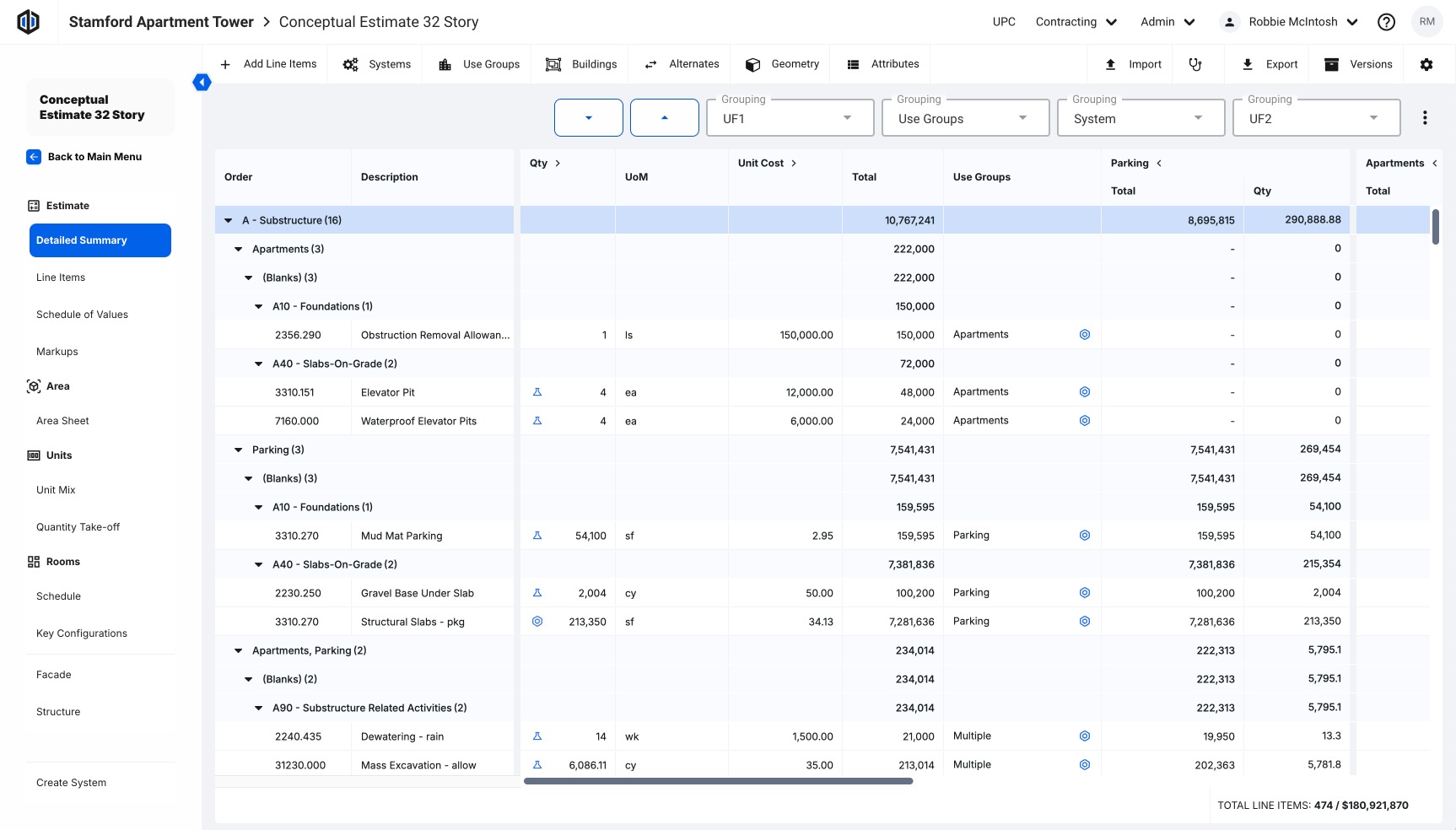
The platform has building-shaped ways of thinking: use groups for areas with different purposes, area sheets tied to geometry, and reusable units, rooms, systems and assemblies. Change the number of repeated rooms or the floor area and the linked costs can be recalculated. The familiar line item is still there. Ediphi simply gives the line item more context.
The test was a real estimate
Wright-Ryan Construction offers a useful, modest test of the thesis. Brian Labossier, a senior estimator in Maine, was replacing Sage Estimating. He opened an Ediphi sandbox and tried the catalog and its systems-based method. The method had a learning curve: he had to think through use groups and area sheets instead of reaching for a template. But for a conceptual budget, he reported a change from roughly eight hours of work to one.
Hours for a conceptual budget, according to Wright-Ryan estimator Brian Labossier. It is his account of one workflow, not a guaranteed result for every project.
His account is especially interesting because it includes the awkward bit. On larger schematic estimates with many line items, Labossier said he can spend more time inside Ediphi. The savings arrive elsewhere: less takeoff work and fewer trips among spreadsheets. His favorite detail may be the last mile, where customized Excel reports can feed from the estimate. Software that asks a contractor to abandon every familiar document would be making a rather expensive demand for purity.
“On a conceptual budget, you're going to cut from eight hours to one hour.”Brian Labossier / Wright-Ryan Construction
Stevens Construction took another sensible route. Its team imported its own cost database before testing Ediphi, then trained the wider preconstruction group. Director Nick Burkel says the units, rooms and systems structure helps when a client has requirements but no plan. His team can begin with a count of offices or exam rooms and work toward a footprint and budget. Stevens says estimating time fell by half. Again, the important ingredient is its own data. A catalog does not invent trustworthy local costs merely by looking tidy.
A founder who had already seen the handoff
Ediphi's co-founder and chief executive, Dustin DeVan, spent six years as a general contractor before founding BuildingConnected, the preconstruction company Autodesk bought for $275 million. He returned to the same broad territory with CTO and co-founder Michael Navarro, a veteran of preconstruction and operations. Navarro had encountered the problem from the inside: while leading Suffolk estimators in 2017, he could not find a platform that fit their work, so he helped build one that Suffolk adopted nationwide. Their target at Ediphi was the moment cost knowledge disappears between tools, teams and project stages.
The company emerged with a $6.5 million seed round led by Suffolk Technologies in 2023. Norwest Venture Partners led a $12 million Series A the following March. Ediphi said its paying customer base grew tenfold in 2024. Those figures show investor conviction and early demand; they do not tell a buyer what a seat costs. Ediphi sells enterprise software through demos and customer agreements, and it does not publish a standard subscription price.
DPR Construction ran a year-long pilot with estimators, meeting Ediphi weekly to test and refine the platform, then selected it for a wider deployment in 2025. That duration says something. A contractor making thousands of estimates needs more than a clever screen. It needs common data structures without forcing every estimator to work in exactly the same way. Hensel Phelps is another named enterprise customer. By the end of 2025, Ediphi said five of the top 20 U.S. builders had enterprise-wide rollouts, and reported revenue growth above 200% for the year.
The catalog is the quiet centerpiece
There is a comic mismatch between the drama of construction and the humble name “Unit Price Catalog.” Yet that catalog is where Ediphi's case becomes concrete. Teams can keep personal working prices in MyUPC, propose useful entries for a shared company catalog, and apply regional costs. The aim is a number with provenance: what was priced, where, when and by whom. In April 2026, Ediphi rebuilt the catalog grid with search, filters and faster approval work. It is a product update with no theatrical flourish, and perhaps for that reason one of the more revealing ones.
The company has also filled gaps around the estimate. Multi-user collaboration lets colleagues work in the same cloud record. Above-the-line markups give teams a way to allocate fees, contingency and overhead inside an estimate. A native Togal.AI integration announced in May 2026 connects quantity takeoff to estimating, with Stevens Construction the first live customer. Ediphi Academy, launched in beta in June, gives users more than 50 short training videos and a foundations credential. In September, Ediphi announced it had completed a SOC 2 Type II examination, a relevant milestone when contractors entrust a vendor with years of proprietary cost data.
The alternatives are familiar: a desktop estimating package, a separate cost model, and the spreadsheet that somehow survives every software purchase. Ediphi's distinction is the connected record. It works best when a contractor has enough repeatable work and historical data to make comparisons meaningful, and when the team is willing to maintain a shared pricing vocabulary. On a wholly novel project, or with unreliable old estimates, a clean catalog can organize uncertainty but cannot abolish it.
There is a practical lesson here for any company buying workflow software. Begin with one real old project. Import the actual cost database. Ask an estimator to price a changed version, explain the number, and send a report in the format a client expects. That test is less glamorous than an empty demo account. It also reveals whether a system remembers what your business knows.