The idea arrived as an embarrassment. Dylan Etkin was leading Bitbucket, a source-code host built inside the company behind Jira, and the team was no longer seven people moving in a tight little pack. It was growing toward 40. Work crossed desks, repositories and release machinery. Yet Etkin could not plainly say what had shipped, whether it had helped, or whether the team was getting better. For someone surrounded by tools designed to make software work visible, this was an exquisitely software-shaped joke.
Then he noticed the neglected hinge in the whole process. A deployment was where months of design, code and argument finally touched a customer. Until then, the work was possibility. Afterward, it had consequence. Engineering organizations treated this decisive event almost as an administrative afterthought. Etkin later said the realization struck him “like a lightning bolt.” The deployment was the most important thing.
That observation became the spine of Sleuth, the San Francisco company Etkin co-founded in 2019 with Don Brown and Michael Knighten. It also explains the rest of his professional arc: an engineer who likes measurement, but distrusts measurement detached from action; a manager who wants machines to swallow toil, but not judgment; and a founder whose new preoccupation is what happens when AI agents inherit an organization's tools without inheriting its rules.
Learning the machinery from inside
Etkin had studied computer science at Arizona State University from 1997 to 2000. His master's work examined selective denial-of-service attacks against internet-based information systems, an early clue toward a career spent thinking about systems under pressure. In 2005 he joined Atlassian, then a small Australian software company, as one of Jira's first developers. He became Jira's first architect and later led engineering work for Bitbucket and Statuspage.
The long tenure matters. Etkin was not observing scale through a quarterly dashboard. He watched a company and its software change their operating rhythm. He and his future Sleuth co-founders have described helping Atlassian teams move from releases every nine months toward daily delivery. He spent ten years there, left, and later returned for another three. That gave him both the builder's view of a product and the manager's view of all the invisible coordination gathering around it.
“Engineering is a creative endeavor, and engineers are more similar to artists than assembly line workers.”Dylan Etkin
The quote supplies an important caveat to his appetite for metrics. Counting developers like widgets encourages performance theater. Measuring the delivery system can reveal where creative work is snagging on waiting, handoffs or avoidable process. Sleuth would organize itself around DORA metrics such as deployment frequency, lead time, change failure rate and recovery time. But Etkin's sharper point was always about the loop: observe a system, try a change, and see whether the change improved the outcome.
An idea with excellent survival instincts
Etkin began noodling on a deployment-centered product around 2015. He called it Deploy Hub. He was not ready to leave and start a company, and the category was still young. Another startup and a return to Atlassian provided credible reasons to wait. The annoying part was that the idea would not cooperate by becoming irrelevant. “I gave this thing plenty of time to die on the vine, and it's not going to,” he recalled. Every conversation about the gap animated him again.
Eventually timing did what persuasion could not. Brown was an architect at a successful startup. Knighten was a vice president of product at another. Etkin assumed neither would abandon a good job for his persistent idea. Both had been waiting for the right people to attempt something similar. Their combined Atlassian experience made early decisions unusually quick. Etkin has said their company-values exercise took about an hour because the founders already knew the behaviors they respected.
The name offered a less efficient exercise. Etkin searched for Sleuth, saw an available domain and bought it. Months later Knighten noticed the registration date did not make sense. Google had been correcting Etkin's misspelling while he searched, and he had purchased the wrong domain. Knighten quietly negotiated for sleuth.io and delivered it to Etkin as a wedding present. A company devoted to accurate visibility began with its CEO being foiled by invisible autocorrect.
The kindness trap
Sleuth's network supplied early customers, which was both welcome and misleading. People who knew the founders believed in the vision and paid reasonably early. The company took that as evidence that its initial deployment-tracking offer had found its market. Etkin later called it a false sense of product-market fit. Deployment tracking remained central, but organizations wanted the larger result: a way to understand engineering efficiency, improve it and communicate the effect.
It is a founder's version of an instrument-calibration problem. Revenue is a strong signal, but friendship can add noise. The task is to discover whether someone bought the product, the promise or the people. Sleuth expanded into DORA metrics, automated project health checks, resource and incident analysis, and workflows attached to engineering data. In 2020 it announced a $3 million seed round. A $22 million Series A led by Felicis followed in 2022, bringing reported funding to $25 million.
Etkin resisted the lonely dashboard. He has spoken of “dashboard graveyards,” places where accurate charts go to receive respectful neglect. His answer was automation: guardrails, notifications and actions that meet developers inside their normal tools. A useful measure should provoke a useful next move. Otherwise the metric becomes a particularly expensive wallpaper.
The robots acquire permissions
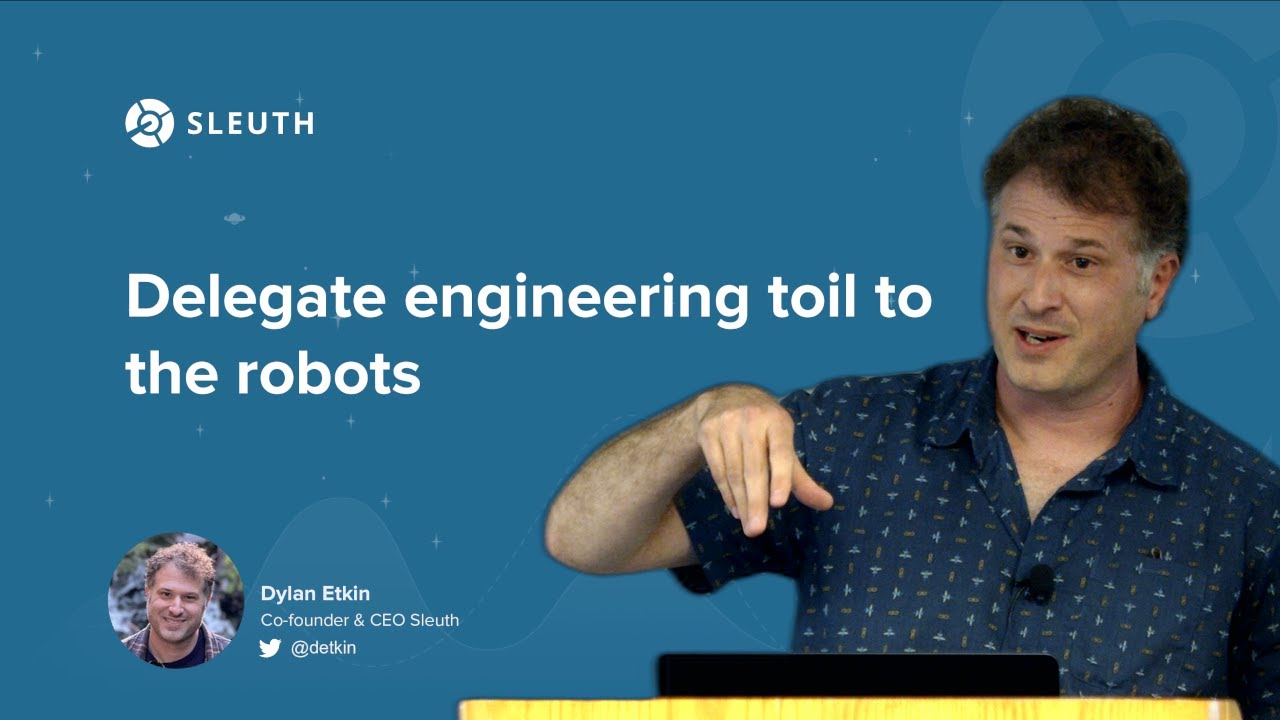
By 2023, Etkin was giving talks with the cheerful title “Delegate Engineering Toil to the Robots.” The thesis was practical: developer experience improves when teams automate the repetitive parts surrounding valuable work. Automations should be cheap enough to try, broad enough to matter and measurable enough to revise. This was optimism with a clipboard.
In 2026 the robots became capable enough to complicate the assignment. Companies were buying AI coding seats, connecting assistants to internal systems and watching a few developers become dramatically more effective. Etkin began writing about the missing organizational layer: reusable skills that encode a team's conventions, methods to distribute and evaluate them, and controls over the MCP connections that let agents reach systems such as customer databases, monitoring tools or communications platforms.
One small episode made the shift vivid. While changing Sleuth's sx command-line tool, Etkin spent about 45 minutes building an isolated Docker and tmux setup for an interactive test. He complained in Slack. Brown replied that he had made a skill for that. The skill captured the fussy procedure so another agent could repeat it. Etkin's lost afternoon turned into shared infrastructure.
But useful instructions also create questions. Which version is approved? Who can change it? What data may an agent reach? Etkin's concern about role-based access for skills and MCP is the natural sequel to his earlier work. Visibility without control produces anxiety. Control without distribution produces a wiki no one reads. He wants the practice close to the work, available across tools and auditable by the organization.
“We have 40 years of code that contains valuable knowledge, we need to make this easily accessible to our AI assistants.”Dylan Etkin
Mission control, with fewer blinking lights
There is a fitting personal detail in Etkin's conference biographies. He is a space enthusiast who has climbed around inside a life-size replica of the Mir space station in Star City, Russia. Spacecraft make the relationship between telemetry and action impossible to ignore. Every signal means little by itself. Together, interpreted by people with procedures and judgment, the signals allow a crew to act.
Etkin's career has stayed on Earth but retained the control-room problem. Jira organized work. Bitbucket organized code and review. Sleuth organized the moment that code became an event in the world. Its newest work tries to organize the knowledge and permission carried by AI agents. Each step adds machinery. His consistent interest is making the machinery understandable without making the humans behave like machinery.
This is also why his candid reflection on leadership lands. Etkin has described beginning life with “zero filter,” then learning to improve how he interacts because he wants to lead well, communicate clearly and empower smart people. The engineer in that admission is recognizable: notice an outcome, inspect the system, revise the behavior. No personal dashboard required.
The deployment insight survives because it is less about software than consequence. Work becomes meaningful when it reaches someone. Measurement becomes meaningful when it changes a decision. Automation becomes meaningful when it returns attention to people. For Etkin, the tools keep changing, from issue trackers to deployment intelligence to AI skills. The useful moment remains the same: when a possibility becomes real enough to learn from.