A Dragon 32 is an unlikely place to begin a story about cloud video. It was the computer Dror Ginzberg’s father gave him at twelve, followed by a programming course. Four years later, he sold his first software. Before there was a company to run, there was the satisfaction of making a machine do something useful.
Then came a less cooperative machine: the business. An early startup he formed with a friend ran into regulatory expenses that demanded more money than they had anticipated. They spent a year developing their product and trying to raise investment before closing it. A working program could still belong to an unworkable plan. The distinction was expensive enough to remember.
Ginzberg would eventually co-found Wochit, a company built around helping people make videos quickly. Its familiar promise of speed conceals a rather long apprenticeship. His story includes engineering jobs, an image business, a television conversation and the discovery that removing work for a customer creates a considerable amount of work for everyone building the product.
The television had too much to read
The idea that helped produce Wochit began with a conversation between friends about text on connected televisions. Reading all that information on a television seemed an awkward use of the screen. Could the information become video instead?
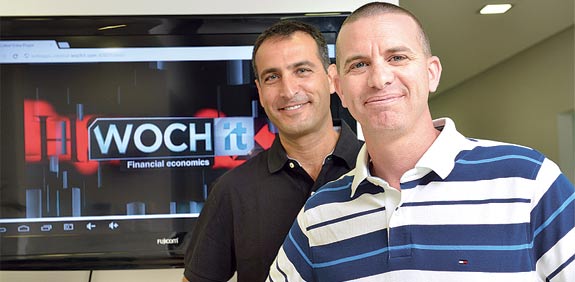
It was a modest irritation with large consequences. By 2012, Ginzberg and Ran Oz had founded Wochit. Oz brought his own experience as a co-founder of BigBand Networks. Together they were entering a business where the demand for moving images was growing faster than many publishers’ ability to make them.
The appealing part of their proposal was easy to explain. A newsroom already had stories. Photographs and footage already existed. Audiences were watching video. Connecting those things, however, involved production tools, permissions, narration and distribution. Every connection consumed time. Wochit set about reducing the distance between having something to say and having a video ready to show.
A career in the machinery
Ginzberg’s route to that problem ran through the machinery of communications. He served in MAMRAM, the Israeli military computer unit, working on telecommunications and information systems. His subsequent career included senior roles at Emblaze, Comverse and BeInSync, which was acquired by Phoenix Technologies.
He dates his work in video to 1996. That gave him a long view of an industry in which an attractive demonstration and an everyday product can be separated by years. A possibility on a screen still needs an infrastructure, a customer and a reason to be used regularly.
PicApp became another part of that education. Ginzberg was a co-founder and technology executive at the image business, acquired by Ybrant in 2011. Images were already his professional territory before Wochit began assembling them into moving stories. The continuity matters: his next venture required understanding both the technology of media and the arrangements that let people use it.
The assignment that became a job
His involvement with PicApp had an unusual opening. Yair Goldfinger, a friend and one of Mirabilis’s founders, asked him to assess the company. Ginzberg examined it for three days and presented his conclusions to the board. The response was an invitation to join and put those conclusions into practice.
A report is a comfortable object. It can identify problems without being obliged to answer tomorrow’s telephone call about them. Joining the business meant accepting the next stage: making the recommendations work. About a year and a half later, PicApp was acquired.
Ginzberg’s advice about investment carries a similar preference for looking underneath appearances. He has urged founders to investigate prospective investors by talking with people at companies they already back. Money arrives with a relationship attached. A useful reference call asks what that relationship feels like after the introductory meeting has ended.
- 2012Ginzberg and Ran Oz found Wochit.
- 2013The public video news service launches; a $4.75m Series A follows in May.
- 2014An $11m round and the Gutenberg Prize at the Tribeca Disruptive Innovation Awards.
A news story has a short appointment
When Wochit’s public service launched in February 2013, it monitored online topics and assembled short news videos using material from partners including Reuters and Getty Images. Narration accompanied the pictures. The aim was to supply a changing stream of clips that publishers could select for their audiences.
The urgency was commercial as well as editorial. A breaking story can attract attention before a conventional production process has found its coat. Publishers wanted video while readers were still arriving. A clip delivered after the audience had moved on might be perfectly serviceable and economically late.
Wochit’s early distribution partners included Grab Media, OneScreen and Rightster. Publishers could also use branded versions of the material. In May 2013, the company announced $4.75 million in Series A investment from Redpoint, Cedar Fund and Greycroft. The following year brought an $11 million round led by Marker. The short clip had acquired a substantial operation behind it.
The person inside the process
The company’s early production system included people at consequential points. Narrators recorded voiceovers. Moderators could alter the selection and treatment of material. As self-service tools developed, customers could take on that editorial role themselves.
Ginzberg’s formulation was deliberately practical. “You just have to be yourself and express your opinion.” The ambition was to let a person concentrate on expression while the platform dealt with more of the production apparatus. It was an invitation to participate, accompanied by a good deal of backstage engineering.
“You just have to be yourself and express your opinion.”
Dror Ginzberg, on making video creation accessible
There was also a hard limit to what speed could excuse. Early coverage raised concerns about the wording of one automatically assembled news report. Ginzberg separately emphasized the importance of quality checks and explained that Wochit’s output was intended to supplement the coverage newsrooms could produce. The tension was present from the beginning: making more material creates more occasions to exercise judgment.
A video can be assembled on time and still require a careful editor. That remains part of the work, however agreeable the software becomes.
Before editing, permission
In a 2018 interview, Ginzberg described Wochit through three ingredients: automation, creative tools and content. The last ingredient deserves its place beside the more visibly technical ones. A customer needs access to footage and the right to distribute the finished result.
His examples of automation could be thoroughly ordinary, such as changing a horizontal video into a square format. Useful software often earns its keep on chores like that. The storyteller should be able to think about an audience without spending the afternoon repeatedly adjusting a frame.
He described customers primarily as larger publishers and brands, with different production needs. Editorial teams might require volume; a brand might need fewer pieces for a different purpose. The common task was to bring usable media and approachable controls together. An editor without footage is still waiting to begin.
A video founder makes room for words
For someone selling video technology, Ginzberg has been notably willing to defend writing. In a 2015 essay, he rejected the prediction that video’s rise would erase the written word. Digital distribution had changed the newspaper business, he argued, while written journalism continued to be produced in abundance.
He saw video as a way to bring people toward that material. The position gave his company a more interesting purpose than declaring an older medium finished. A story could reach someone through moving images and still reward reading.
That argument also offers a useful way to understand Wochit’s customer. A publisher has reporting, an identity and an audience to serve. A new production tool has to fit those existing strengths. Announcing the death of everything already on the premises would be a rather difficult opening to a sales meeting.
Watching the audience, too
Ginzberg’s public writing ranged beyond production. In 2017, he examined Facebook Watch through the older dream of social television: people watching, discussing and recommending programmes together online. Earlier attempts, he argued, had struggled with fragmented adoption.
Facebook’s existing network made the experiment interesting to him. The audience and its connections could matter as much as the feature list. He framed its prospects as a test, rather than an accomplished result.
That distinction belongs in a career spent watching technical ideas become products. A demonstration proves that something can happen. An audience decides whether it becomes a habit. Ginzberg was looking at both ends of the video business: how a story gets made and what persuades people to gather around it.
There is a drummer in this story
The professional record has a pleasing change of tempo. His 2018 conference biography describes him playing funk and rock drums at local venues. Behind the company presentations was someone with another reason to care about timing.
His operating habits are less theatrical. He has described keeping a changing list of ten priorities, making decisions quickly and correcting mistakes as they become visible. He also treats repeated customer feedback as a reason to act. These are workmanlike practices for a business selling other people a shorter working process.
“Humor helps keep things in perspective,” he has said. It is sound equipment for a founder’s desk. So is the willingness to return to an ordinary problem after the interesting conversation about it has ended.
The question survives the product changes
Today, Wochit still lists Ginzberg as its co-founder and CEO. Its range includes Studio for video creation, Frame for an editor embedded in another platform, and WAVE for automated video production driven by data and templates. AI-assisted workflows now feature prominently in its offering.
The product vocabulary has changed since the early news clips. The underlying problem remains recognizable: organizations have information to communicate and a finite amount of time in which to make it watchable. Ginzberg’s work has stayed close to the practical obstacles between those two things.
The twelve-year-old with the Dragon 32 learned that instructions could make a computer perform a task. The founder’s longer education was in discovering everything surrounding that task: customers, capital, permissions, colleagues and judgment. Ten minutes of finished video can be a small thing. Making those ten minutes possible has occupied a much larger part of his life.