A car arrives at a dealership. The keys change hands. Everybody has got what they wanted, except the driver, who is now standing at the wrong dealership. To move the next car, someone must move the person. A business that looked like a straight line has become a loop.
- Draiver connects vehicle moves with drivers, dispatch software and delivery records.
- Customers can buy managed logistics or use the technology with their own people.
- The useful efficiency measure includes the journey between paid journeys.
This is a helpful place to begin with Draiver, founded in 2013 by Zarif Haque. Its business sits in the unglamorous space between a vehicle being available and being useful. A rental car needs another branch. An auction purchase needs its buyer. A service customer needs a car collected. Each request sounds small. Together, they create an elaborate scheduling problem.
The passenger nobody ordered
In a driveaway movement, a driver gets behind the wheel of the customer's vehicle. There is no need to wait for that car to fill a slot on a transporter. But there is still a person to schedule, a vehicle to inspect, a handover to record and another assignment to reach. The drive can be the easy part.
Draiver's Command Center, launched in 2024, builds plans around those dependencies. It displays moves and drivers on a map and in a table, recommends combinations of trips, and coordinates dispatch. The company's AI proposition becomes concrete here: suggest which movements belong together so drivers spend less time being repositioned.
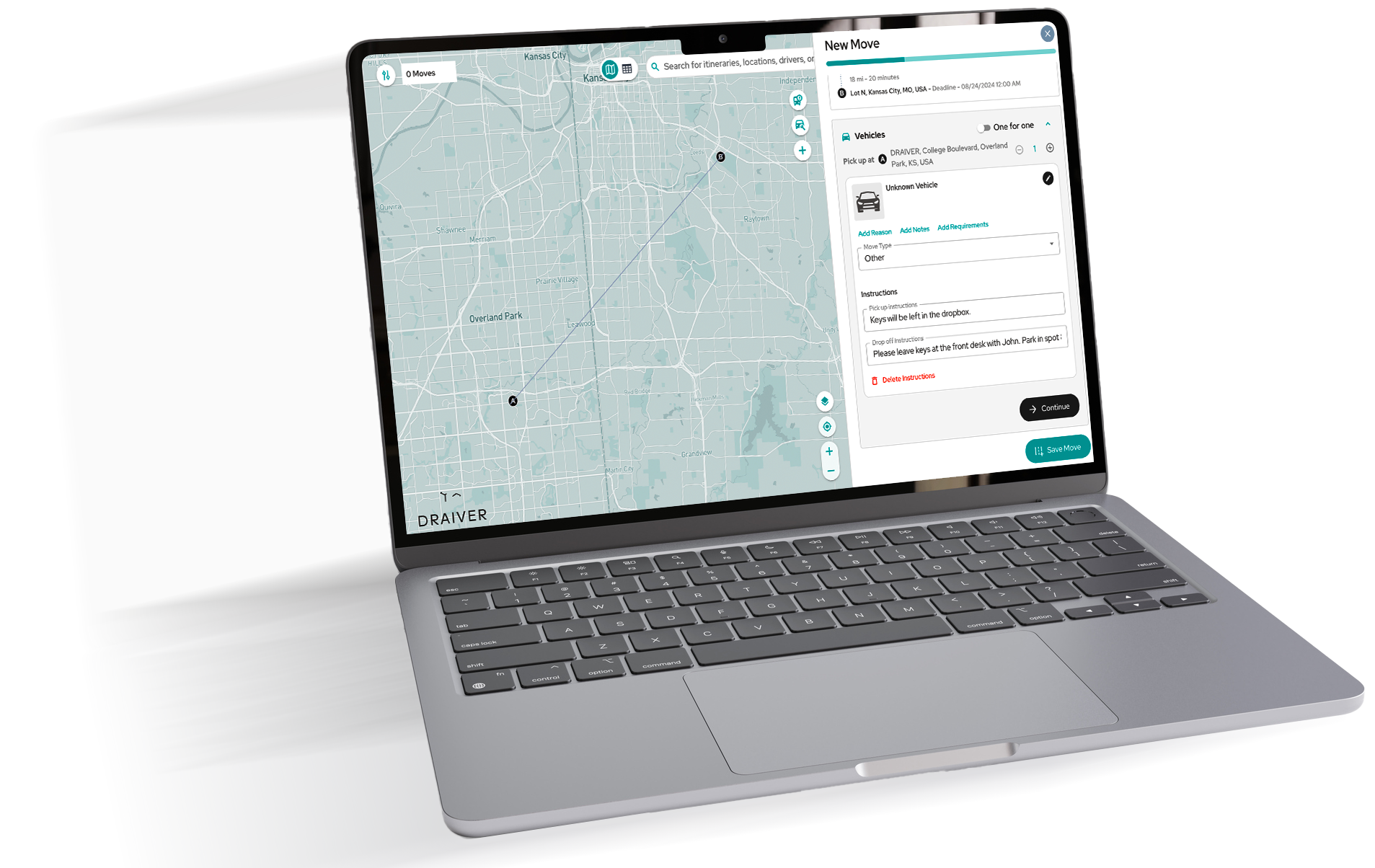
The driver app takes the plan into the street. It provides inspection workflows, photographs, expense capture and delivery records. A built-in chase tool arranges rides between assignments. Draiver deepened its Uber for Business API partnership in 2021, extending the relationship into vouchers for customer and employee travel. Passenger mobility became part of vehicle logistics.
“Our job is to make your job easier”Draiver's leadership page
That modest sentence is a useful test of the product. A dispatcher should have fewer calls to make. A customer should see the car's progress. A driver should know the next step. Technology earns its place by removing a specific piece of coordination from somebody's day.
Buy the movement. Or bring the drivers.
Draiver offers two ways into this system. Managed Services handles planning and coordination for customers who want the operation taken care of. Draiver SaaS lets businesses organize their existing drivers using the same planning and execution tools. Marketplace drivers can supply additional capacity when the customer's own team is stretched.
Its customers include manufacturers, dealer groups, auctions, rental businesses and fleet operators. Draiver's website displays names including Rivian, Enterprise, Hertz, Element and OPENLANE. Their reasons for moving vehicles differ, but all confront a related nuisance: inventory in the wrong place ties up money and attention.
The service menu now reaches beyond delivery into inspections, cleaning, fueling, charging, storage and title and registration work. The logic is practical. A delivered vehicle may still need several jobs completed before it can enter service. Coordinating those jobs in one workflow gives Draiver more of the customer's operational problem to solve.
Software pricing starts at $9 per VIN, according to the SaaS page, with special pricing for higher volumes. That figure is a software starting point. A buyer still needs to account for labor, fuel, tolls, repositioning and the selected service. The marketplace terms also describe service fees charged to drivers after accepting trips, covering matching and associated platform services.
The $16 hiding in a car move
The most useful number on Draiver's website may be one of its smaller ones. In an anonymous Ford dealership case, the company says cost per unit fell from $63 to $47. Daily units per driver rose from two to five. Those are company-reported results from one operation, rather than a forecast for every dealership.
$16 less per unit · approximately 25%
Anonymous Ford dealership on Draiver's SaaS page.
The difference suggests a better purchasing question than whether a route algorithm sounds clever. How many completed moves can each driver deliver in a working day, and what does each move cost after all the waiting and return travel? A cheap dispatch fee can coexist with an expensive operation.
An operator can copy the measurement before buying the system. Pick a recurring route, record pickup delays and chase time, count completed moves, and include inspection and administrative work in the cost. Then run a limited pilot. Draiver's separate anonymous auction case reports a pilot followed by expansion to 14 additional locations. Test, measure, expand is the transferable idea.
A map gets bigger. The handoffs stay local.
Draiver's current company timeline dates its acquisition by Kavak to 2021 and Federico Ranero's appointment as CEO to 2023. In September 2026, the company marked its Spanish launch in Madrid alongside Kavak. Its current website lists five operating countries: the United States, Canada, Mexico, Brazil and Spain.
140K+ contractor drivers in the network
5 countries on the current operating map
Scale matters, but a network count is not a promise that a suitable driver is around the corner. Availability varies by market. Driveaway also requires a vehicle that can be driven; Command Center advertises access to haulers for non-drivable units. A customer protecting mileage may prefer hauling. The right method follows the actual vehicle and assignment.
Nor is trip planning unique to Draiver. HopDrive offers dealership pickup and delivery, inspections and return rides. Draiver's pitch rests on combining its driver marketplace, in-house workforce software and wider readiness services. For a buyer, the comparison belongs at the level of a real day's work.
That brings us back to the driver at the dealership. A successful delivery has put the car where it belongs. A well-designed operation also knows what happens to the person holding the empty key envelope. Draiver is building its business around answering both questions.