A website developer slipped an extra letter into “entrepreneur.” Divesh Sharma could have asked for a correction. Instead, he kept the mistake and gave it a job. The eXtrepreneur would be a founder whose business ambitions crossed national boundaries. A small spelling accident became the vocabulary of D Globalist, the company he founded to help businesses expand abroad.
It is an appealing origin for a business concerned with unfamiliar territory. Something arrives looking slightly wrong; Sharma considers whether it might contain an opportunity. There is no need to turn a keyboard mishap into a theory of genius. What makes the anecdote revealing is the follow-through. The word appears throughout his company’s identity, right down to his title: Founder and Chief eXtrepreneur Officer. Even the business card has travel plans.
Behind the playful spelling sits a fairly demanding proposition. A founder can have a product customers want at home and still struggle to sell it elsewhere. Sharma has built his work around the people, commercial arrangements and local knowledge that sit between those two achievements. His subject is international ambition. His recurring concern is how to make it operational.
The adviser behind the extra letter
Sharma’s professional background supplies a useful explanation for that emphasis. His work includes investment management for ultra-high-net-worth individuals, international structuring, inbound and outbound investment advice, and fundraising for growth-stage businesses. He has advised companies across industries, with experience spanning manufacturing, consumer goods, real estate, education and information technology.
These are disciplines in which a promising idea soon acquires conditions. Money moves between jurisdictions. Companies need structures. An investor’s requirements enter the conversation. A founder may describe a border as a line on a map; the adviser has to consider what happens when a transaction crosses it.
That contrast helps explain the particular business Sharma chose to build. D Globalist combines access to founders and investors with expertise in business setup, regulation and market entry. His background gives the proposition a practical center: overseas expansion consists of decisions that affect one another. The market, the partner and the corporate arrangement belong in the same conversation.
His public work also resists a narrow industry identity. He deals with the recurring problem of entering another market rather than treating one kind of product as the only candidate for international growth. The resulting room can contain people who make physical goods alongside people who sell software. Their questions may differ sharply. Geography gives them a reason to compare notes.
First, find someone who knows the street
For all the expansiveness of his branding, Sharma’s account of entering a market is methodical. He describes a progression from testing demand to local relationships, then building an international team and considering a permanent presence. Commitment follows learning. A founder earns a better-informed next step by doing the previous one properly.
Local partners occupy an especially important place in that thinking. A person who understands the market can explain how a pitch will land, which introduction matters and what a prospective customer expects. His comparison is to a guide who understands unfamiliar surroundings.
“Think of it as finding a trusted guide who knows the local terrain.”
Divesh Sharma
It is a modest metaphor for a founder who enjoys ambitious terminology. The guide has been there before. That is the qualification. The value of the relationship lies in useful context, especially when a founder’s successful habits from home need adjustment. An introduction becomes more valuable when the person making it understands the question.
- 01Test the
demand - 02Build local
connections - 03Assemble a
global team - 04Consider a
permanent base
A sequence of decisions, rather than a race to open an office.
Dubai features in his thinking as a place where businesses can encounter customers from different backgrounds. His interest is in what those encounters can teach a founder. The broader point travels well: choosing a location also means choosing whose reactions you will hear. Expansion begins to look like an exercise in listening.
A room with a limit of 200
The annual Forbes India D Globalist Entrepreneur Mobility Summit, DGEMS, gives Sharma’s ideas a physical meeting place. Forbes India’s event program includes the 2023 gathering and the subsequent edition at Taj Palace in New Delhi on November 18, 2024. The Select 200 cohort brings together companies selected for their potential to operate internationally.
The structure matters to his story because Sharma is attempting to organize access. Founders meet other founders, investors and people familiar with particular markets. Recognition offers an opening for a conversation; the gathering puts prospective participants within speaking distance. A conference timetable is, among other things, a carefully printed theory of who should meet whom.
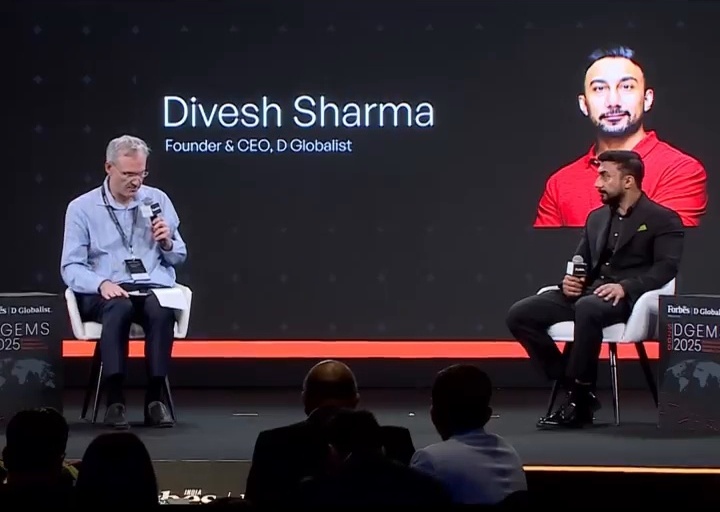
At the 2025 summit, investor Ron Levin asked Sharma what distinguished the offering from accelerators, events and government programs. Sharma’s answer emphasized a managed community, a shared international outlook and the collaboration with Forbes India. He connected the intake limit to the ability to look after the community.
That answer reveals an operational ambition beneath the language of borderlessness. A network needs boundaries of its own: who joins, why they are there and how much attention the organizer can give them. Selecting 200 companies each year creates a constraint Sharma can explain. Maintaining the usefulness of the relationships is the continuing task.
Companies selected for DGEMS each year. A limit Sharma links to managing the community.
The 2025 agenda shows the different conversations he wants that community to have. It includes venture investors, government representatives, alumni founders and businesses discussing their own expansion. Sharma’s fireside chat sits near the beginning. His role is partly to establish why these people belong in a conversation together, before the program separates their expertise into sessions.
Making the meeting last longer
An annual gathering creates a practical problem for anyone promising continuing help: eventually, everybody leaves. D Globalist’s response includes eXtrefy, a private digital network launched at DGEMS 2025. It gives the Select 200 community a place to maintain contact, exchange market knowledge and seek expansion connections between events.
The platform also brings technology into Sharma’s model. D Globalist describes an AI engine drawing on 600 companies and their expansion journeys to support contextual matching. The intended combination is human experience and software that helps members find relevant people. Its usefulness depends on the relevance of the connection it produces.
The company currently reports more than 1,400 founders in an ecosystem reaching 160 countries. Those figures describe its community and reach; they are not a count of offices Sharma operates. For his work, the distinction is consequential. Someone with experience in the right place may be more useful to a founder than an address on an international office list.
As the community grows, his responsibility changes. Bringing people together is one job. Helping them locate the experience they need inside a larger group is another. The platform extends the question posed at the summit: how does a founder find the person who can help with the next decision?
Generosity, with some administration
D Globalist’s Founders’ Code makes the social expectations explicit. Members are asked to make introductions, share lessons, respect confidentiality and contribute before expecting immediate returns. It also calls for an environment where useful discussion can survive without being overwhelmed by noise. Anyone who has joined a business messaging group will appreciate the administrative courage involved.
For Sharma’s proposition, those expectations are part of the design. Experience becomes useful to the next founder when someone takes the time to explain it. A community of people seeking assistance also needs people prepared to give it. The code tries to put that reciprocity into words before a member needs a favor.
The team behind him reflects the coordination involved. D Globalist lists venture strategy, global regulatory, brand and communications, and digital product roles. Its directory also includes specialists working across different regions. Sharma’s chosen title may be unusual, but the organization surrounding it has recognizable work to do: research, introduce, explain, build and follow up.
The ambition after the applause
The published 2026-2028 roadmap stretches the relationship beyond summit day. It sets out continuing platform access, founder evenings, branding support, regulatory assistance and investor introductions. Its proposed 2027 calendar includes meetings in Dubai, Mumbai, Bangalore and Delhi, alongside a US expansion week in San Francisco. These are program plans, with execution still ahead.
The direction is clear. Sharma wants the occasion to become an ongoing habit of founders helping one another enter markets. His own journey, from international advisory work to convening this community, places him between two kinds of expertise: knowing how cross-border business is arranged and knowing whom a founder should speak to next.
The extra letter survives because it offers members an identity to carry into those conversations. The practical work begins with a smaller act: asking a question, listening to someone who has faced it and deciding what to do with the answer. Sharma’s ambition gives that exchange an international address. A developer’s spelling error has found considerable employment.