The sentence arrives before Diljit Dosanjh does. “Punjabi aa gaye oye!” he calls, stretching the last word until an arena can climb inside it. Then the beat lands, the dancers move and several thousand phones rise in agreement. The phrase means the Punjabis have arrived. It is boast, greeting and roll call at once. In his mouth, arrival is plural.
That plural matters. Dosanjh has spent more than two decades becoming famous without behaving as if fame were a private country. His concerts are full of firsts, but he presents them as shared property. A full Punjabi set at Coachella in 2023. A sold-out BC Place in Vancouver the next year. Punjabi lyrics on American late-night television. Each new room is made to feel less like his conquest than a family wedding whose guest list got wonderfully out of hand.
The easy word for this is crossover. It is also the wrong shape. Crossover usually suggests leaving one lane, trimming a few local references and reporting to a wider audience in a language it already knows. Dosanjh kept the language. He kept the turban, the village jokes, the loose-limbed bhangra and the habit of addressing a crowd with the conspiratorial warmth of a cousin who has just noticed you near the sweets. The audience crossed over to him.
“Punjabi aa gaye oye!”A concert entrance, and a statement of fact
A bus leaves the village
He was born Diljit Singh in Dosanjh Kalan, a Punjab village whose name he would eventually carry around the world. At 11, he was sent to live with an uncle in Ludhiana. His mother wanted the city to offer what the village could not. The boy on the bus understood something harsher: perhaps he was less wanted than his younger brother. He stayed angry for more than a year.
The city supplied its own education. He sang devotional music at a local gurdwara. A schoolteacher discovered that he could memorize poetry quickly and began putting him forward to recite at competitions. At first, performance was simply a clever route to being dismissed from class early. Repetition did the rest. People began calling him an artist; eventually, he believed them.
His apprenticeship was not glamorous enough to acquire mythology. There were wedding parties and frequent local bookings. There was a first album, Ishq Da Uda Ada, recorded while he was still a teenager. Producer Rajinder Singh suggested changing the spelling of his first name from Daljit to Diljit. The surname came into sharper public use later, after people from his village honoured him during an early Canadian visit. Stardom began with two small editorial decisions: a vowel and a village.
He studied as well as performed. When he discovered Gurdas Maan, one of Punjabi music’s durable figures, Dosanjh went through the songs and stage shows with the attention of a mechanic opening an engine. He wanted to know why the work lasted. Michael Jackson was another early idol. Neither influence required imitation. What he borrowed was the seriousness of live presence: a song is only half alive until a crowd gets hold of it.
The actor hiding inside the pop star
Music made him recognizable. Punjabi cinema made him elastic. The Lion of Punjab in 2011 was the formal beginning, followed by films that let him become a romantic lead and, crucially, a comic one. Jatt & Juliet and its sequels drew on a quality interviews had already captured: he can make modesty funny without turning it into a performance of innocence.
His Hindi-film debut in Udta Punjab arrived in 2016, years after Punjabi audiences had learned his rhythms. On the first day, Kareena Kapoor Khan asked to take a photograph with him and members of her staff. He remembered the gesture because it dissolved the new boy’s unease. The performance won him Filmfare’s Best Male Debut award. More important, it revealed that the exuberant singer knew how to be still.
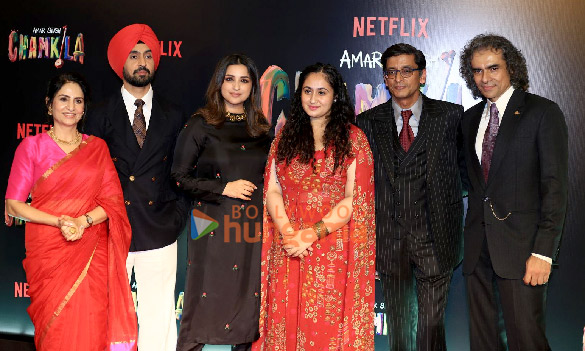
Amar Singh Chamkila asked for both halves of him. Imtiaz Ali’s 2024 film cast Dosanjh as the Punjabi singer whose blunt, popular songs made him famous and controversial in the 1980s. Dosanjh could not coast on imitation; too many viewers knew the voice, the posture and the history. His performance was nominated for Best Performance by an Actor at the 2025 International Emmy Awards. The nomination gave an international label to an ability Punjabi moviegoers had watched develop for years.
His gift is not switching between singer and actor. It is knowing how much of himself each room can bear.
A stadium-sized private dare
On his first trip to Canada, Dosanjh saw the stadiums. He was not yet playing them; he was learning that concerts could be that large. He made a private resolution. “When I arrived in Canada, that’s when I first saw the stadiums,” he recalled years later. Ambition often sounds grand in retrospect. At the time it can be one person looking through a window and quietly being unreasonable.
In April 2024, the private dare became public architecture. He opened the Dil-Luminati tour at Vancouver’s BC Place before 54,000 people, setting a reported attendance record for a Punjabi concert outside India. The North American leg drew 215,000 attendees and grossed more than $27 million. Toronto’s Rogers Centre supplied another 42,000 people. The figures explain the business; the sight was stranger and better: a sports stadium organized around Punjabi lyrics, with no explanatory pamphlet in view.
The scale kept moving. The North American Aura tour in 2026 sold out 15 shows, drew more than 225,000 people and grossed $32 million. Two nights at Madison Square Garden made Dosanjh the first South Asian artist to sell out two performances there on the same run. An announced Wembley Stadium show offered the next test. He had begun to break his own records, an agreeable form of competition.
There is business intelligence inside the spectacle. Punjabi music’s audience is both rooted and dispersed, with communities across India, Canada, Britain, the United States and Australia. Dosanjh treats that geography as a network rather than an exile. His shows do not flatten the differences between those places. They give people in each one a loud, temporary centre.
Watch “G.O.A.T.” live at CoachellaOfficial Coachella performance - April 2023Clothes that speak before he does
Dosanjh also understands the entrance before the entrance. His clothes can be streetwear, severe tailoring, a vivid turban or all three arranged as a cheerful argument. Fashion is not decoration around the career. It is another way of keeping his references visible when the platform grows.
For his 2025 Met Gala debut, he wore a custom ivory-and-gold Prabal Gurung ensemble inspired by Punjabi royal dress: sherwani, tehmat, jewelled turban, kirpan and a cape carrying the outline of Punjab. A layered diamond necklace evoked the famous Patiala necklace. The outfit was precise enough to reward explanation and immediate enough not to need it. He arrived looking neither borrowed nor grateful.
Years earlier, a wax figure at Madame Tussauds had offered a quieter symbol. Dosanjh became the first Sikh celebrity represented there with a turbaned figure. His response was characteristically amazed: he had never imagined having a figure at all. The turban was not an accessory added to the achievement. It was part of what the achievement meant.
Charm, with the machinery showing
His public personality makes seriousness easy to miss. When an interviewer apologized that her Punjabi was “sad,” he corrected her: “Punjabi sad nahin hote.” Punjabis are not sad. It was quick, silly and hospitable. He could have made her embarrassment larger. Instead he gave her a joke and moved on.
That lightness is not the absence of discipline. The wedding circuit, the Gurdas Maan research, the parallel film career and the carefully calibrated stage shows all reveal machinery beneath the grin. Even his privacy has structure. He offers the public abundant comedy, fashion, music and warmth while keeping much of his family life outside the frame. The boundary lets the persona remain generous without becoming total.
A clue to his temperament is how he talks about success. Good periods end, he has said; then the next project asks whether you can do it again. That refusal to settle into the throne keeps the work moving. Coachella becomes Fallon. Fallon becomes a stadium. One stadium becomes two tours. Chamkila becomes an Emmy nomination. The point is not to preserve the moment but to turn it into a rehearsal.
Watch “Born to Shine / G.O.A.T.”The Tonight Show Starring Jimmy Fallon - June 2024The room catches up
Dosanjh’s career carries an argument that reaches beyond music. The universal does not always begin by sanding off the particular. Sometimes it begins with a detail offered confidently enough that strangers become curious. A Punjabi lyric can travel because of its beat, then stay because someone looks up the meaning. A turban can be recognizable before an audience knows its history. Humour can cross a border by tone alone.
He has collaborators across pop and film, from Sia and Ed Sheeran to Imtiaz Ali, A. R. Rahman and Kareena Kapoor Khan. Yet the connection holding the story together is between artist and diaspora: people hearing the language of home occupy spaces that once felt culturally distant. At Vancouver’s stadium, that connection had historical weight. The spectacle was modern, but the feeling in the stands was older than the LED screens.
The boy sent away from Dosanjh Kalan learned that distance can be an injury and an opportunity at the same time. The adult turned distance into an audience. His official calendar now points to another enormous room, Narendra Modi Stadium in Ahmedabad, for November 2026. There will be another entrance. The sentence will arrive first. By then everyone will know how to answer.