The first dream had a hoop, not a microphone. In eighth grade, in the Gurdaspur district of Punjab, Amritpal Singh Dhillon began spending two hours after school on a basketball court. The game offered a small republic with simple laws: find space, make the shot, despise defeat. He has said those hours were an escape from a difficult childhood. They were also an education in repetition, one that would become useful when his future arrived in an entirely different uniform.
The court was short on glamour and, sometimes, hardware. Dhillon’s village sits close to the Pakistan border, where coaching, facilities and money for repairs were scarce. A broken rim could remain broken. Players borrowed from their parents to fix what they could. The path to a professional sporting life narrowed before it had properly begun.
Years later, already living in Canada, Dhillon returned in 2019 and tried to dunk on the old court. He broke the ring. The failed dunk is funny; what happened next is more revealing. Before he left, he had the ring fixed so the children there could keep playing. Ambition is usually photographed looking forward. Dhillon’s version occasionally turns around with a toolbox.
Survival mode has no soundtrack
Dhillon moved to British Columbia in 2015. He studied business administration at Camosun College on Vancouver Island, after an engineering education in Punjab, and worked the jobs that keep an immigrant’s arithmetic from collapsing: retail, gas stations, convenience stores. He has described 12-hour days in blunt terms. When work and expenses consume the calendar, desire becomes a luxury. Basketball shrank from every day to weekends. Music waited in the margins.
There was a night when a hotel would not give him a room because he had no credit card. He slept in a car until a woman he knew asked her partner to use his card for the booking. The partner agreed, though not without asking Dhillon not to steal or break anything. It was a graceless little transaction that carried a great deal of grace. Dhillon’s memory of it ends with a question: if people do not bring one another up, who will?
That question is the hidden grammar of his career. Pop likes a solitary hero because one face fits nicely on a poster. AP Dhillon is the visible figure in a story written in the plural. In Victoria, he found Gurinder Gill, lyricist Shinda Kahlon and producer Gminxr. Managers Herman Atwal and Kevin Buttar helped turn the informal crew into an operation. Their label was called Run-Up Records, a name with the cheerful menace of people who had no interest in waiting outside.
The run-up, in six beats
A hit with room to breathe
The early records arrived in 2019. A year later came “Brown Munde,” with Gill and Kahlon, produced by Gminxr. The track does not sound desperate to prove its importance. Its bass moves low and unhurried. The voices sit inside the beat instead of wrestling it. The phrase at its centre, “brown boys,” was specific enough to feel intimate and broad enough to become an invitation. Punjabi listeners heard themselves; other listeners heard confidence that required no glossary.
The song spread through India, Britain, Canada, New Zealand and the worldwide Punjabi diaspora. “Majhail” and “Brown Munde” topped charts. “Excuses,” another collaboration, became the sort of record people encountered at weddings, in cars, in gyms and through short videos until it seemed less released than atmospheric. Their 2020 project, Not by Chance, placed all seven of its tracks in New Zealand’s hot-singles chart and the top five of Britain’s Punjabi chart.
Dhillon’s delivery is the clever part. He can sound cool without freezing the melody. His records borrow the negative space of R&B, the low-end architecture of hip-hop and the emotional directness of Punjabi song. They rarely announce the fusion with trumpets. They behave as though these sounds have always shared a kitchen.
A qualitative map of the sound
His father had exposed him to music beyond Punjabi folk, including Sufi sounds from Pakistan and music from elsewhere in India. Canada added another shelf to the record cabinet. Dhillon’s achievement was not to split the difference between cultures. A split difference pleases nobody. He kept the Punjabi language at the centre and let the production speak in several accents.
Learning the stage backwards
Most performers learn live music in cramped rooms and graduate one fire-code limit at a time. Dhillon’s first substantial Canadian run went to arenas. Crowds of more than 10,000 appeared almost immediately. It sounds like a shortcut until one considers the education skipped: how to rescue a quiet room, pace a set, survive a bad monitor and win over strangers standing three feet away. Dhillon had to learn those lessons while the seats climbed toward the roof.
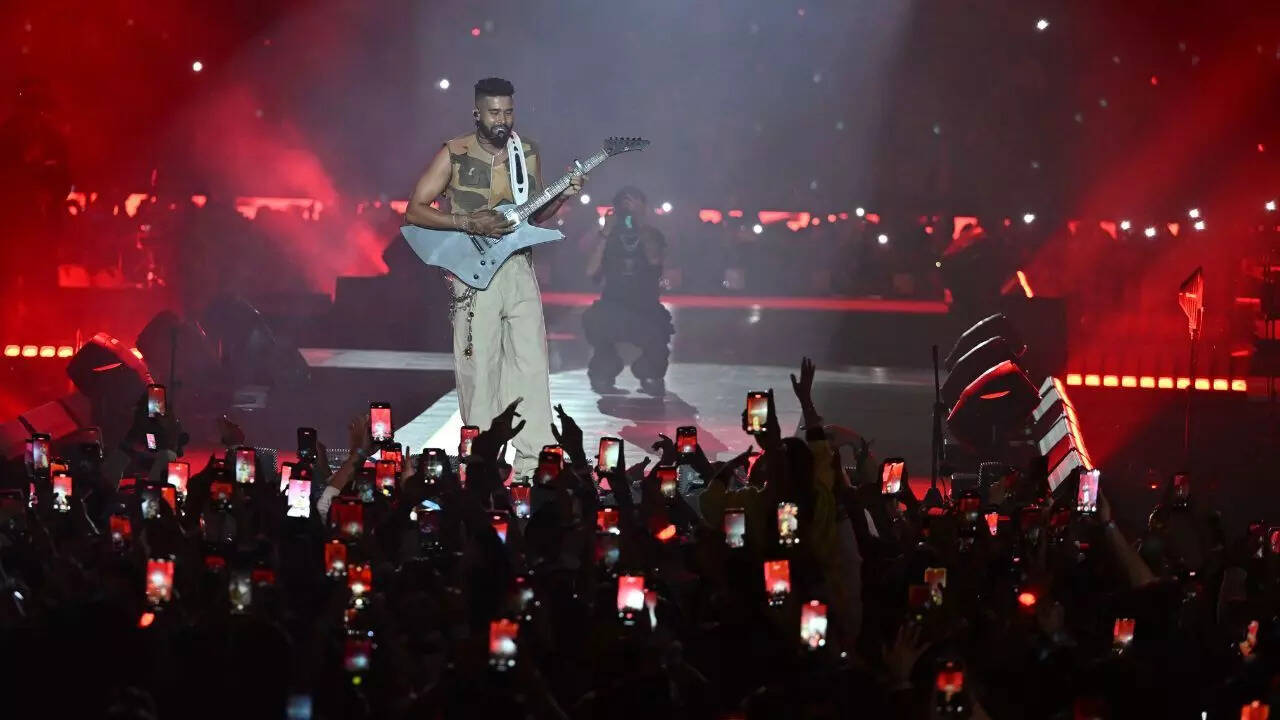
The scale sharpened rather than settled his appetite. In a 2023 conversation, he described two goals: stadiums, then taking the music global. The order is charmingly practical. First find a larger building. Then consider the planet.
That March he became the first artist to perform in Punjabi on the JUNO Awards broadcast, playing “Summer High” in Edmonton. Later that year, “With You” entered the Canadian Hot 100 at No. 42. A four-part Prime Video documentary, AP Dhillon: First of a Kind, followed his life and first Canadian tour. The title risked vanity; the footage supplied the work.
In 2024 he performed at Coachella and signed with Republic Records. The resulting nine-track project, The Brownprint, widened the guest list: Nigerian singer Ayra Starr on “Bora Bora,” Atlanta rapper Gunna on “Losing Myself,” Punjabi veteran Jazzy B on “315,” plus Kahlon and Syra. The name nodded to Jay-Z’s The Blueprint, but the adjective changed the assignment. Dhillon was not merely studying a classic. He was marking who got to draw the next set of plans.
In March 2025, the record won the inaugural JUNO for South Asian Music Recording of the Year. Awards can be poor judges of tomorrow, but new categories reveal what institutions finally noticed yesterday. Punjabi music had been part of Canada for decades. Dhillon’s win made that presence difficult to keep treating as peripheral.
The basketball player returns
A month before the JUNOs, Dhillon walked onto a different kind of stage at San Francisco’s Chase Center: the NBA All-Star Celebrity Game. He joined musicians, actors and elite athletes for the annual piece of cheerful chaos. The appearance mattered to him beyond publicity. He spoke about breaking the old stereotype that Indians could not play basketball, and about creating opportunities that he and his friends had lacked.
It is tempting to call this full circle. Circles are too neat. His friends from Punjab who played better than him went into shipping and office work because there were no coaching centres or facilities to carry their talent. One celebrity game cannot repair that system. Dhillon knows the difference. What it can do is put the missing possibility on television.
The athlete remains audible in how he talks about music. He admires Fred VanVleet, the basketball player who went undrafted and bet on himself anyway. “So far, we are betting on ourselves,” Dhillon once said of his own team. The phrase is modest only until one asks what they wagered: savings, sleep, reputation and the sensible life their education had promised.
More rooms inside the voice
His latest turn adds louder guitars. Released in January 2026 with Kahlon, “Raatan Lambiyaan” pushes toward rock after Dhillon teased it informally online. It arrived after the sold-out One of One Tour, whose Delhi stop drew a reported 20,000 people. He explained the experiment simply: he wanted something powerful and different from what he had done before.
The surprise is not that he has changed genres. It is that genre ever looked like a border to him. His listening life began with Punjab and nearby Pakistan, expanded through India, then collided with the sounds around him in Canada. Pop, trap, R&B and rock are materials. The identity lives elsewhere: in the low-slung voice, the conversational melodies, the loyalty to Kahlon’s writing, the instinct to leave air around a beat.
There is an image that ties the journey together. A boy shoots until the court disappears into evening. Years later, an immigrant makes music after a shift long enough to erase desire. Then an arena goes dark, thousands of phones rise, and a Punjabi chorus travels back toward him from people he has never met. The scoreboard is enormous now. The habit is the same: take the shot, fix what breaks, come back tomorrow.